BACK
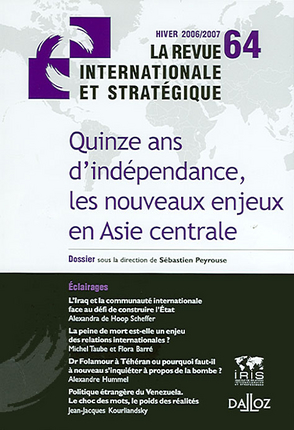
"Quinze
ans d'indépendance. Les nouveaux enjeux en Asie centrale"
[Fifteen
years of Independence. New Issues in Central Asia]
La
revue internationale et stratégique,
Paris, IRIS, no. 64, 2006.
|
This
special issue aims to analyse the situation of the five Central Asian
States fifteen years after independence and the collapse of the Soviet
Union. Rather than give an exhaustive “appraisal” of these
countries, the objective here is to elucidate the new issues with which
they are confronted. It is for this reason that the focus here has been
put not on the well-known stakes of the “Great Game” between Russia
and the United States in Central Asia but on the less well-known issues
that are nonetheless those of tomorrow.
This
is also the occasion to reflect upon the umbrella notion of “Central Asia”
under which the five republics are generally subsumed. Are the developmental
paths of these countries similar or ought rather the paths followed be
differentiated from one another? Catherine Poujol opens this debate by re-situating
their independence in the long-term and by highlighting the weighty role the
Soviet legacy is playing in the orientations of these new States. These States
all share a certain unity of culture, language and history, as well as the same
soviet heritage, one that, along with Belarus, makes them the countries the most
entrenched in soviet logics of authoritarian paternalism.
|
|
The evolutions
undergone have nevertheless been distinct and the economic choices since
independence of, on the one hand, Kazakhstan and Kyrgyzstan, have differed from
those of Uzbekistan and Turkmenistan, on the other. Their various policy
orientations have also given rise to social and political realities that today
can no longer be made to conform to a single schema: despite the fact that all
the Central Asian regimes have over many years developed more hard-line
authoritarian stances, the daily life of a Turkmen citizen bears no relation to
that of the majority of Kazakhs. The future also heralds as much variability:
under current conditions, it seems that the only state able to guarantee its
citizens an increase in livings standards to compensate for reduced public
liberties is Kazakhstan, whereas the other four States lack the means at present
to put an end to the rapid and massive pauperization of their populations.
The
questions raised here, then, bear as much on domestic policy as on foreign
policy, the stakes of both being intrinsically interlinked. The Andijan
insurrection, the motivations of which were both religious and political, is a
case in point as this local event also worked to accelerate the entire
region’s strategic reversal back toward Russia and China and came to symbolize
the waning of western influence. More, as Adeeb Khalid shows, the inability of
the local authorities, especially those of the Uzbek regime, to manage their
relation to Islam in a more detached way contributes to focussing attention on
the Islamist threat and at the same time to giving life to it. Also,
developments in the political situation in Xinjiang, analysed by Rémi Castets,
clarify the gamble China is taking in seeking to achieve stabilization by
developing the “Grand West” economically, despite the fact that the
separatist tendencies with the Uyghur minority there are still far from
extinguished. The migratory fluxes of Central Asians seeking work in Russia will
also have long-term consequences on the domestic and foreign policies of Central
Asian States. They manifest a re-composition of relations between the former
centre and its “colonial” periphery: as Marlene Laruelle shows, Russia has
still not left the optic of Central-Asian societies, and is fast becoming one of
their main “life-savers” on the economic level.
The
increase in drug trafficking, the topic of Sophie Hohmann’s article, is, for
its part, as much an object of international concern as it is an issue of
domestic public health and a destabilising element for existing regimes, whose
complicity with mafia networks is becoming less and less veiled. In addition, Gaël
Raballand’s article confirms the impact, on the national and international
levels, that the gas and oil issue is having, in particular in Kazakhstan and in
Turkmenistan: the ability of regimes to redistribute a share of the income will
be a key element for the political stability of these countries in years to come,
when the time for a change in power has come and the first presidents vacate,
whether willingly or by force, their places to their successors. Finally,
China’s rise in influence in Central Asia, analyzed by Thierry Kellner, augurs
a shift in the region’s geo-strategic positioning: the economic attraction
exerted by their powerful neighbour, despite the concern it provokes in Central
Asian societies, is not something regimes who lack allies willing to support
their authoritarian political decisions can afford to disregard.
Lastly,
it pays to ask whether the region has not, since 2005, effectively entered into
a significant period of transition. The question of rotation in power – for
want of real alternatives – will be at the heart of future political
developments and will reveal the stability or otherwise of these systems formed
of fifteen years of independence, the unity of their societies, the extent to
which their borders have been interiorized and to which there is a consciousness
of constructing a new civic identity. The elites stemming from the soviet
nomenklatura, who played their historical role in the accession to independence,
will sooner or later have to give up their places to new elites who, albeit no
less paternalistic in the way they conceive their relation to society, will not
have had the same soviet past and will have partly been shaped by the new
realities of a post-bipolar world. The proportion of youths born in the region
slightly before or after the disappearance of the soviet regime is enormous and
they will come to exert a political influence corresponding to their
sociological reality. In addition, in the most open States, like Kazakhstan,
Kyrgyzstan and Tajikistan, new elites educated abroad, principally in Russia,
but also in Europe, the United States and in China, are being educated and their
long-term impact cannot be dismissed. As such this report hopes to contribute to
showing that the apparent immobility of the Central Asian societies since the
disappearance of the USSR should not give us any illusions – the region’s
role on the international stage is certain to become greater.
Quinze
ans après l’indépendance, quels nouveaux enjeux en Asie centrale ? / Sébastien
Peyrouse
L'Asie
centrale, bilan : quinze années de discours et de pratiques sur l'intégration
dans un espace désintégré / Catherine Poujol
ENJEUX
DE POLITIQUE INTERIEURE
Le
tournant ouzbek de 2005. Eléments d'interprétation de l'insurrection d'Andijan
/ Sébastien Peyrouse
La
question ouïghoure et sa dimension centre-asiatique/ Rémi Castets
L'Islam
et l'Etat post-soviétique en Asie centrale / Adeeb Khalid
ENJEUX
DE POLITIQUE REGIONALE
Le
narcotrafic en Asie centrale : enjeux géopolitiques et répercussions sociales
/ Sophie Hohmann
Les
hydrocarbures du bassin Caspien : de la construction à l’affranchissement des
interdépendances ? / Gaël Raballand
ENJEUX
GEOSTRATEGIQUES ET RELATIONS AVEC LES VOISINS
Le
nouveau rôle de la Russie en Asie centrale : les migrations de travail des
Centre-asiatiques vers la Fédération russe / Marlène Laruelle
La
tranquille montée en puissance de la Chine en Asie centrale / Thierry Kellner
BACK