Islam
et politique en ex-urss (Russie d’Europe et Asie centrale)
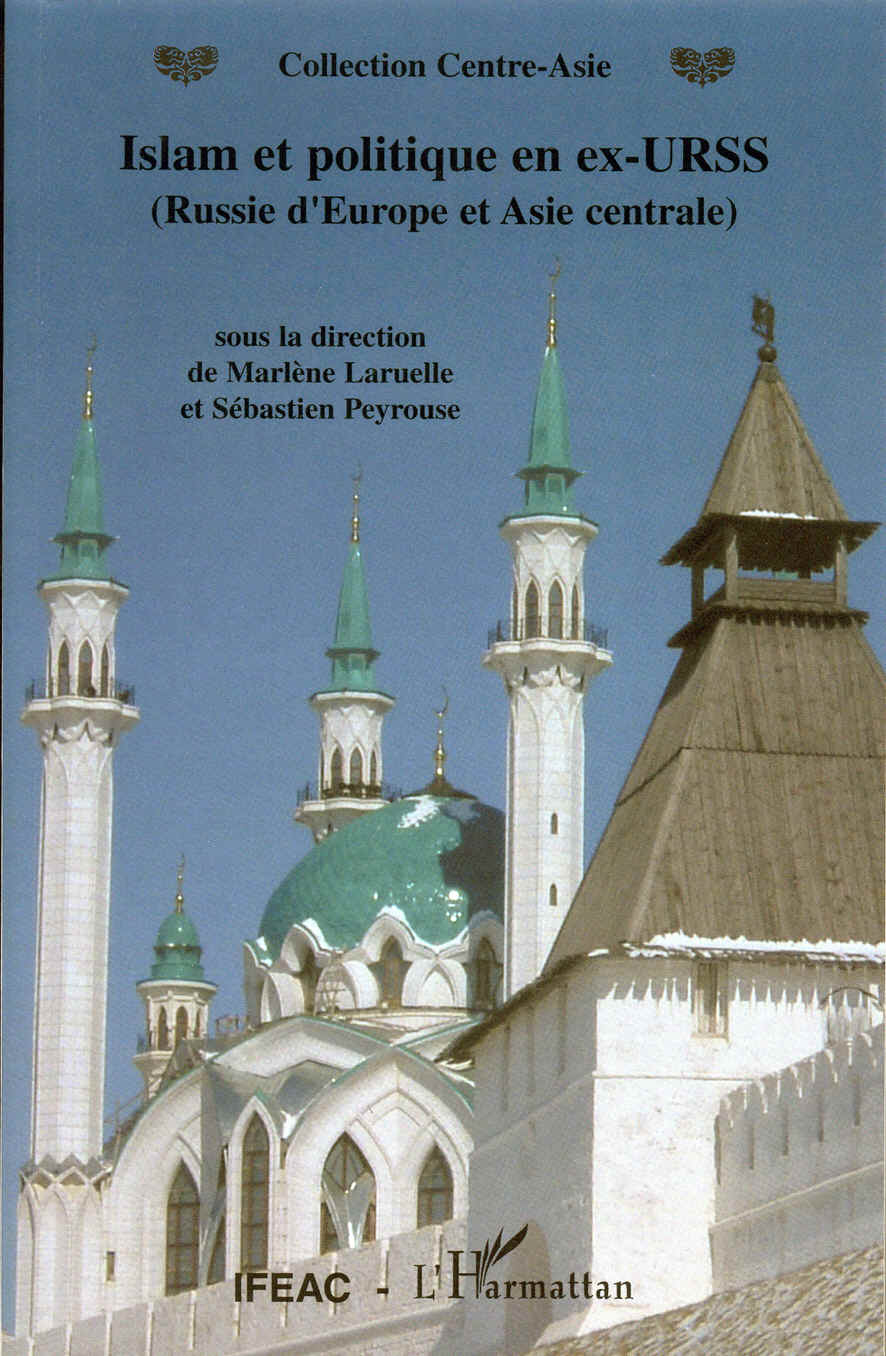
[Islam
and Politics in the Former Soviet Union (European Russia and Central Asia)]
Paris,
L'Harmattan - ifeac, 2005, 338 p.
|
More
than fifteen years after the collapse of the Soviet Union, this book aims to
review the current evolution in this area, by emphasizing the question of
religion and its links with politics. The period of political liberalization in
the perestroika was followed/accompanied by an upsurgance in religion. The new
States of Central Asia and the republics of the Russian Federation consisting of
a majority of Muslims (Tatarstan, Bashkiria) use their religious identity as
instruments in order to assert their nationhood and statehood.
The interweaving of religion, politics and nationality is neither new nor
specific to this geographical area. It lies within the scope of some more
general processes, through which the post-Soviet societies have too rarely been
analysed. These themes could arouse a more general reflection about the
paradoxical links emerging today between religion and politics. The
former/Religion tries to take advantage of the globalization to occupy new
public spaces and to present itself as one of the foundations of the individual
and collective identities. Islam in the former USSR should not be considered to be a cultural
isolate.
It
is part of the globalization and of the processes of religious recomposition,
such as: the individualization of belief, its participation in "neo-ethnical"
identities, its formulation in terms of antiglobalization etc. This book does
not focus on specific questions of islamology; it rather offers an analysis of
the Post-Soviet Islam as a political plan by comparing it with the other Muslim
States and with European Islam, which is relevant to understand the Russian
case. This book also aims to illustrate the necessity of a reflection which
takes into account the entire Post-Soviet region: the collapse of the Soviet
Union in 1991 and the independence of the fifteen republics do not mean that there
are no common schemas of analysis, nor does it
result in the absence of any developmental unity of these countries
during the last fifteen years.
|
|
Contents:
Marlène
Laruelle, Sébastien Peyrouse.
Introduction.
Les processus globaux de recomposition identitaire et religieuse. L’islam
post-soviétique, p. 15.
Première
partie. Religion, État et politique, des instrumentalisations réciproques
Rafik
Mukhametchin.
Les composants islamiques de la politique confessionnelle en république du
Tatarstan, p. 41
Sébastien Peyrouse.
La recomposition du spectre religieux en Asie centrale : l’alliance entre
islam et christianisme orthodoxe, p. 61.
Marlène
Laruelle.
L’appartenance à l’islam comme critère politique ? La
politisation des Directions spirituelles et la constitution de partis musulmans
en Russie, p. 85.
Evgueni
Moroz.
« L’islam habite notre avenir ! » Le prosélytisme
musulman en Russie, conversions, institutionnalisation et stratégies
politiques, p. 117.
Danil Azamatov.
Le facteur religieux aux élections présidentielles bachkires de 2003, p. 135.
Aïdar Khabutdinov.
Les diverses instrumentalisations politiques de l’islam au Tatarstan, p. 145.
Partie
II. Question sociale, question nationale. La place de la foi dans la sphère
publique
Jean
Radvanyi.
Quelques réponses à une question non posée : l’islam et le recensement
de la population de Russie en 2002, p. 159.
Francoise Dauce.
Les revendications musulmanes en Russie : entre mobilisation et défection
politique, p. 171.
Xavier Le
Torrivellec.
Sous la croix des recensés. Identités et religion : le recensement russe
de 2002 en république du Bachkorstostan, p. 189.
Sanat Kuchkumbaev.
Les combinaisons paradoxales de l'islam kazakh : renouveau
institutionnel, identité nationale et politisation, p. 209.
Edouard
Ponarin, Lilia Sagitova.
Construction de l'identité nationale et islam :
les Kurdes de Turquie et les Tatars de la Volga, p. 223.
Partie
III. L’enjeu de la transmission sociale et théologique de la foi
Achirbek
Muminov.
Chami-damulla et son rôle dans la constitution d’un "islam soviétique",
p. 241.
Adil
Kariev.
La vallée du Ferghana dans les années 1970-1980, aspects
économiques et sociaux du
mouvement islamiste, p. 263.
Marlène
Laruelle, Sébastien Peyrouse.
Nouvelles formulations idéologiques et théologiques de l'islam
post-soviétique, p. 273.
Nurlan
Alniazov.
La communauté musulmane du Kazakhstan,
acteurs officiels et groupes officieux, p. 297.
Sergeï
Abachin.
Le soufisme "populaire" en Asie centrale, p. 309.
Bakhtiar
Babadjanov, Martha Brill Olcott.
Sécularisme et islam politique en Asie centrale, p. 323.