Back
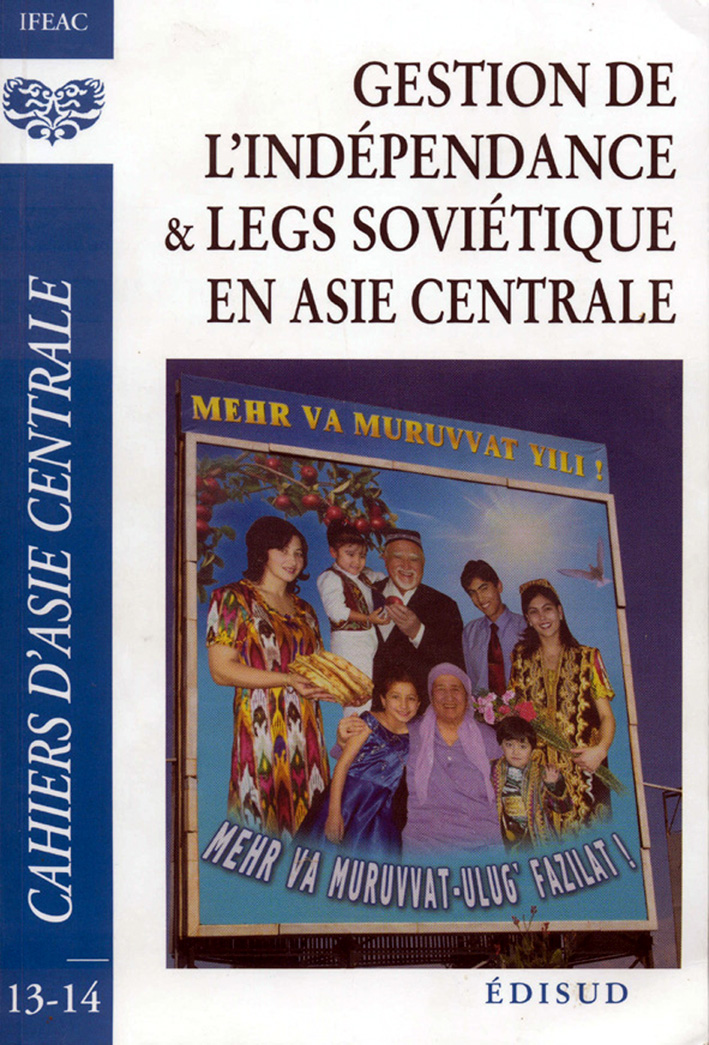
Gestion
de l'indépendance et legs soviétique en Asie centrale
[Managing
Independance and the Soviet Legacy in Central Asia]
Cahiers d'Asie centrale, no. 13-14, Edisud- ifeac, 2004, 334 p.
|
Since
Independence, new official discourses in each of the Central Asian
States have attempted to condemn, more or less virulently, the former
Soviet regime. However, one should not be deluded by leaders and
governments’ thundering declarations about official change and renewal,
and by the multiple discourses that exist around a specific national way
of development. Despite the reforms launched since 1991 and whatever
political leaders’ true or simulated willingness to engage in such a
process, less than a decade and a half is not sufficient to remove the
political-economic system that was dominant for several decades. In Western journalistic circles, Central Asia is often viewed as a new area located close to sensitive countries (e.g. Afghanistan, Northern Pakistan), on weapons and drug routes and threatened by possible Islamic destabilization. One could deplore such a mass-media perception, which lacks any historical hindsight. Contemporary Central Asia is first of all a cultural space with more than a century and a half of a Russian-Soviet legacy. The idea of a political, religious and national renewal quite often seems to be an optical illusion, resulting from the prior obscurity of Central Asia: the independence of 1991, which is often presented as a rebirth, actually appears to be both an outcome and a beginning.
This issue of Cahiers
d’Asie centrale adresses the question of continuity between Soviet and
Post-Soviet Central Asia, a rarely addressed but fundamental thematic to
understanding the contemporary situation of the area and to escape many
cliches. It does not view continuity as a postulate and neither denies the
reforms that have been engaged in nor the several quick evolutions that have
taken place over recent years. It acknowledges the violent shock caused by the
collapse of the Soviet Union and the real “rupture” felt by Soviet
citizens. However, this issue firstly aims to show the general public the many
Soviet aspects that are too quickly forgotten about but which cannot be
ignored in order to understand the evolution of these countries, especially
their present move towards authoritarianism. It also aims to remind academic
circles about the difficulty in carrying out research about Central Asia
without a knowledge or at least consciousness of the Russian-Soviet experience,
essential in order to avoid the mirage of a “rebirth”.
|
|
Contents:
Introduction par Sébastien Peyrouse et Marlène Laruelle, p. 9
Regards sur le contemporain : évolutions et lignes de continuité
Boris Petric, Svetlana Jacquesson, Jean-François Gossiaux, André Bourgeot.
« L’émergence
de nouveaux pouvoirs locaux sur les cendres d’un kolkhoze kirghize (région
de Naryn) », p. 21
Marlène Laruelle.
« Continuité des élites intellectuelles, continuité des problématiques
identitaires : ethnologie et "ethnogenèse" à l’Académie
des Sciences d’Ouzbékistan », p. 45
Sébastien Peyrouse.
« La gestion du fait religieux en Asie centrale : poursuite du
cadre conceptuel soviétique et renouveau factice », p. 77
Sophie Hohmann.
« Santé publique en Ouzbékistan contemporain : continuités soviétiques
et limites des processus engagés », p. 121
Gaël Raballand.
« Permanences conceptuelles et fonctionnelles du système économique soviétique en Asie centrale », p. 163
L'experience soviétique, matrice theorique et pratique
Isabelle Ohayon.
« Du campement au village : sédentarisation et transformations de l'aoul
kazakh à la période soviétique », p. 177
Catherine Poujol.
« L'islam en héritage : nouvelle approche d'une problématique
persistante, entre résistance participative et acculturation passive »,
p. 199
Sergeï N. Abachin.
« Les
descendants de saints en Asie centrale : élite religieuse ou nationale ? »,
p. 215
Rinat H. Chigabdinov.
« De la question du socialisme islamique au Turkestan : le parcours d’Arif Klevleev (1874-1918) », p. 231
Les politiques publiques de l'eau en Asie centrale post-soviétique
Julien Thorez, Pierre Thorez.
« Le
partage des eaux dans le Caucase oriental et les républiques d’Asie
centrale, une manifestation des tensions post-soviétiques », p.
245
Raphaël Jozan, Charles Baubion.
« Un
souffle de réforme sur la politique de l’eau en Ouzbékistan ? »,
p. 261
Jérémy Allouche.
« Continuité et discontinuité dans la politique de l’eau en Asie
centrale », p. 285
Jeune recherche.
Alice Moscaritolo.
« L’Occident multiple ou les représentations de l’autre dans le regard d’étudiants ouzbeks », p. 303
Notes et documents.
Jean-Christophe Roux.
« La presse écrite en Ouzbékistan », p. 321
Comptes rendus, p. 327