
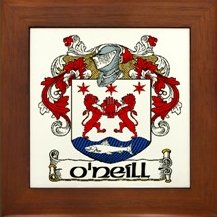
I received an interesting e-mail from Laura Blaikie containing information about an O'Neill-Lamont Clan connection. The information is as follows:
I have been researching my family history, here are some excerpts that may be of interest to you. You will no doubt find the Coat of Arms interesting, and the connection of the O'Neill princes from Tyrone (of the 11th century) to Queen Elizabeth II.
The Blaikie Family is a part of the Lamont Clan.....the clan is descended the royal house of Dalriade and from the O'Neill princes of Tyrone in Ireland in the 11th century. In the eleventh century Anrothan, younger son of AEDH Athlamhan 'the Handy' O'NEILL, KING OF ULSTER 1030-1033 (Royal Heir of Ireland who was given the throne during his father's pilgrimage to Rome but who died in his father's lifetime in November 1033) moved to Scotland and married the daughter of the King of Argyll and received wide lands there. According to the mediaeval Irish and Scottish genealogies he was ancestor of the MacLaghlans of Strathlachlan, The Lamonts of that Ilk (of whom the Lyons of Glamis, Earls of Strathmore, are probably cadets), the MacSorleys of Moneydrain, the MacEwans of Otter, the entire Clan Neill in Scotland (i.e. the MacNeills of Barra and the McNeills of Gigha and Colonsay), the MacSwins of Castleswin, and the MacSweeneys of Donegal.
For centuries the O'Neills were Kings of all-Ireland, Kings of Ulster and Princes of Tyrone.
In the twelfth century the O'Neill clan divided once more. Aedh (Hugh) Macaemh Toinleasg (the 'Lazy-arsed Youth') O'Neill, King of Cenel Eoghain 1176-1177, Royal Heir of Ireland, slew his father's slayer, 1160; restored O'Neill power after his inauguration at Tullyhogue; established his rule over all Tir Eoghain (Tyrone) and became supreme in the north of Ireland.
Clan Lamont is one of the oldest of Scottish clans, with an oral tradition of descent stretching back to the Kings of Ireland. The name is derived from a chief in the 13th century, Sir Laumon, whose charter granting lands to the Paisley Abby, is still in existence. Few clans can document their existence at such an early date. Although the name comes from the 13th century chief, the clan is much older, being known as MacKerracher before Sir Laumon's time. Sir Walter Scott refers to him in Antiquary as "Lamon mor ", or the Great Lamont in English. Sir Laumon's mother is believed to have been a daughter of the great Somerled, ancestor of the MacDonalds. Tradition, supported by a genealogical work of 1682 found in Inveraray Castle, maintains that a son of Sir Laumon, had to flee Cowal as a result of a murder; and founded the Lyons of Glamis. He took the name of Lyon from the Lamont arms, and chose as his arms, the reverse of the Lamonts, a blue lion on a silver field.
Queen Elizabeth II on her mother's side, as she is a descendant of the Lyon of Glamis, dating back to the 13th Century.
This is the branch founded by the son of Sir Laumon, that had to flee Cowal in the 13th Century as a result of a murder and took the Lamont Crest and reversed the silver lion on a blue background on the Lamont Coat of Arms to a blue lion on a silver background, which is a royal coat of arms.
Glamis Castle has been the family home of the Earls of Strathmore and Kinghorne since 1372 when Sir John Lyon was created Thane of Glamis and given the Castle by King Robert II of Scotland. Four years later, Sir John married Princess Joanna, the King's daughter. Glamis has been lived in and visited by many members of the Scottish and British royal families. It was the childhood home of Her Majesty Queen Elizabeth The Queen Mother and it was here that Her Royal Highness The Princess Margaret was born in 1930.
The Castle is the legendary setting of Shakespeare's most famous tragedy, 'Macbeth', and is mentioned frequently by name in the play. "Glamis thou art ..., And yet would'st wrongly win; thou'dst have, great Glamis ...".
make custom gifts at Zazzle