Thaipusam is an important festival
which falls in the Tamil month of Thai. In this month special importance is
given to the asterism Pusam (Pushya in Sanskrit). The day usually coincides
with the full moon day. Thaipusam is a special day for Lord Siva and Lord
Muruga. However the worship of Lord Muruga on Thaipusam day has become much
popular not only in India but in all parts of the world where South Indians
has settled.
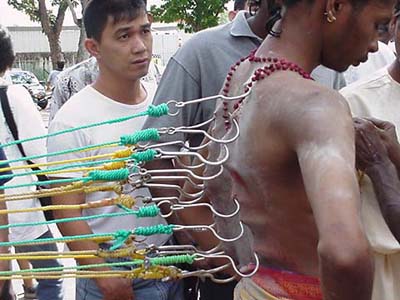
The kavadi has become an important
aspect of Thaipusam. Singapore and Malaysia are well-known throughout the
world for their Thaipusam festivals. Even devotees from India make a trip
to these countries during Thaipusam to witness the festival. Thaipusam originated
in Singapore soon after the Thandayuthapani Temple at Tank Road was established.
Each year thousands of devotees offer their kavadi to Lord Muruga as their
penance and devotion.
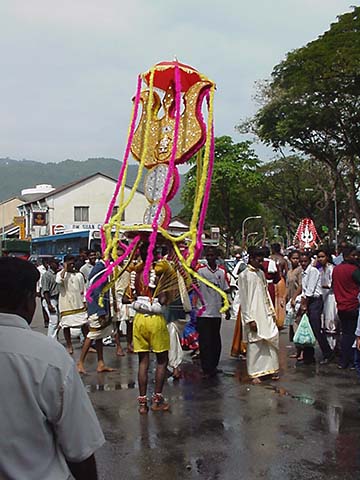
Kavadi is a Tamil word that
describes anything that is suspended in a pole, carried on the shoulder. In
older times this was how traders peddled their goods. Today kavadi is a semi-circular
structure, decorated with flowers, peacock feathers and palm leaves. It usually
bears a VEL (symbol of Lord Muruga), and has two vessels of milk that is offered
for abishegam. By carrying a kavadi, a devotee is infact carrying items to
be offered to the Lord.
Items like brown sugar, rose
water, fruits, can also be brought as a kavadi. The popular VEL kavadi in
Singapore and Malaysia are however banned in India, where kavadi originated.
Carrying a kavadi must not be considered as an act of courage. It is not an
act to show passers-by how many hooks ones body could bear or how big ones
kavadi is. By placing the kavadi at Lord Muruga’s feet and pouring the milk
as abishegam, the devotees should pour out the love from his heart, cleanse
his mind and soul, ask His forgiveness, mercy and love. To do that the size
of the kavadi is not important, the devotion is.
During
the kavadi procession we usually chant VEL VEL or AROHARA. VEL is Lord Muruga’s
weapon, the Spear What does AROHARA means? Arogam in Tamil means Pure, blissful.
Hara(n) is another name for Lord Siva. So AROHARA means Blissful Siva. It is
an emotional charged cry for the blessings of Lord Siva.
Thaipusam
Deepavali
Deepavali,
or the Festival of Lights, is a joyous Hindu celebration which marks the victory
of light over darkness and of good over evil. The "Little India" of Singapore,
centred along Serangoon Road, is decorated with fairy lights, garlands and colourful
arches to mark this festive period.At night, Hindu temples, such as Sri Veerama
Kaliamman, Sri Vadapathira Kaliamman and Sri Srinivasa Perumal, are also brightly
lit, while special delicacies and other festive goods are on sale throughout
the streets of Little India.
The
origin of Deepavali is shrouded in mystery. An intriguing legend narrated Lord
Krishna victory over Narakasura, the Demon King, and restored universal peace.
Celebrating the jubilant occasion, the people lighted the country with earthen
oil lamps, symbolizing the triumph of Good over Evil. Inspiring the young and
old, there are other fascinating versions related to the origin of Deepavali.
Interestingly,
Deepavali is a delightful Hindu festival celebrated with grandeur and prayer.
It is a day for fostering family harmony and togetherness. Exchanging goodwill,
visiting relatives and renewing friendship. Seeking blessings and spiritual
enlightenment. More significantly, the ultimate message of Deepavali is that
the glorious light of benevolent and righteous deeds will eventually triumph
over all forms of evil . Collectively, the enlightening and educative morals
of Deepavali will inspire humanity to seek international peace, goodwill and
camaraderie
It
is essential to clean the house to welcome Deepavali. Members of the family
will be busily involved in tidying every room of the house. Depending on their
respective budget, some would engaged renovation contractors to upgrade the
interior decor of their house. Others would simply do some painting to give
a new look to their homes. Meanwhile, housewives would do the last minute shopping
for Deepavali.
Celebrating
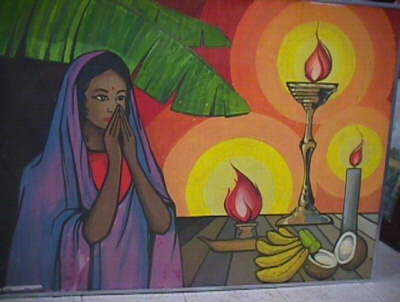
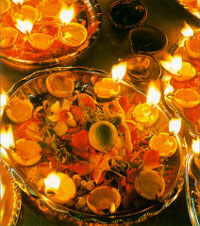
Deepavali, Hindu families would light rows of earthen oil lamps and display
them along the doorways and window ledges. Interestingly, the front doors and
windows are wide open to welcome Lakshmi ( Goddess of Wealth ). It is a tradition
to take an oil bath. Collectively, members of the family would make preparations
for the festival.
During
Deepavali, Hindus will involve in prayers, illuminating their homes and paying
respect to senior members of the family. Visiting relatives and renewing friendship.
Promoting goodwill and exchanging gifts. Devoted housewives will have the opportunity
to show off their culinary skills. Pots of spicy and delicious curries, white
rice and Deepavali delicacies to entertain visiting relatives and friends. Wearing
new clothes, children will indulge in a spree of merriment and enjoy eating
a variety of cakes and sweets.