The really hard problem of consciousness is the problem of experience. When we think and perceive, there is a whir of information-processing, but there is also a subjective aspect. As Nagel (1974) has put it, there is something it is like to be a conscious organism. This subjective aspect is experience. When we see, for example, we experience visual sensations: the felt quality of redness, the experience of dark and light, the quality of depth in a visual field (p. 201).It is truly exciting to see that scientists are willing to tackle the essence of subjectivity, giving it the same dignity of serious acknowledgement as Descartes did so long ago. The question now is, is the subjective experience of consciousness amenable to a scientific mode of inquiry? In other words, can science solve the mind-body problem?
Then a Voice said: "Behold this day, for it is yours to make. Now you shall stand upon the center of the earth to see, for there they are taking you."One can allow one's own imagination to recreate a sense of what Black Elk might have seen. Add to that the power of a dream to convince us of its reality while we are "in it", and I think most people would understand that such an experience is possible, even if they choose to believe it was all just a dream. What I would like to examine is a possibility that lies hidden in the above quotation from Black Elk's vision. This possibility comes from a personal insight that I have had that was inspired by the vision that Black Elk has had. In the way of knowing that is myth it is entirely permissible to respond to a vision with one's own vision. What proves the truth of such a response is a matter for one's heart. So you the reader may judge what follows but make sure your heart is in that judgement.
I was still on my bay horse, and once more I felt the riders of the west, the north, the east, the south, behind me in formation, as before, and we were going east. I looked ahead and saw the mountains there with rocks and forests on them, and from the mountains flashed all colors upward to the heavens. Then I was standing on the highest mountain of them all, and round about beneath me was the whole hoop of the world.8 And while I stood there I saw more than I can tell and I understood more than I saw; for I was seeing in a sacred manner the shapes of all things in the spirit, and the shape of all shapes as they must live together like one being. And I saw that the sacred hoop of my people was one of many hoops that made one circle, wide as daylight and as starlight, and in the center grew one mighty flowering tree to shelter all the children of one mother and one father. And I saw that it was holy.
8Black Elk said the mountain he stood upon in his vision was Harney Peak in the Black Hills. "But anywhere is the center of the world," he added.(pp. 42-43)
[Alexander] Friedmann made two very simple assumptions about the universe: that the universe looks identical in whichever direction we look, and that this would also be true if we were observing the universe from anywhere else. From these two ideas alone, Friedmann showed that we should not expect the universe to be static. In fact, in 1922, several years before Edwin Hubble's discovery [that all other galaxies were moving away from ours], Friedmann predicted exactly what Hubble found!Any place in the universe we look out at the galaxies, we will see them all rushing away from where we stand as if we are in the center of a universe still exploding outward from its primordial birthplace. With the notion of the universe as a whole as an exploding volume, starting at a tiny point and increasing in volume as time passes, it would appear that every point in the universe now is in the center of that vast volume. As Hawking here states, he finds it a matter of modesty to think that this is true since otherwise our planet would turn out to be in the exact center of the vast universe. Not that being in the center necessarily means anything special for us scientifically. It is simply so statistically unlikely that it is highly suspect.
...Now at first sight, all this evidence that the universe looks the same whichever direction we look in might seem to suggest there is something special about our place in the universe. In particular, it might seem that if we observe all other galaxies to be moving away from us, then we must be at the center of the universe. There is, however, an alternate explanation: the universe might look the same in every direction as seen from any other galaxy, too. This, as we have seen, was Friedmann's second assumption. We have no scientific evidence for, or against, this assumption. We believe it only on grounds of modesty: it would be most remarkable if the universe looked the same in every direction around us, but not around other points in the universe! (pp. 40, 42)
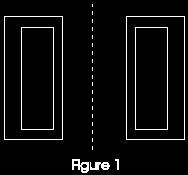
| Pursuing two ways of knowing is like looking with two eyes in order to perceive the world in depth. Now I would like to bring into this discussion one of the known mechanisms in the human brain for depth perception, stereopsis. Stereopsis is the term used in the scientific investigation of vision for the ability of the visual nervous system to discriminate the relative distances of objects by virtue of the positional incompatibilities, or disparities, between the objects as seen by the two eyes. This works within a range of distance near to that at which the two eyes are focused. Objects which lie outside of this "Panum's area" of focus appear as displaced double images (Matlin & Foley, 1997). To experience this doubled image simply focus your eyes at a distance and hold up your finger close to your eyes. You should see two fingers coming from two hands where you know that view of the world only contains the one hand (assuming your other hand is out of sight). |
|