home
COMPLAINT
REGARDING MINISTER OF DEAT - PUBLIC PROTECTOR
Dear All
South African Seal Supporters,
Below
is my final letter to the Public Protector. It is
hoped with all your tremendous support on the
petition and guest book comments, that we can get
government to finally answer and address some
questions that have been outstanding for years on
the management of Cape Fur seals - and get GUNS
finally banned from fishing.
Please read,
this report carefully, for it might just open your
eyes to other mismanagement happening in your very
own country with your own animals. To truly
protect our animals, we must be careful not to
become "comic book" animal lovers, but
instead investigate everything, take nothing for
granted, cross and dot all our T's.
Please
- keep the support pouring in on the petition and
the guest book, at 600 from 30 countries, we are
far short in our opposition of the 30 000
fishermen, so please pass this on !
For the
Seals
Francois
Hugo - Seal Alert-SA
PS - Please do sign our guest book
and on-line petition.
http://www.canadianvoiceforanimals.org/SASealAlert_index.html
http://www.PetitionOnline.com/Rrancois/petition.html
http://www.geocities.com/seal_alert The
Cape Fur Seal Power Point show that matches my
report to Public Protector is here, under Cape Fur
Seals.
http://www.seashepherd.org
http://www.cvfa.iitalia.com
http://www.seals.gen.tr
See also www.actionagainstpoisoning.com
cry for help guns at sea aug05
<http://www.altarriba.org>
Organización Internacional para la
Defensa de todos los Animale
Dear Adv. Gary Piennar/Public
Protectors Office
I refer to my background report
emailed to you on the 18th August 2005. Below is
specific answers to your questions or remarks in
your earlier email. Please let me know if you need
supporting documents, newspaper articles or copies
of anything. Francois.
CAPE
ARGUS NEWSPAPER
Some
investors are risking up to R32 million in
efforts to secure a share of South Africa's
long-term fishing quotas,
worth
R70 billion over the next 15-years
9
000 Applications are expected, yet there are
only 3 900 quotas in the entire fishing industry
covering 19 different sectors,
30
000 FISHERMEN will soon have 15-year rights to
fish.
In
February 2006 these "rights" will be
awarded.
Their
" CRIME" eating FISH
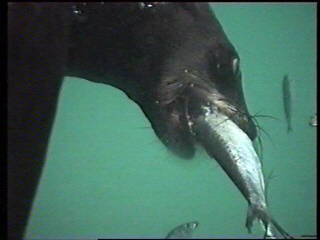
THEIR
PUNISHMENT
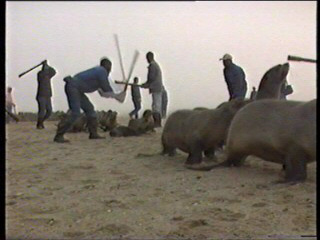 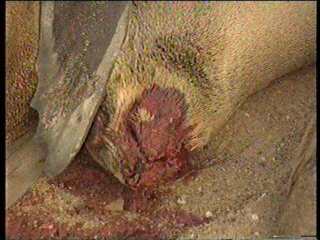
IF THAT DOES
NOT WORK STARVE THEM TO DEATH OR LET THEM SUFFER
FROM ENTANGLEMENT
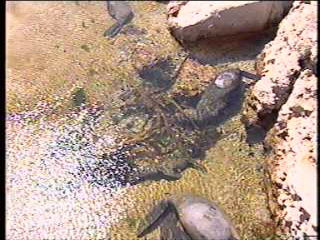 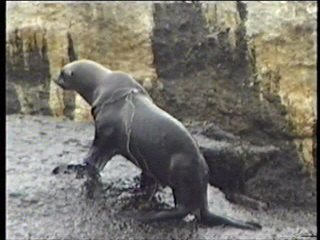
YOUR
CRIME ! BEING BORN AT THE TIP OF AFRICA 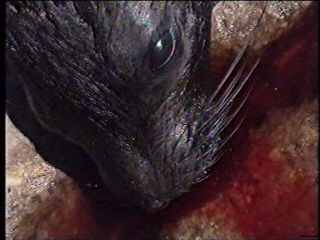
(1)
why you argue that it is unnecessary for fishermen
to continue to be allowed to take guns to
sea, particularly why you argue that 'close
inshore' fishing vessels do not need guns (I think
you said there had been no attacks on such fishing
vessels in the past 10-15 years, is that
correct?);
- Under the Constitution, in the Bill of
Rights it clearly states, Environment,
everyone has the right a) to an environment
that is not harmful to their health or
well-being; and b) to have the environment
protected, for the benefit of present and
future generations, through reasonable
legislative and other measures that ii)
promote conservation.
- Under Common Law, seals are defined as wild
animals and are therefore (res
nullius), they belong to nobody, either
the state or private parties. So what real
protection do they have?
- In terms of South Africa's Constitution,
seals and seabirds as a marine resource
(excluded from nature conservation in Schedule
4 Part A) fall within the functional area of
national legislative competence. Hence
national government will be responsible for
determination and development of the policy.
(See correspondence in this regard)
- Under the South African Animal Protection
Act of 1962, it reads, "To
consolidate and amend the laws relating to the
prevention of cruelty to animals".
Under "Animals" means any equine,
bovine,sheep, goat, pig, fowl, ostrich, dog,
cat, or other domestic animal or bird, or any
wild animal, wild bird or reptile which is in
the captivity or under control of any person.
Under "Owner" in relation to an
animal, includes any person having possession,
charge, custody or control of that animal.
Clearly seals are therefore excluded, as they
not even mentioned, nor are wild seals under
any ownership or control.
- Under the Seal Act, it states, "To
provide for the control over certain islands
and rocks ...and protection" and under
definitions it defines "island"
means any island or rock specified in Schedule
1. In Schedule 1, a total of 46 islands in
southern Africa is listed, and there is no
mention anywhere of the mainland or
mainland colonies within this act.
(However since the independence of Namibia in
1990, only the islands in South Africa would
still fall under this Act)
- There are 22 islands of approximately 900 ha
in South Africa. Breeding seals are found on 9
islands which account for 10 ha, or 1%.
- Under the Act, upon any island or within the
territorial waters or along the coast of South
Africa, (which until 1990 include Namibia),
between the low-water mark and the
high-water mark, No person shall, "Pursue
or shoot at or willfully disturb, kill or
capture a seal" and since 15th of
December 2000 (with the new regulation
hurriedly rushed through parliament, after
26-years of this Act, without any public
participation, in an attempt to
un-constitutional prosecute and arrest, Seal
Alert-SA for rescuing seals since 1999),
additionally it now became an equal Criminal
Offence under the Act, "To be in
possession of any seal or part or product
thereof at any time, and to feed a seal"
without a permit.
- Under the Sea Birds and Seal Protection Act
of 1973. The jurisdiction of the Minister
(Delegation issues to still be addressed), his
jurisdiction would cover the offshore islands
listed under schedule 1 of the Act, and upon
which Cape fur seals breed. According to MCM's
seal population survey's (sent to you in
2001), this would involve, 9 offshore seal
breeding colonies, between Black Rocks - Algoa
Bay (east coast) and Elephant Rock near
Olifants River/Vanrhynsdorp (west coast).
- In 1971 - 35 531 pup birth's were recorded
for all 9 offshore colonies. Giving a total
seal population of 142 124. (South African
part of the seal population under the
Ministers jurisdiction). In 1997, there
was a total of 36 772 pups born. Giving a
total seal population under the Minister's
jurisdiction according to the Act, after 26-
years of Seal conservation and protection, of
147 088. (The only mainland seal colony in
South Africa at kleinsee has never been
defined in the Act, and falls on private
land).
-
Dr Herman Oosthuizen, scientist at MCM,
in reply to a number of my questions,
he states "We have appointed a
consultant in Australia to collate and
verify all pup counts from 1971 up to
2004" and on a request for sealing
quota data, "Same consultant is doing
an update". In a question by Seal
Alert-SA regarding where harvesting is
taking place and the humanness of island
seal harvesting, the reply "No current
harvesting on islands".
-
In a final question, to Dr Oosthuizen. Seal
Alert-SA wrote "Can you supply me with
the figure for the total land area for all
the islands and rocks listed under the Seal
Protection Act, in schedule 1, and the total
island/rock land area that breeding seals
occupy today?", his reply was as
follows, "I do not have this
information as we have never collected this
information".
- In a debate letter to the Cape Times dated
1st October 2003, written by Deputy Director
Horst Kleinschmidt of MCM. It states I quote,
"Conservationists agree there is no
threat to their existence. On the contrary,
the Seal population continues to grow at about
3% per annum".
- In the 1980's in a book, "Oceans of
Life", Dr Jeremy David, head of Seals at
MCM, wrote the following, I quote, "and
grew at an average rate of about 3.7% per
annum from 1971 to 1984".
- As MCM have claimed 35 531 seal pups were
born in 1971, (and as throughout 1971 - 2005,
seals are still only found breeding on 9
islands out of 22 in SA or 1% of the total
protected island land), at an annual
growth of 3%. The Seal population on islands
in SA, should have grown after 26-years by a
minimum of 78%. In other words, if Mr
Kleinschmidt's claims are "correct",
and "Cape Fur Seals are under no
threat", then in 1997, 62 245 pups should
have been born (instead only 36 772 seal pups,
a growth after 26-years of just 3% or 0.13%
per annum or an actual decline of 41%)
- In order for the above to have occurred. The
surveys reflect that on average 35 000 seal
pups were born every year, after 26-years, a
total of 910 000 pups were born, and as there
has been no growth. Between 900 000 and 1
million protected Cape Fur seals have
therefore disappeared.
- To truly understand the severe loss of seals
in South Africa, under natural and normal
conditions, with no commercial sealing
activities, the Seal's growth should be around
14% per annum (As is being experienced with a
similar species in Australia, the Australian
fur seals) and not the 3%, as claimed.
This would mean that a further 500 000 seals
are missing. Bringing the total to unnaturally
dying or being illegally killed to 1.5 million
over the last 26-years, or about 57 000 a
year.
- I refer to page 27, pt 7.24 of the
Commission on Sealing/1990. "The
recommendations if adopted, can only be
applied to that part of the seal population
which falls under the jurisdiction of the
South African authorities. There is no
evidence that there is more than one seal
population in southern Africa, and it is
recommended that the Minister gives priority
attention to liaison with the relevant
authorities in Namibia with a view to the
possible implementation of a unified policy
for seal management". Therefore, just
like the Seal Population knows no borders
between South Africa and Namibia, likewise do
the fish stocks, in this once most productive
fishery in the world.
- Where have all the pilchards gone?
14-05-2002 MAGGI BARNARD at WALVIS BAY THE
zero pilchard quota announced by the Minister
of Fisheries and Marine Resources has
inevitably led to the question of why the
resource has declined so vastly. The
pilchard catch has dropped from a staggering
1,3 million tons in 1968, 125 000 tons in the
early 1990s, 10 000 tons for last year and a
first time zero total allowable catch (TAC)
announced for the 2002 season. Ten days ago
Minister Abraham Iyambo explained that there
is no "single or simple answer" to
the question, but held one major environmental
factor responsible for the decline. Other
opinions, such as those offered by Greenpeace,
suggest that the decline of fish stocks is
often linked to poor management and
regulation. There are also those who would
argue that the irresponsible and abusive
administration of marine resources by the then
apartheid South African government, before
Independence, should be blamed for the
"severe depletion". They go as far
as saying the Namibian Government should claim
damages in an international court of law.
Although this is in Namibia, where the
Namibian portion of the seals has dropped 55%
in the last decade, with 300 000 currently
starving to death each year. There is every
reason to believe, something similar could in
future threaten the conservation of seals here
in South Africa.
- In the same book, "Oceans of
Life", Dr Jeremy David, states the
following, "Many fishermen regard seals
as 'Public enemy number one', because of a
conviction that commercial fish eaten by seals
would otherwise be available to the
industry"
-
In the Argus
Newspaper, dated 19th August 2005, it reads
"Some investors are risking up to R32
million in efforts to secure a share of
South Africa's long-term fishing quotas,
worth R70 billion over the next 15-years 9
000 Applications are expected, yet there are
only 3 900 quotas in the entire fishing
industry covering 19 different sectors, 30
000 FISHERMEN will soon have 15-year rights
to fish."
- From the Fishing Industry Hand Book. There
are 2 884 South African fishing boat
licenses in 1995. 2 246 fishing boats or 78%
of these boats, fish within range of
Cape Fur Seal breeding colonies in South Africa. Of
the total boats, in Hand line fishing (see
Hand line Association comments to the
Commission), 73% or 1 683 are boats, or better
known as ski-boats, are under 8-metres in
length. Their range is restricted to I believe
10-nautical miles out to sea.The balance of
this hand line sector is trawlers and sports
fishing vessels, who have a longer range, but
equally interact and kill seals illegally,
which number, 627.
- The other sectors of fishing involved in
killing or drowning seals illegally are,
Inshore Trawlers 38, Purse Sein Trawlers 73,
East and West coast Lobster boats 208,
and squid boats 293.
- Bringing the total number of fishing boats,
fishing within range of 9 Cape fur seal
breeding colonies in South Africa to 2858 and
whose 2858 fishing skippers and 17 000 to 28
000 fishing crew, who regard seals as
"Public enemy number one".
- There is another fishery, longline fishery
and I quote from the Commission report in
1990, "Lines can be up to 20km long, have
on average 11 000 hooks which are set in the
early evening (The prime foraging time of
seals). Lines are left overnight for 10 to 12
hours. Hauling in of lines is a slow process,
which may take up to 10 hours. (This fishery
because of it's destructive methods, was due
to be terminated in 1990, but is still
continuing in 2005). Many seals get shot and
skippers are known to patrol the top deck as
the lines are pulled in, with shot-gun or
rifle in hand. The number of boats is unknown,
but there are at least 20 in operation.
- On the 27th August 2001, Seal Alert-SA
requested the following information from Dr
Jeremy David, (1) Can you supply details of
how many seals are illegally killed in South
Africa each year? (2) Can you supply details
of how many prosecutions or persons were
charged for these illegal acts? No reply has
ever been received.
- Likewise on the 30th August 2001, your
office sent him a similar letter, with a
further 24 questions and requested they be
read with my email above. I refer to questions
23 and 24, I quote, "Please provide
details of the number of seals reported and
estimated killed by the fishing industry,
including all copies of all reports submitted
to MCM or the Department by commercial fishing
interests, during the period 1997 to
date" and "Please provide details of
the number of seals found on or near South
African beaches involving stranded;seals
killed by or on behalf of MCM, the SPCA, the
SAPS or any other person; seals found dead,
from 1 January 1999 to date". No reply
has ever been received.
- In 1990 it was reported to the Minister by
the Commission, and I quote "It is
estimated that up to 27 000 seals per year die
through entanglement in bottom trawls and an
unknown number die through similar
entanglement in purse-seines". This
figure must be remembered can only be
attributed to the South African part of
the Seal population interacting with the
fisheries, and that this is only two sectors
of a 19 sector fishing industry. In addition,
I quote, "Although illegal, shooting at
seals from fishing boats also occurs,
resulting in an unknown number of mortalities
each year".
-
Professor Patti Wickens is the only
person to have researched the South African
fishery industry interactions with seals
since 1990. Her paper on Trawling in 1992 -
1994, states, I quote, "Over one-third
of the total population ranges along the SA
coastline, the area considered in this
study".(This becomes her first mistake,
in that as per the Act, an additional 65% of
the one-third should be excluded for two
reason, 1) It falls outside the Act and
jurisdiction. 2) These seals in northern
South Africa, interact very little with
SA fishery operations. ( a good example of
this is the recent tracking of seals in
Namibia). Therefore her findings should have
represented this fact, but it did not.
-
Recent satellite tracking of Males and Cows
in Namibia by the IDYLE French group, clearly
shows where trawling and Longlining takes
place in reference to the closeness of
fishing operations to the coast and the
foraging range of seals from each particular
colony.
-
Her findings after a two-year study, reveal
that 2 500 to 3 600 seals get drowned and a
further 300 to 600 seals are deliberately
killed that are hauled abroad trapped in the
netting. Her conclusion is that 2 800 to 4
200, is and I quote, "this is
negligible (0.4 - 0.6%) in terms of the
feeding population of seals in South Africa.
This becomes her second mistake.
-
She defines her study area further in SA, as
"west" and "south"
coasts (South - east of Cape Agulhas), and I
quote, "all fishing effort by inshore
trawlers is concentrated on the south
coast". (In this region there is only
two breeding seal colonies, which in 1994,
recorded 1 252 pups or 5 008 seals). Her
paper goes on further to say,
"interactions result in little cost to
the offshore and midwater trawl fisheries.
For the inshore trawl fishery, there is an
estimated cost of R69 728 or (0.3%), but
states this is a negligible cost to the
industry". During the IFAW seal
workshop in 2003, Dr Jeremy David presented
Wickens findings as per her request. He
stated and I quote, "Inshore trawl
sector....... about a 1000 seals drown .
amounting to 0.2% of the population. This
however is not quite correct, for there are
only 5 008 seals in this region as per
(1994), a 1000 being drowned, is a massive
loss of 20% to this regions population of
seals. To understand how severe, see below.
-
In 1999, Dr Carolyn Stewardson did a paper
specifically on the "south" coast
seal population referred to in Wickens paper
and study area. I quote, "Cape Fur
Seals inhabited 6 islands in Algoa Bay and 2
in Plettenberg. At present, Black Rocks
support 700 seals. In the last 12 years the
population has decreased by 82%. .... by
confining the population to Black Rocks, the
population is unable to build up its numbers
sufficiently to stimulate colonisation of
neighbouring islands. Limited space for
breeding seals on Black Rocks and the
influence of storms, restricts the number of
pups that can be reared successfully. The
effect of man on the Seal, Stag and Black
Rocks population is therefore a permanent
one".
-
In the IFAW seal workshop in 2003, Dr Greg
Hofmeyer of the depart of Marine Mammals in
Pretoria, stated and I quote, "unlike
seals, seabirds are a conservation problem
(which seabirds ?, all the seabirds or just
anyone of 17 seabirds that might decide to
start breeding on islands), and the two
cannot co-exist". I have never heard of
such gross mismanagement in my life.
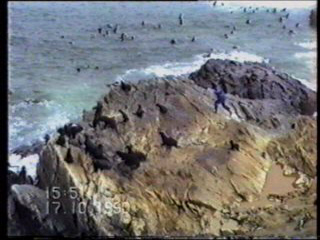 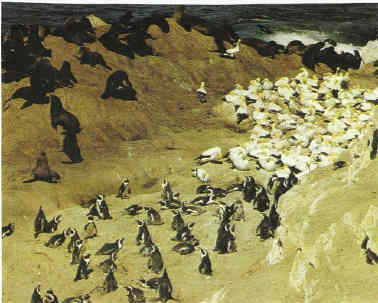
IS THIS
NATURAL CHASING SEALS AWAY - IS IT
TRUE SEA BIRDS & SEALS CAN NOT CO-EXIST ?
-
The question therefore, should Professor
Wickens be comparing the 4 200 seals killed
by the fisheries (excluding the unknown
number shot illegally) for the whole
fisheries, to the whole South African seal
population, or just those 9 offshore
colonies listed under the Act, or the 36 000
pups or 144 000 seals found in this consider
region stretching from Black Rocks Algoa Bay
to Elephant Rock near Vanrhynsdorp. If you
agree with me, according to the Act, then 4
200 seals being killed by fisheries out of
144 000 seals, is a considerable concern,
because at (2.9%), this loss is almost equal
to the growth claimed by MCM of 3% per
annum, or as I have pointed out is actually
only 0.13%. If this is in fact, a true
reflection, fisheries in SA are in fact
threatening the survival and conservation of
Cape Fur Seals in South Africa.
-
Professor Wickens findings of only 4 200
seals drowned or killed by the whole fishery
industry in South Africa alone, falls
far short of the 27 000 seals described in
the Commission report in 1990, for just one
sector out of 19 fishing sectors. The
question has to be raised, can any announced
research of the illegal killing of seals by
the industry, be possible. When for example,
everyone from Fishermen to the Minister
confirms seals are being shot, and who some
describe as an "illegal war" on
seals, yet Professor Wickens could not
present one scientific findings of these
numbers.
-
I quote from the Commission, "Many of
the purse-seine boats have fire-arms on
board and hundreds, if not thousands of
seals are shot each year", and "in
the hand line fishery (with hand line boats
accounting for 73% of all the boats), the
fishermen also shoot seals, thereby causing
serious danger (the gun shots are so
frequent and random) to nearby boats when
the fleet is concentrated".
-
To date, all research undertaken appears to
have only focused on the loss to the
industry, and no thought of the loss to the
species of seal and it's survival, as
protected under the constitution.
-
Professor Wickens also undertook research
with the line fishing industry, and this is
what her conclusions were, I quote,
"Deliberate killing of seals by
fishermen during line-fishing occurs
indiscriminately and particular during peak
snoek fishing period, however, estimates of
this (illegal and criminal) mortality is
currently impossible".
-
Is this acceptable? Marine scientists can
even tell us how deep a wild seal dives,
what fish is in it's stomach and how far it
swims in our vast 4000 km coast line, but
cannot produce any research on how many
seals are being illegally killed, clearly
this is unacceptable.
In the Constitution, the government has a duty
to conserve a species. If during Professor
Wickens research she found that instead fishing
operations was threatening the survival, and was
not the negligible 0.3%, as claimed. What would
government have done then in 1994? In this year,
Governments in Namibia and South Africa, both
believed seals were thriving and reaching their
highest population level in the past 100 years.
A decade later, things have turned completely
around (as predicted in 1999), 84% of the Seals
in Namibia has dropped by 55%, the seal
population has halved. At Kleinsee, as it is a
restricted area, we have no idea or recent
survey figures from which to assess, so we
simply do not know, what is happening to over
70% of the South African seals at Klein see. All
we do know, is the seal population that falls
under the Seal Protection Act, and here we have
seen the unexplained disappearance of up to 1.5
million seals from just 11% of this species, and
have seen that there has been little or no
growth since 1971. It is my belief, that when
seals were thought to be thriving government
touted themselves as great seal
conservationists, but since the last decade, and
the biggest mass mortality of seals the world
has ever seen, governments in both South Africa
and Namibia, are either in denial, hoping they
can fool the public by lying or alternatively
are just hiding away from the problem, canceling
workshops, refusing to attend meetings and
ignoring email requests. Even worse than this,
government is concentrating on awarding 70
billion rand - 15 year long term fishing rights,
when clearly the fisheries are in complete
chaos. 300 000 seals starving to death each
year, is not something that should be ignored,
or as some would like to claim, nature
correcting itself. Gross human mismanagement
caused this, and only human management can
correct this. For Namibia to have increased its
sealing quota from 30 000 to 60 000 in 2000, at
the same time 300 000 was starving to death or
every cohort being born, is not only totally
irresponsible wildlife mismanagement, it reeks
of genocide. The state of affairs in South
Africa and Namibia on a species that knows no
man-made borders, is unacceptable.
(2)
details of your allegations that they are
allegedly the ones who do most of the shooting
of seals
If think the answer has been addressed above
in depth. It is in the Commission in 1990,
Deputy Director of MCM admits so in writing,
Professor Wickens research confirms so, as did
Dr Jeremy David of MCM in the IFAW Seal
Workshop. In addition, there is numerous
newspaper reports coast to coast confirming same
as well as individual fishermen themselves,
making statements in the press and live on
television.
(3)
details of your allegations that none have been
prosecuted. I think we also discussed the need
to balance one right against another; the
individual's right to carry a gun in
self-defence must be reasonable and necessary
and must outweigh the right of the public to not
be subjected to the unnecessary cruelty of the
continued killing of seals.
See above. Both your office and Seal Alert-SA
has requested written proof as far back as 2001,
of any evidence of any fishermen being
prosecuted, all our requests have been ignored.
Frequently I have made these statements in the
public newspapers and on television, and not
once has MCM refuted my statements. In the past
34 years of the Seal Protection Act, I know of
only two incidences where people were arrested
and charged under this Act. The one is myself,
for tube-feeding a rescued days old Cape fur
seal, the first pup to be successfully
hand-raised and released into the wild in South
Africa's history, and the second was an
individual who was charged whilst attempting to
skin a stranded seal on the east coast in about
2003.
(4)
I have noted
the comments of the police Commissioner in your
email below that they can do nothing without a
witness statement, which, I think, corroborates
your view that enforcement is impractical and
impossible and, therefore, a ban on guns on
boats is the only practical solution.
As of last
count there is over 600 individuals and
organizations from over 30 countries around the
world, that have signed the petition to have
Guns Banned during fishing trips, and an
additional 500 comments, voicing their outrage,
and who are would agree, that the only practical
solution is an immediate Ban on Guns, being
taken to sea by licensed MCM fishermen, who are
currently seeking 15-year rights to fish, worth
R70 billion.
I trust your
office will act quickly, to restore to South
Africa, and I quote, Mr Horst Kleinschmidt,
Deputy Director of MCM, "We are a civilised
country and will take action against all forms
of cruelty or transgression". Lets hope
with the Minister's recent complete lack of
response or reply, and in which over 30 days has
passed, that these words are not simply just
"Public Relation" to put on a pretty
public face to the citizens of South Africa and
the world.
Finally I wish
that it be noted, that much of these illegal
activities both by MCM and fishermen, was
brought to your attention in my first complaint
regarding seal mismanagement in 2000. This
matter has still not been officially addressed
or finalised, over 5 years has since lapsed. I
sincerely hope and trust, that this new
complaint, does not take a similar time-frame to
investigate.
For
the Seals
Francois
Hugo Seal Alert-SA
021-790
8874
AS
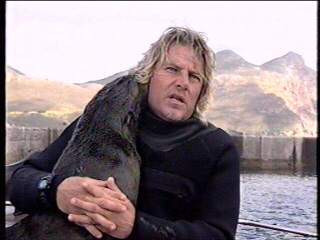
I HAVE NO MOM - YOUR EAR WILL HAVE TO SERVE AS MY
NIPPLE - POPEYE _____________________________________________________________________________
----- Original Message -----
Sent: Tuesday, August 16, 2005
4:22 PM
Subject: RE: COMPLAINT REGARDING
MINISTER OF DEAT - PUBLIC PROTECTOR
Thanks
Francois, I'll look out for it.
Kind
regards
Gary
Hi Gary,
only a pleasure, it is true afterall,
not just words. I will get on this
right away, just me a day to get all
my facts and info, together. Francois.
----- Original Message -----
Sent: Tuesday, August 16,
2005 1:01 PM
Subject: RE: COMPLAINT
REGARDING MINISTER OF DEAT - PUBLIC
PROTECTOR
Hi
Francois
Thank
you for your kind words.
I
think more detailed info regarding
the issue of guns would be helpful.
Although you and I have discussed
this telephonically, my recollection
may be inaccurate, so it would be
helpful to have an accurate record
of Seal Alert's and Gun Free's
reasons why you are complaining
about DEAT & MCM continuing to
allow fishermen to take guns to sea.
In
other words, (1) why you argue that
it is unneccessary for fishermen to
continue to be allowed to take
guns to sea, particularly why you
argue that 'close inshore' fishing
vessels do not need guns (I think
you said there had been no attacks
on such fishing vessels in the past
10-15 years, is that correct?); (2)
details of your allegations that
they are allegedly the ones who do
most of the shooting of seals; and
(3) deatils of your allegations that
none have been prosecuted. I think
we also discussed the need to
balance one right against another;
the individual's right to carry a
gun in self-defence must be
reasonable and necessary and must
outweigh the right of the public to
not be subjected to the unneccesary
cruelty of the continued killing of
seals. (I think these are the main
parts of your argument; is that
correct?)
I
have noted the comments of the
police Commissioner in your email
below that they can do nothing
without a witness statement, which,
I think, corroborates your view that
enforcement is impractical and
impossible and, therefore, a ban on
guns on boats is the only
practical solution.
Regards
Gary
Hi
Gary,
Thank
you once again for your quick
response and professional conduct,
you are clearly an asset to your
department. I notice you were not
nominated for Deputy Public
Protector position, this is a
pity, because you would have had
my vote, as I am sure many, many
others. I understand they are
looking to fill it with a lady
Deputy, well that would be my
second vote.
I will
contact Stoffel tomorrow and
ascertain the progress on my
initial complaint.
Please
let me know, if in the email
updates I have forwarded you,
there is sufficient content, or if
you would like me to summarise the
issues just about guns.
Gun-free-SA, has also indicated
that they would like to be
involved in the process.
Please
Gary, each day more and more seals
are being illegally shot, the last
within a public place a few days
ago, Hout Bay harbour, by
sportfishermen, whose employees
refuse to lay a charge for fear of
losing their jobs. The Hout Bay
police Commissioner when contacted
by me, stated it is not unlawful
to witness a crime, and not report
it. Without a statement of a
witness and evidence, he can do
nothing.
For
the Seals
Francois
Hugo Seal Alert-SA
----- Original Message -----
From: Gary Pienaar
To: SealAlertSA
Sent: Monday, August 15,
2005 5:12 PM
Subject: RE: COMPLAINT
REGARDING MINISTER OF DEAT -
PUBLIC PROTECTOR
Hi
Francois
We
can regard your email below as
the lodging of a complaint.
While we ordinarily regard 28-30
days as an inadequate lapse
of time to constitute an undue
delay, which allows us to
commence an investigation, that
time period applies to
mailed/posted correspondence. In
this case, however, the
email format of your
correspondence/petition would
have made it relatively
simple for the Department to at
least acknowledge receipt of
your email petition, and to
devise and explain the process
they intend to follow in
preparing a response to you. I
propose that we will contact
them with that aim in mind, at
least at this stage of the case.
I
confirm that this matter would
be a new and separate complaint,
unrelated to the substantive
content of your initial
complaint. As such, this new
complaint can be dealt with from
this office, at least for the
moment. We will open a file and
provide you with emailed
confirmation of the file
reference number.
In
regard to your initial
complaint, I confirm my previous
advice to you to please contact
Adv Stoffel Fourie at our head
office as I am not informed of
progress or developments in that
matter. The telephone number
there is (012) 366-7000.
Kind
regards
Gary
Dear
Adv. Gary Pienaar - Public
Protectors Office
As
per our telephonic discussion
a few days back, you informed
me, that if I had not heard
from the Minister or his
office by the 8th of August
2005. That I could come in to
your offices to make an
official complaint, directly
to yourself. Today, it is
28-days, and still no reply,
see below attached email.
As
of last check with my website,
hosted by CVFAC. 1367 people
from around the world in 24
countries, have seen the power
point Seal Alert show and a
further 756 have added
supportive comments to the
Guest Book. We are also
putting together an
International Petition.
A
number of individuals and
organizations have expressed a
desire, to be a co-complainant
in this official complaint, as
they too have had no responses
to their emails, letters or
faxes. Some of these are,
Canadian Voice for Animals
Canada,
ActionAgainstPoisoning;
Seals-Turkey, Seashepherd and
IFAW, to name just a few.
I
would also like to submit the
comments of 756 Seal
Supporters to the Ban on Guns
in Fishing in South Africa.
Please
advise, how do we move forward
from here, and what steps can
and is your department likely
to take.
I
further understand that after
the Public Protectors Office
"think tank"
meeting, where my original
complaint against MCM/DEAT
regarding Seal Mismanagement in
2000, was transferred to head
office, and Adv. Stoffel
Fourie last year. As I have
not had a response for some
months, and was assured in a
previous meeting, that this
matter was soon to be
resolved, can you indicate
whether this complaint will
form part of that one, or a
separate one.
Some
urgency is requested, please
advise.
For
the Seals
Francois
Hugo Seal Alert-SA
----- Original Message -----
Sent: Tuesday, July 19,
2005 1:43 PM
Subject: Re: Fw: REQUEST
MEETING WITH MINISTER VAN
SCHALKWYK - CAPE FURSEALS
Dear Mr Hugo,
On behalf of Mr Marthinus van
Schalkwyk, Minister of
Envirnomental Affairs and
Tourism I herewith acknowlegde
receipt of you e-mail
regarding the above.
Your request is receiving the
necessary attention and will
be discussed with Minister.
You can expect a further
communication from our office
as soon as possible.
Best regards
|
|