SUMMARY
A "Place of Death" is defined as one in which, throughout history, the constant presence of the Angel of death has been felt in the form of fatal catastrophe and violence. The project intends to create a "Place for Death" (Cemetery - monument) in a "Place of Death" (Pisagua). It has been decided as one of its objectives that the cemetery itself (a paradigm of funeray architecture) take the condition of a monument, thus celebrating the idea of the "Mistery of Death" in its totality as work. Pisagua, now a modest fishermen's village in the desertic northern Chilean Pacific coast has been chosen as the location, because of its tragic history, constantly linked with death since its beginning to present day....
The architecture design is set forth as a conceptual work, and as such disregards doubts about a practical need for it, in favor of the powerful vocation of the place, whose uniqueness requires and accepts an approach from Architecture such as this one.
The image provided by the myth of death relates with the unconscious, with depths, descent, and what is under the surface of earth and hidden, gives to the architectural language of the project the possibility of excavating, of working the ground in levels, and for part of the program to be invisioned in the underground.
The cemetery is thought of as "a body for a body" and its parts and components have a location and meaning similar to those of a living organism; this is linked and coincides with old visions and beliefs of ultraterrestrial regions as a living being, a spiritual organism within which souls exist. The Center, or connector of different physical levels and symbolic realities, is another image taken from myth and it is important within the project. Definite patterns of occupation are proposed according to the functions of the new buildings and the typology of graves, on one hand, and according to the symbolic condition of the main spaces, on the other.
FUNERARY ARCHITECTURE
THE PLACES OF DEATH
To everything that is invisible, which secretly gives power and meaning to the waking world.
There are places where, without any intelligible explanation for our rational nature, the powers of Death have become the masters and have walked the land throughout history. This are "the places of death" . Cemeteries are "places (created) for death; however, in what I have called "places of death" it is the event itself which nakedly reveals itself and fills us with apprehension and awe. This is generally known through history, and above all, through visible evidence: wars, plagues, killings, tortures, accidents, etc. My work intends to recognize and somehow reunite what is essential to these places. lt intends to honor the constant presence of the Angel of Death (without whose passing renovation and change, nothing would exist,) creating a "Place for death (Cemetery), in a "Place of death" (Pisagua).
WHY A CEMETERY-MONUMENT?
The Cemetery is the Architectural work for excellence that approaches the different aspects that conform the theme of funerary architecture.A monument, apart from intending an attitude of permanence and remembrance, celebrates; and in the case of the funerary monument, what is celebrated is Death, which is the powerful underlying leitmotiv of funerary architecture and of my personal search.It has been decided, as an objective of this work, that the cemetery itself (a paradigm of Funerary architecture), take the condition of Monument, celebrating the idea of "Mystery of death "- in its totality as work.It is not the intention of this proposal to celebrate or bring to memory one particular event of those that have ocurred in the location of the project (which have been many), but rather its strong history linked to death.
WHY PISAGUA?
As it has already become apparent, in this place of the Northern Chilean Pacific Coast, I have found a tragic history, strangely obsessive and repeatedly linked with death, Ioneliness and oblivion. In any period in which a relation is made, the sole mention of Pisagua brings to the individual or collective Chilean mind, remembrances related with tragic and massive deaths. A brief historical -necrological review mentions the presence of early precolumbian burial sites (from before 1.000 B.C). In the nineteenth century the place was devastated by an earthquake and tidal wave, plagued with yellow fever which ravaged the population, and became a site of battle in two wars: The Pacific War and the Chilean Civil War. In the twentieth century the town was destroyed by fire in three occasions, it suffered two outbreaks of bubonic plague, it was the place of deportation and elimination of dozens of homosexuals (1947), and was a concentration camp for politic prisoners in three occasions: under the government of Gabriel Gonzalez Videla (1947), under Carlos Ibañez del Campo (1956) and finally under the regime of General Augusto Pinochet (1973); the final episode is the finding in 1990 of a common grave for 21 prisIoners executed by shooting between September 11 of 1973 and February 1974.
THE CASE : SEABOARD CEMETERY
This case is presented as a conceptual exercise, and as such takes an important distance from reality. The main one is that Pisagua, with its scarce population and impoverished commercial activity, makes the need for this case and program questionable. With regard to this, in proposing the architectural project as an exercise in which to put into play certain architectural problems, these acquire relevance. The powerful vocation of the place dissolves any doubt; it is a unique place that requires and accepts an approach from architecture such as the one I present. The project is set forth as an intervention next to the old cemetery, taking it as a fragment, as part of the new whole, but a fragment that is able to speak of its own law and history.
LOCATION
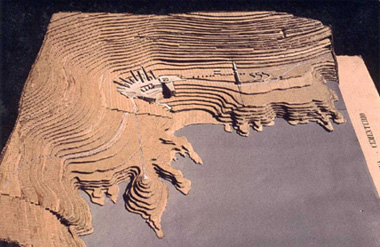
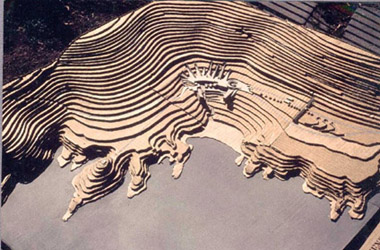
Site and geography are two important aspects at moment to understand the sense of the project. The Coast range falls on Ocean Pacific in climbs from a height of 500 m, a geological formation named marine terrace shapes horizontal planes at a height of 50 m. before to falls on the sea. At east Atacama desert extends in high andean plateau, it is recognized as the regions most arid of the planet. At west Ocean Pacific extends, the great marine abyss of Pacific descends to a depth of 3.000 m. inmediatly in front of the coast.
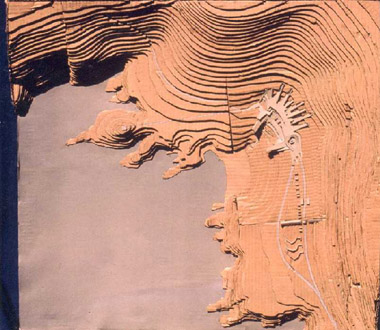
The project is located in a small bay partly occupied by old cemetery, at approximate 4 km. from Pisagua town; at north a hill separates it from the Old Pisagua town, the ancient port destroyed by war, fires and plagues.The site is on a marine terrace that looks at marine horizon and Pisagua town, it is surrounded by steep hills that become walls.
It is possible to understand the place as the boundary between two deserts, an earth desert and a desert of water.
PROJECT, ATTITUDE AND IMAGE
The project is set forth as a Cemetery - Monument. A place for death built in a place of death. The work represents what is trascendental in a reality: it "celebrates the mystery of death". It points out the meaning of the place, revealing its vocation, which in the case of Pisagua it is the constant and notorious presence of the "Angel of Death". Finally, the work mediates with its context: with the geography of the site and the old cemetery, and at the same time obviously with the city of the living. The project incorporates the old cemetery as an untouched fragment, a witness of history.
The work proposes a general structure that receives the collective and individual rites of death, but does not intend to be finished. Rather it will be the mourning relatives, through their popular expressions in the places of burial of their dead., who will give the work its finished character. Definite patterns of occupation are proposed, on one hand, by the programatic condition of the project: based on zoning according to the functions of the new buildings and the typology of the graves (in ground, in niches, in mausoleums), and on the other hand, according to the symbolic condition of the work (meaningful metaphorical spaces). The work will be structured on a system of supports based on retaining walls, which allows for these kinds of occupations, as well as its own growth.
THE IMAGE
Death related to the Unconscious.
Hypnos : Dreams
Thanatos : Death
(Twin brothers in the greek myth)
Koimeterion : "Place for sleeping"
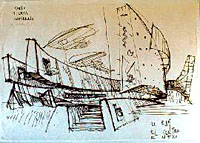
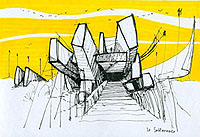
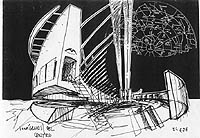
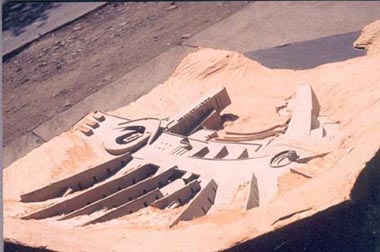
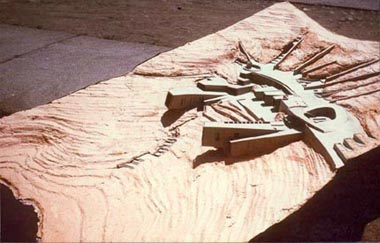
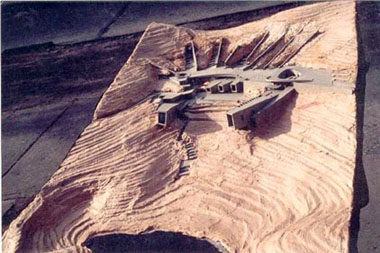
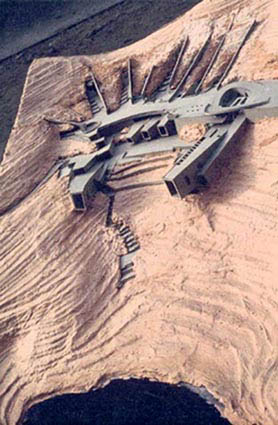
In myth, Death is associated with Dreams and therefore with the deep regions of the unconscious. It is a relation with depth, with descent, with what is under the earth and hidden. This image gives to the architectural language of the project the possibility of excavation, of working the floor in levels and of part of the program being underground. The shapes and volumes emerge half-buried from the earth, from the depth, they suggest the existence of a hidden world rather rather than showing it really until one penetrates in it; as the fragmented images that appear from the dark regions of the unconscious.
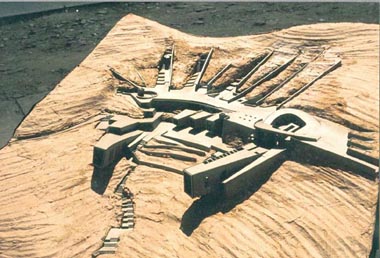
The cemetery, thought of as "a body for a body", is linked and coincides with old visions and beliefs according to which the ultra-terrestrial regions are understood as a living being, a spiritual organism unconceivable because of its extrahuman condition and dimension, within which more spiritual entities (the souls) would exist. This powerful image gives to the project the possibility of a general layout according to an organic law, by which the parts and components of the project will have a location and meaning similar to those of a living organism. Thus it is possible to distinguish the following scheme in the body of the project:
HEAD The Center or connector of different levels and realities. The monument, the missing persons' Mausoleum.
THORAX The emotive center, the heart of the project. The great wake chapel.
ABDOMEN The processing and digestive center. The common grave.
LIMBS The places of burial. The penetrations into the site and volumes prolonged to the sea.
The Center is an important image within the project, it has correspondence with the head of the ensemble as a connector of different physical levels and symbolic realities. It is the singular monument within the project, the space that connects the common grave of the missing people during the military regime, with the so called "Gallery of the Pacific War heroes". The meaning of this place is to privilege the similarities above any existing difference. It is in this way that these two apparently oppossite realities are united under a common theme of heroic death.
Other equally powerful images are the Boundary and the Threshold between two completely different regions. The Journey through ultraterrestrial regions and the corresponding Stations that conform this journey; the levels in which the other world is believed to be stratified. Finally, the Ascent and Exit once the trials and levels of the Other World region are known.
PARTS AND COMPONENTS
The work, as it intends to be a cemetery and monument at the same time, allows its parts and components to have at least three levels of understanding:
- SYMBOLIC LEVEL ................................................. . . It represents and points out. A level of fragmented order, dispersed on the general plan. It is a level of a sensitive and mental order, which lies in the functional level plan.
- FUNCTIONAL LEVEL .......................................... .... What the work was created for. It is organized in great zones related with the place and the needs of the funerary rite. It is received and supported by the constructive level.
- CONSTRUCTIVE LEVEL ............................... . ... Materials and structure. Building system; reinforced concrete walls and slabs. Structure that allows, like a great skeleton, the organization of functional patterns of occupation.
The project is the synthesis of the three levels, its architectural form must be able to receive and reflect both the Symbolic level and the Functional level. The proposal is creating a metaphoric link between :
Constructive level - ..Body
Functional level ...- ..Mind
Symbolic level .....- ..Soul
SCALES OF FUNERARY ARCHITECTURE
Basic formal components that allow for the composition of the project, which will give shape to the images that are sought.
1) Personal Grave...
2) Funerary Monument........
3) The Necropolis
PROGRAM
A zoning of the program has been proposed according to the different levels of the project, and their parts and components.
ELEMENTS OF THE SYMBOLIC LEVEL
Spaces of a metaphorical order which function is mainly to point out or communicate an idea about the mystery of death.
- The boundary (between two worlds).
- The threshold (access).
- The stations
- The journey (processiona ltravel)
- The descent (the hidden)
- The center, the axis mundis, the connector between different levels and realities (Missing's Mausoleum)
- The heart, the place of farewell, the great wake chapel and its three single chapels
- The catacombs
- The ascent
- Places of retirement and meditation
THE SYMBOLIC ASPECT OF DEATH
Myth is the telling of sacred history, an event that occured in primordial times in the beggining. It is from myth where Funerary architecture obtains its power. There are some constant ideas and themes that can be extracted from the different beliefs about the mystery of death.
1. The existence of a force or essence from the material body that survives it. Death is a transition and not the total annihilation of the individual.
2. The entrance and voyage of this essence to a region different from the material world.
3. The trials and judgement that the travelling soul must overcome in its route through the ultraterrestrial regions, and the meeting with beings that facilitate or make these trials more difficult.
4. The descent to the subterranean or infernal regions, the supreme trial of the spiritual voyage. Divine judgement, the critical stage of the voyage.
5. The levels in which the other world is believed to be stratified, frequently with stratified models of the universe. Heaven and Hell, heaven usually above. Earth is in an intermediate position. There is a center or connector of this levels with the earthly world. This is a point of intersection of the three cosmic regions. It is usually symbolized by the cosmic pillar, axis and tree that supports The Creation.
6. The strong relationship between this (earthly) world and the other world.
On earth we can observe:
7. The need of rites and ceremonies that facilitate the existence of the deceased in the other world.
8. The need for a sacred place destined for burying and for performing this ceremonies.
9. The strong influence of natural and astronomical phenomena in the origin of these beliefs..........Heaven - The star, liberation. Earth - The subterranean, the descent.
10. The profound mystery that surrounds all these events to the understanding of mortals.
ELEMENTS OF THE FUNCTIONAL LEVEL
I. CEREMONIAL AREA
- Wake chapel ...................................................120 m2
-Sacristy..............................................................30 m2
- Annexed rooms (3) 20 m2 each ...........................60 m2
- Public lavatories .................................................25 m2
-Ossuary
- Mausoleum (missing persons common grave)......300 m2
Subtotal...........................................................2.535 m2
II. ADMINISTRATIVE AREA
- Secretary office and waiting room ........................25 m2
- Sales ...............................................................20 m2
- Archives ...........................................................20 m2
- Accounting and finances ....................................35 m2
- Annexed room ...................................................25 m2
- Kitchen-dining room ...........................................30 m2
- Bathrooms ........................................................25 m2
- Storage ............................................................10 m2
Subtotal.............................................................270 m2
III. SERVICES
- Deposit for corpses in transit ...............................55 m2
- Room for reductions and preparation of the body ...30 m2
- Maintainance workshop ......................................35 m2
- Machinery and tools storeroom ...........................25 m2
- Transportation ...................................................35 m2
- Storerooms 40 m2 - Living room for staff ..............25 m2
- Bathrooms and dressing rooms........................... 60 m2.
Subtotal ...... ......................................................305 m2
IV. OTHER SERVICES
- Commerce of related articles .............................100 m2..
- Flower shops ...................................................100 m2..
Subtotal ............................................................ 200 m2
V. BURIAL AREA
Destined for the burial of the body. It must also provide a place for the individual rite in which relatives remember their dead. Organized according to grave typology.
- Graves with perpetual and temporary niches for children and reductions (0.30 x 0.30 x 0.30 m).
- Graves with niches for aduts, perpetual and temporal.... (0.80 x 0.80 x 2.20)
- Graves in the earth, perpetual and temporal (0.90 x 1.30 x 2.20 m)
- Family graves (3-6-9 persons)
- Groupings of niches for congregations or associations.(9-12-18 persons)
- Ossuary
- Missings' mausoleum.
- General common Grave
The elements of the different areas and both levels will be linked by ceremonial circulations (which receive the procession of the funerary rite) and by alternative circulations.
- Total built surface (approximate)........................1.310 m2.
- Total cemetery surface (approximate)...............14.500 m2.
- Old cemetery surface (approximate).................12.000 m2
IMAGES
DRAFTS
GENERAL PLAN
 |
Location Cemetery´s bay |
 |
Location Cemetery´s bay |
 |
Location Cemetery´s bay |
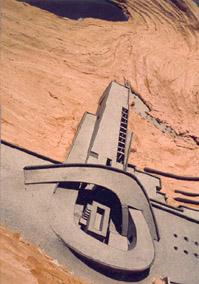 |
Missings' mausoleum Head of the project The Center
|
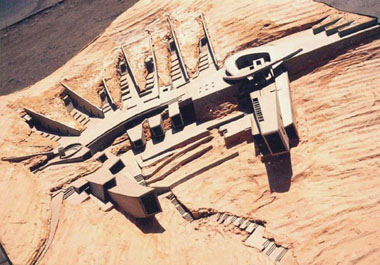 |
A body for the body |
 |
|
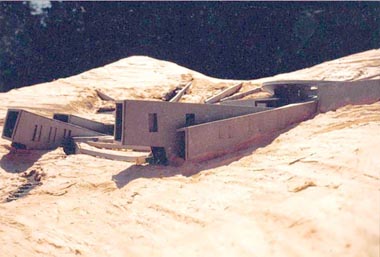 |
The volumes emerge from the ground |
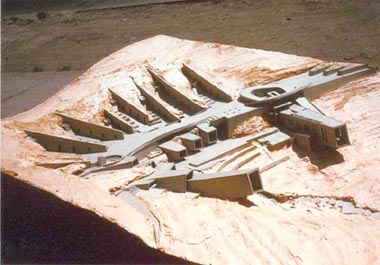 |
Working the ground in levels |
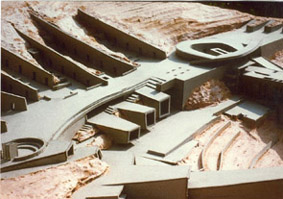 |
Main terrace and Wake chapels terrace |
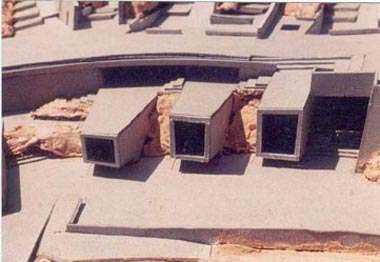 |
Wake chapels Heart of the project |
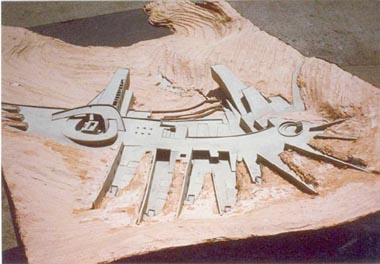 |
The project linkes the marine horizon and the continent |
 |
|
 |
|
 |
|
 |
A boundary between two deserts; an earth desert and a desert of water |
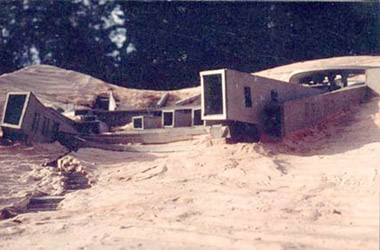 |
View from the beach |
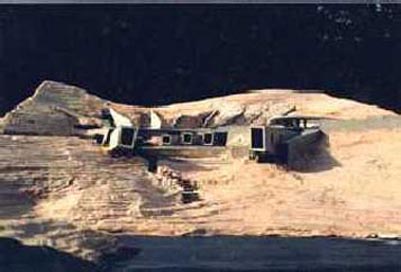 |
View from the sea |
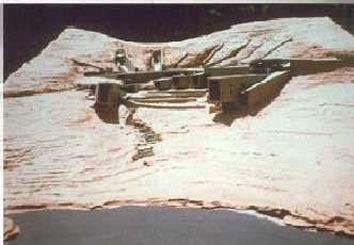 |
View from the sea |
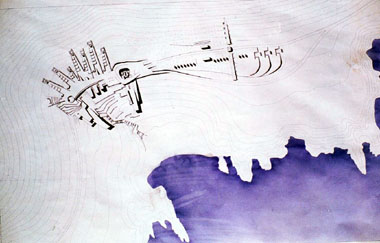 |
Location New and old cemeteries |
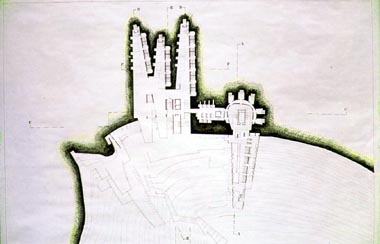 |
Plan 1° level underground |
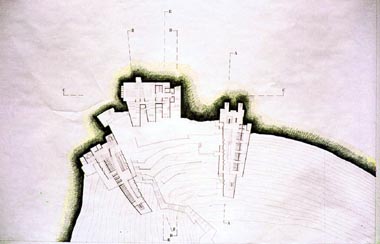 |
Plan 2° level underground |
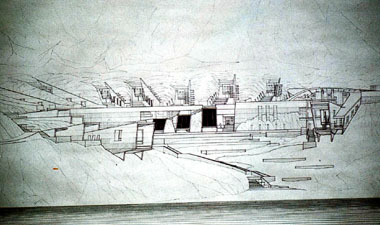 |
Elevation from the sea |
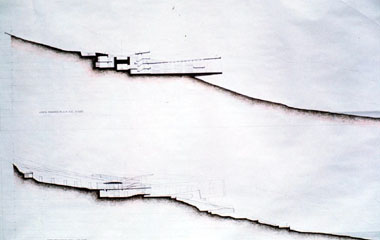 |
General sections |
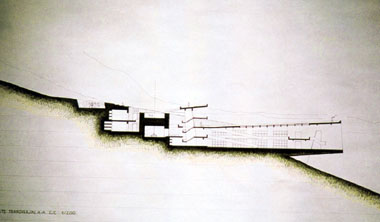 |
Section by Missings' mausoleum. |
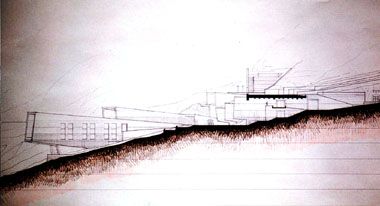 |
Section and lateral elevation |
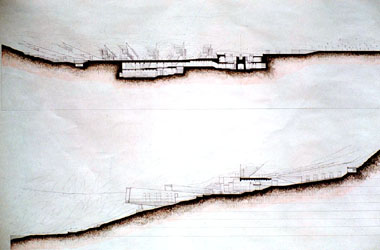 |
General sections |
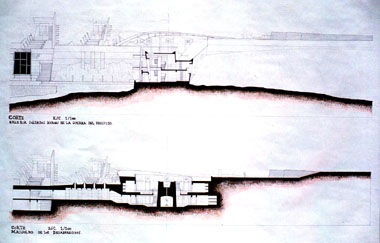 |
Section by Missings' mausoleum. |
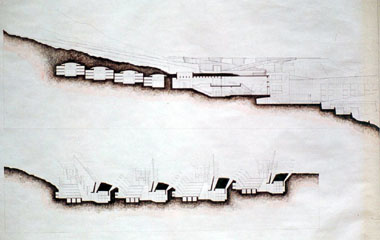 |
Section by graves and wake chapel |
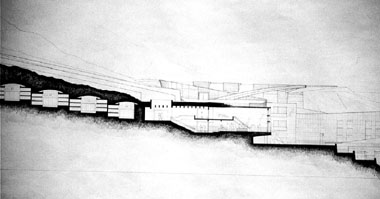 |
Section by a wake chapel |
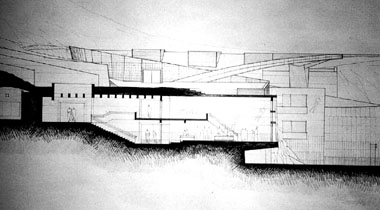 |
Section by a wake chapel |