We Build,
We Fight.






|
Seabee
History
|
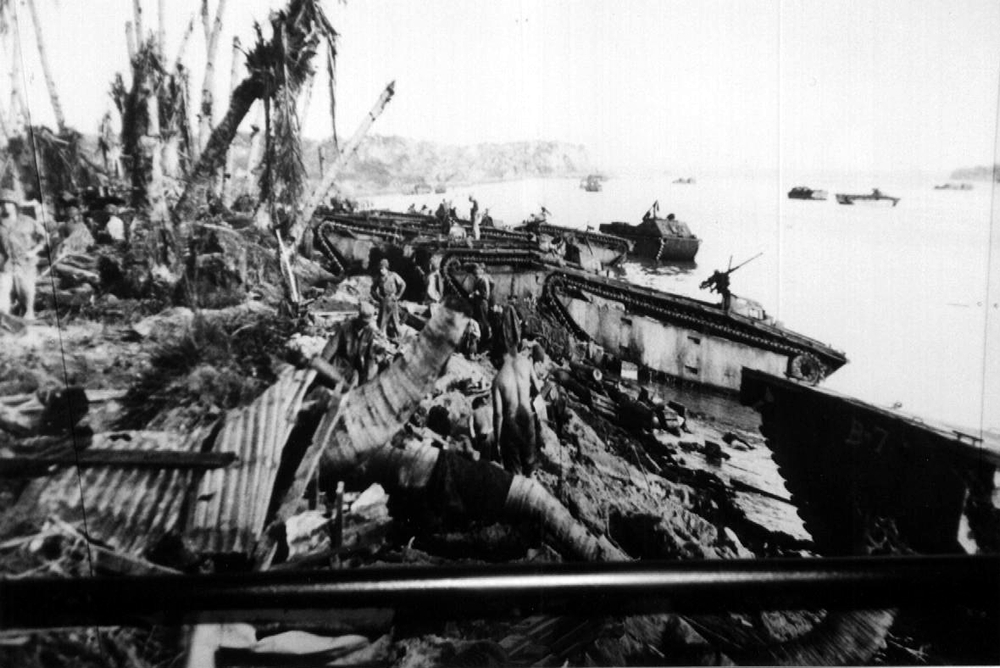
US armed forces land on Guam during WWII.
(Source: Museum in Guam visited in 1994)
From Navy Public Factfiles (March 2001):
Seabees — their simple motto tells the story: "We build, we fight". From the island hopping of World War II and the cold of Korea, to the jungles of Vietnam and the mountains of Bosnia, the Seabees have built entire bases, bulldozed and paved thousands of miles of roadway and airstrips, and accomplished a myriad of construction projects.
In December 1941, with an eye on the developing storm clouds across both oceans, Rear Admiral Ben Moreell, Chief of the Navy's Bureau of Yards and Docks, recommended establishing Naval Contruction Battalions. With the attack on Pearl Harbor and the U.S. entrance into the war, he was given the go-ahead.
The earliest Seabees were recruited from the civilian construction trades and were placed under the leadership of the Navy's Civil Engineer Corps. Because of the emphasis on experience and skill rather than on physical standards, the average age of Seabees during the early days of the war was 37.
More than 325,000 men served with the Seabees in World War II, fighting and building on six continents and more than 300 islands. In the Pacific, where most of the construction work was needed, the Seabees landed soon after the Marines and built major airstrips, bridges, roads, warehouses, hospitals, gasoline storage tanks and housing.
With the general demobilization following the war, the Construction Battalions were reduced to 3,300 men on active duty by 1950. Between 1949 and 1953, Naval Construction Battalions were organized into two types of units: Amphibious Construction Battalions (PHIBCBs) and Naval Mobile Construction Battalions (NMCBs).
Over the past 50 years the Seabees have repeatedly demonstrated their skills as fighters and builders. From the islands of the Pacific to the jungles of Vietnam to the sands of Saudi Arabia and to the mountains of Bosnia, they have built and fought for freedom. In peacetime, they have been goodwill ambassadors. In peace and in war, they have lived their motto: "Can Do!"
Home
| Seabee History | 72nd NCB | Seabee
Links
Sign
Guestbook | View
Guestbook