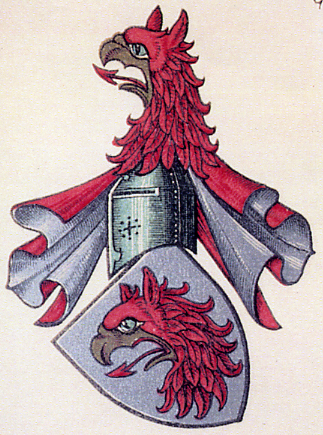
During the rise of Western civilization heraldry thus began ... it became popular during the eighth and ninth centuries among those who could afford an image, such as chieftains, knights or kings, to adopt a crest that suited their principles and represented them symbolically. A family carries specific colours that bear significant meaning to the family's attitude.Traditionally, a family crest or a coat of arms, consists of four parts...one, the crest itself, which often depicts a beast, second, the family helmet upon which the crest is seated, third, some decorative manteling, and finally the shield, which contains an altered version of the crest.
It is a general misconception that every surname is entitled to a specific crest, but in reality crests depend on individual families. More importantly, one must realize that not everyone is entitled to a specific coat of arms. Crests have to be awarded to a family or inherited through a line of male ancestors.
The ancestors of the Domizlaffs included some prominent people, some of them which included knights, that bore the family crest for many centuries, but when the Domizlaffs began to intermarry into the rising Middle class, the crest was carried on but no longer displayed with the same enthusiasm. It was not until my great-grandfather Georg H. C. Domizlaff, the chairman of the familly-organisation, officially reentered the family into the register of associations in Stettin as the Domizlaff zu Alten-Stettin on Feb. 20, 1913. The family simultaneously assumed a crest, which shows a red gryphon head on a silver field. This is the old crest of the parallel line of heritage of the duke of Stettin of the 12. Century.
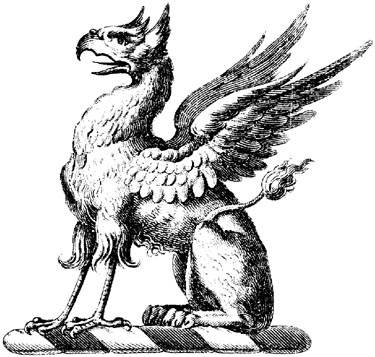
Our Crest is a red, almost blood coloured gryphon upon a solid silver ground.The gryphon is a fable beast that has the head and wings of an eagle and the body of a rampant lion. The traditional meaning of a gryphon is the dominance of earth and sky, wisdom and universal strength. A gryphon is also a guardian that defends the sacredness of the subject that it is set out to protect. "It symbolised a guardian, its ears showing attention, its wings swiftness, its lion-like shape courage and audacity, and its hooked beak hoarding and tenacity." (J.Cherry: 1995: 100. Mythical Beasts, British Museum Press. London).
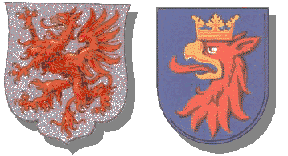
My family roots trace back to Stettin in Pomerania. While I was reading up on Stettin and actually visited it this summer, I noticed that the crests of Pomerania and Stettin are very similar to ours. They both present various renditions of the same red gryphon on silver backgrounds, which obviously proves that our family derived from Pomerania, specifically Stettin. Below, you can see the various crests and notice their commonalities. |