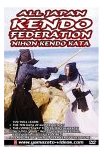
Japanese
style of fencing derived during the Meiji period in Japan
(1868-1912), from the ken (two-handed sword) fighting
techniques of the 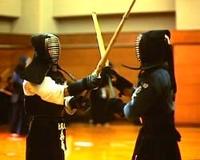 samurai.
Today kendo, which means "way of the sword", is
practiced with shinai (bamboo swords), and fighters wear
protective equipment. The bogu (protective gear) consists of a
men (face mask), a do (breastplate), kote (fencing gloves),
and the tare, a kind of apron to protect the stomach and hips.
Under the protective gear, kendoka (students of kendo) wear a
hakama, or wide split skirt, reaching the ankles. The shinai
is made of four lengths of seasoned bamboo bound by waxed
cord. Contestants are barefoot and fight on a smooth floor.
samurai.
Today kendo, which means "way of the sword", is
practiced with shinai (bamboo swords), and fighters wear
protective equipment. The bogu (protective gear) consists of a
men (face mask), a do (breastplate), kote (fencing gloves),
and the tare, a kind of apron to protect the stomach and hips.
Under the protective gear, kendoka (students of kendo) wear a
hakama, or wide split skirt, reaching the ankles. The shinai
is made of four lengths of seasoned bamboo bound by waxed
cord. Contestants are barefoot and fight on a smooth floor.
The main cuts
or thrusts that may be delivered in kendo are limited as
follows: (1) oshomen - a downward cut aimed at the center of
the forehead; (2) hidarimen - a diagonal cut to the left side
of the face mask; (3) migimen - a diagonal cut to the right
side of the face mask; (4)migido - a diagonal cut to the right
side of the breastplate; (5)gyakudo - a diagonal cut to the
left side of the breastplate; (6) kote - a cut at the right
wrist or lower forearm; (7) hidari kote - a cut at the left
wrist or lower forearm; and (8) tsuki - a thrust at the
throat.
An important
part of training is the use of the kiai, which is an explosive
sound, a kind of controlled and personalized yell intended to
inspire courage and determination in the utterer and fear in
the opponent, and to upset the concentration of the opponent
as a cut or thrust is made.
A shiai
(match) is normally known as a "3-point" match,
lasting three to five minutes. Kendoka bow to the opponent and
prepare for the shiai by placing the right foot forward with
the left heel slightly raised. The shinai is raised in both
hands with the tip aimed at the opponent's throat. When a blow
is delivered, the attacker must yell out the type of blow in
order for it to be evaluated by the judges. The first fighter
to score 2 points is the winner. If a match is tied at the
time limit, it is either declared a draw or continued, with
the first fighter to take a point the winner.
Traditionally
kendoka were divided into two ranks: student and teacher. In
modern schools, however, kendoka advance in rank from tenth
kyu (student level) to first kyu. Shodan (first degree, expert
level) can be achieved in approximately two to three years.
There are nine expert levels. No outward indication of rank is
usually worn, although some federations give small colored
patches to sew on the shoulders of younger kendoka. Before a
practice begins, kendoka sit according to level of proficiency
and face the sensei (teacher), who leads them in a moment of
meditative silence (mokuso). Kendo practice is repetitive and
a move must be repeated thousands of times and mastered before
a new technique may be learned. The purpose of such discipline
is not only to learn new skills but to build good character
and a sense of harmony in the student.
History
The
earliest known reference to swordsmanship in Japan is AD 789,
when sword exercise was part of education for the sons of
noblemen. With the unification of Japan in the 16th century,
however, the need for highly skilled swordsmen diminished
because the country was at peace. Modern kendo is the result
of ryu-ha-kenjutsu, or the academic study in the late 19th and
early 20th centuries of swordsmanship pursued by the samurai
class. After World War II (1939-1945), all martial arts,
including kendo, were banned in Japan during the American
occupation of the country, which lasted until 1952. In that
same year the All-Japan Kendo Federation was founded. Kendo is
now practiced in Japan by more than two million people, and it
has some following in the United States, Europe, Brazil,
Argentina, Taiwan, Korea, the Philippines, and Australia. The
international governing body is the International Kendo
Federation (IKF), which was established in 1970, the same year
of the first world championships. Japanese kendokas have won
the individual and team titles at all world championships.
(Taken from MSN Encarta)
Fail to Plan and You Plan to Fail!
Don't
put off the Idea of Learning Martial Arts!
|
|
The San Diego Martial
Arts Directory is based in beautiful San Diego.
And dedicated to providing quality services to the
public since 1997. |
Comments, complaints, or suggestions?
e-mail us at