
CHILDREN’S SITUATION: Facts
and Figures
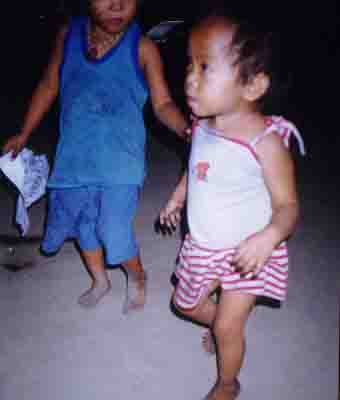
There are an estimated 1.5 million street children in the Philippines, with 75,000 in Metro Manila alone. (Ibon Data Bank, 1994; Situation of the Youth in the Philippines, 1998) Among the three categories of street children, the children on the streets constitute about 70%; children of the street (“hardcore” street children), about 20%; and the completely abandoned children, about 10% of street children in the Philippines. (Situation Study of Street children, UNICEF)
There are more boys than there are girls who are street children. In Metro Manila, the ration is 7:3. Most of these children belong to the 11 – 14 age bracket although age ranges from 6 to 17 years old (DSWD/NCSD/UNICEF, 1988) About one-half of these children, particularly preschoolers, suffer from first degree malnutrition; one-fourth suffer from moderate malnutrition, while about 4% are seriously malnourished. (Black, 1991)
Out of 7.8 million school children, about 56.4% or 4.4. million are malnourished and underweight. Moreover, 720,000 infants are born with low intelligence due to iodine deficiency. (Ibon Data Bank, 1994)
? Seventy six percent of the Philippine population lives below the poverty line. (Ibon Data Bank, 1996) Families of children in commercial sex also registered monthly incomes, which were below the poverty threshold, which is P8,885.00. (Commercial Sexual Exploitation of Children in the Philippines: A Situation Analysis, UNICEF)
A portion of the street children population is children-victim of commercial sexual exploitation. In an ECPAT report (1997), the number was placed at 60,000 to 100,000. Another 1997 study by a University of the Philippines professor however estimated the number of prostituted children at 100,000, of whom 5,000 were in Metro Manila. (Commercial Sexual Exploitation of Children in the Philippines: A Situation Analysis, UNICEF)
The Department of
Social Work and Welfare (DSWD) claims that the annual average increase
of prostituted children is 3,266. It also reports a more than 100
percent increase in cases of sexually abused and exploited children.
Of these cases, 36% were rape cases. Child prostitution and pedophilia
accounted for 12 percent.
(An Overview of Child Rights
in the Philippines, Save the Children UK)
Research studies conducted by the Center for the Prevention and Treatment of Child Sexual Abuse (CPTCSA) in schools in Metro Manila show that for every 3 Filipino children, one experiences abuse (Manila Bulletin, 11 February 1996)
As regards child labor, the DOLE reports that there are about 77,000 workers aged 10 to 14 and 14 million between 15 and 17 years old. (Ibon Data Bank, 1994)
Despite free tuition in public elementary schools, 1,424,774 children aged seven to 12 were not able to go to school in the school year 1993-1994, mainly due to the parents’ inability to meet daily school expenses. (Ibon Data Bank, 1994)
According to a government paper submitted to the 1990 World Summit for Children, there are 120,000 children affected by the insurgency every year. (Ibon Data Bank, 1994) On the other hand, the Citizens’ disaster Response Center 9CDRC) estimated that children in situations of armed conflict (CSAC), which included those aged 15-17, constituted 50% of the civilian population where there were ongoing wars. Based on the CRDC data, overall, those aged 17 and below constituted 51.7 percent of the total number of victims of internal refugee. (Situation of the Youth in the Philippines, 1998)