 |
| Republican Armor |
|
|
|
 |
 |
|
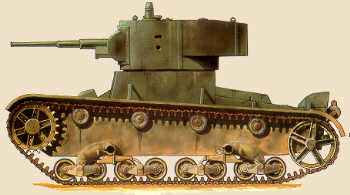
| The pre-war Spanish Army had two tank regiments, the 1st Tank Regiment located in Madrid and the 2nd Tank Regiment in Saragossa. Most of the troops of the 1st Tank Regiment sided with the Republic, and their World War I vintage French Renault FT tanks were consolidated in a company under D. Pogodin to support Krivoshein's tanks during the Madrid fighting. In the face of German and Italian military aid to Franco's insurgent Nationalist forces, Stalin decided to send military aid to the Republican forces in the Spanish Civil War. The first shipment of tanks and tank specialists left for Spain in September 1936. The cargo ship Komsomol arrived at the port of Cartagena on 12 October 1936 with a shipment of 50 T-26 light tanks and 51 "volunteer" tank specialists. In the meantime, the Soviet military attach� at the Madrid embassy, Kombrig Vladimir Gorev, had arranged for the creation of a training center near the town of Archene in Mursia, about 90 km. from the port. The Soviet government did not plan to provide crews for the tanks sent to Spain, but rather to train Spanish personnel to operate them. Archene became the main training and technical center for the Republican tank force for much of the war. The initial training program at Archene was headed by Kombrig Semen M. Krivoshein. Although the initial plans were to confine the use of Soviet personnel to training, by the end of October, the situation for the Republican forces around Madrid was becoming so desperate that the Soviet attach� V. Gorev was authorized to form some ad hoc combat formations from the Archene training center and send them to reinforce the Madrid front. At least three small groups were dispatched to the front, one headed by Komrot A. Novak with six BA-3 armored cars and seven T-26 tanks, a Spanish tank platoon under Major P. Villakansas, and a reinforced company-sized formation under Kombat Paul Arman. The two first groups went into action on the night of 27 October 1936 with little effect. The first significant action by the Republican tank force occurred on the morning of 29 October by Arman's partially formed 1st Tank Battalion. Arman was a flamboyant character, a Latvian who had served with the Bolsheviks in the Russian Civil War, who then served undercover as a Soviet agent in the Latvian Army until 1926 when he returned to the Soviet Union. After attending Soviet officer courses, he served as a company commander in a Red Army BT fast tank regiment prior to his transfer to Spain. Arman was selected to lead the first training group since, unlike most Red Army officers he spoke several western European languages. Arman had selected the best Soviet crews, mixed with some of the new Spanish crews, for a total of 34 Soviet tankers and 11 Spanish crewmen. In a conversation with one of the Spanish generals at the front, Arman is reported to have quipped "The situation is not so hopeless. They have fifteen thousand soldiers, we have fifteen tanks, so the strengths are equal!". On the morning of 29 October 1936, Arman's company was assigned to support a Republican infantry attack by Brigade Lister and Brigade Bueno against Italian and Spanish Nationalist units in the village of Sesena, on the southern approaches to Madrid. The attack on Sesena displayed problems and potential of the tactical employment of tanks in the Spanish conditions. The Spanish infantry had no training to operate with tanks, and Arman had no patience to wait for them. So ordered his company forward without the accompanying infantry. Of his 15 tanks, three were disabled almost immediately by mines on the road to the town, a novel experience as anti-tank mines had been a relatively rare affair in World War I. Pressing ahead, Arman bluffed his way past a battery of Nationalist field guns in the western outskirts of Sesena and his forces then attacked the main Nationalist positions in the town itself. One of his tanks was destroyed in the street fighting when struck by a flaming bottle of gasoline. This was the first time "Molotov cocktails" had been used in combat in Spain. After shooting up the Nationalist forces in the village, Arman led his company out of town eastward in an attempt to strike at the rear of the Nationalist forces. After overrunning a field gun battery, the T-26 tanks encountered three CV 3/35 tankettes of the Nationalist 1st Tank Company. The little vehicles were armed only with machine guns, and their counterattack against Arman's force was hopeless. One was destroyed at close range by tank fire, and another was pushed into a ditch and overturned by the much larger T-26 tanks. By noon, Arman's tank group passed through the village of Esquivias, southward to Borax, and making a circle, finally stopped in a grove on the southeastern outskirts of Sesena. After a rest, the group again attacked Nationalist forces in Sesena, this time from behind the frontlines from the southwest, exited the town, and rejoined Republican forces. During the raid, Arman's group lost three tanks to Molotov cocktails and artillery fire with three more damaged, and suffered casualties of 4 Soviet and 4 Spanish tankers killed and six wounded. Arman claimed that his group had destroyed two infantry battalions and two cavalry squadrons, ten 75mm field guns, 2 tankettes, 20-30 trucks, 5-8 automobiles, some tank transporters and captured two field guns. Although Arman's raid was an important psychological boost for the harried Republican forces, the counterattack of which it was a part was a failure due to the inability of the infantry to fight their way into the town lacking the prmised tank support. The poor coordination of tank and infantry at Sesena would prove typical of the Spanish experience. After several more days fighting around Sesena, the scattered Republican tank formations were united under by Kombrig Krivoshein to form the Aranjuez Group, with a strength of 48 tanks and 9 armored cars. There was no real effort made to concentrate the armor, and Arman's company was broken off again to support Brigade Lister while the rest of Krivoshein's force supported the main Republican column retreating to Madrid. The Republicans were unable to stem the Nationalist onslaught, although there was almost universal praise for the performance of Krivoshein's scattered tank units. The Aranjuez Group took part in the fighting for Torrejon de Velasco and Valdemoro on 4-5 November 1936, the counterattack in the suburb of Cerro de los Angeles on 13 November 1936, and in almost continuous fighting inside Madrid itself through the middle of December 1936. By the time of the siege of Madrid in mid-December 1936, Krivoshein's small armored force was largely spent, not only due to battlefield casualties, but due to the mechanical exhaustion of the tanks themselves. Tanks of the 1930s were not as robust as tanks of the World War 2 generation. The T-26 light tank required intermediate overhaul at district workshops after 150 engine hours, and factory overhaul after 600 hours. The poor quality of the fuel of the time led to engine carbonization, fouled spark-plugs, and other problems which could immobilize the tank. Tracks and track pins began to wear out after 500 miles of travel; side clutches became worn out, and the powertrain was gradually knocked out of alignment from hard cross-country travel. In the desperate fighting during the defense of Madrid, Arman's company had accumulated over 800 operating hours by mid-December, far beyond the regulations, leaving many of his tanks inoperable. Krivoshein's other units were not in much better shape, as the inexperienced Spanish crews were unable to do field repairs, and their unfamiliarity with tank driving led to high rates of clutch and powertrain failures. There were no established maintenance facilities in the Madrid area, and spare parts were almost non-existent. While Krivoshein's tank force had succeeded in its immediate mission of bolstering the Republican forces during the defense of Madrid, this was no way to operate a tank force for prolonged campaigns. As Italy and Germany blatantly violated the non-intervention policy and sent more troops and weapons to Franco's forces, Stalin decided to reinforce the Spanish contingent. While the defense of Madrid was continuing, a second wave about 200 Soviet tank crews and tank specialists arrived aboard the steamer Chicherin on 26 November 1936. The group was a cadre from the 4th Separate Tank Brigade (Light) of the Byelorussian Military District from Stara Doroga headed by Kombrig D. G. Pavlov. The intention was to use these assets to form the 1st Armored Brigade (1.a Brigada Blindada) at the Archene camp. The larger size of this unit was not necessarily a signal that the Soviet advisory group in Spain planned to conduct large scale operations with concentrated tank forces. The Red Army's light tank brigades were designed to provide infantry support to combined arms armies or rifle armies, and were organized to permit individual battalions to be assigned to the rifle divisions during operations. However, the brigade structure contained a more elaborate logistical infrastructure than Krivoshein's group, which would help to address the serious maintenance problems plaguing the first Soviet tank units in Spain. Pavlov's brigade in Spain was only about a third the size of a normal Red Army light tank brigade, with a nominal table of organization and equipment of 96 tanks and an actual strength through most of the winter and spring fighting of seldom more than 60 tanks. As in the case of Krivoshein's units, there were not nearly enough Soviet tankers to man this unit, and as a result, Spanish crews had to be used. In practice, this usually meant Soviet drivers, platoon commanders and company commanders, with the Spanish tankers serving as turret crew. In total, some 351 Soviet tankers served in Spain during the course of the war, but from available unit records, the total at any one time was never more than 160 men, and usually not more than 100 tankers. Pavlov's new brigade absorbed the surviving remnants of Krivoshein's tank units which constituted the 1st Tank Battalion. Pavlov's partially formed brigade was pressed into action in early January 1937 with only 47 tanks on hand. The best equipped unit was the new 2nd Tank Battalion commanded by Kombat M. P. Petrov. The intention was to provide support for the 12th and 14th International Brigades during attacks from Las Rosas towards Majadahonda on 11 January 1937 on Madrid's western front. The attacks began without the promised artillery or air support. In contrast the earlier experience with the Spanish units, the cooperation with the International Brigade infantry was somewhat more successful. The tanks were very useful in overcoming the Nationalist defensive line, which was based around the use of reinforced stone houses. However, once the initial defensive lines were overcome by the tanks and infantry, the infantry was unable to keep up with the tanks and became separated. The tanks could have penetrated the Nationalist lines more deeply, but as Arman's initial raid had shown, penetrations without accompanying infantry were futile. In three days of fighting, the unit lost five tanks, mainly to enemy anti-tank guns. As Soviet aid to the Republicans increased, so too did German and Italian aid to the Nationalists. The scourge of the Republican tank force was the German 37mm PaK 36 anti-tank gun, though the Italian 47mm Italian infantry gun was also used with some success. The Majadahonda offensive soon ended, and the Nationalist forces switched the focus of their assault on Madrid to the southeastern front along the Jarama river. Pavlov's brigade was transported through the city to the new front, and broken up into small company sized detachments to reinforce the Republican lines. As the French had found in World War I, the precense of tanks provided a strong psychological reinforcement to demoralized infantry, and there was great demand for tank support across the madrid front. Even after the losses suffered in recent weeks, the brigade's strength had increased to 60 tanks as more crews became available and more tanks repaired. The Republican forces went over to the offensive, supported by Pavlov's scattered units. On 14 February 1937, the brigade was used in a more concentrated form and in a counterattack with the 24th Infantry Brigade, overcame a major Nationalist force, leading to the loss of about a thousand Nationalist troops killed or wounded. The brigade's units were concentrated again in late February for the assault on Pingarron, and once against, the tanks supported the International Brigades. On 27 February 1937 alone, the brigade launched 5 attacks on Nationalist positions, but took very heavy losses from Nationalist anti-tank guns in the process. In March, the front shifted yet again, this time to the north of Madrid as an Italian offensive began at Guadalajara. Once again, Pavlov's tanks were called on to save the day, and transported to the new sector. During the initial phase of the campaign, Pavlov's units were used in a defensive role to rebuff major Italian attacks. On 13 March 1937, one of the few tank-vs.-tank fights took place when the Republican T-26 light tanks shot up a company of Italian CV.3/35 tankettes near Trijueque, destroying five and seriously damaging two more. There were many small unit encounters with Italian forces, and the Italian tankers soon learned to fear contact with the Republican rearguards when supported by T-26 tanks. When the Italian CTV Volunteer Corps' offensive was finally exhausted, the Republicans went over to the offensive with Pavlov's tanks in the lead. On 18 March, three Republican infantry brigades with tank support routed the lead Italian units and seized the town of Brihuega. By the end of the day, Pavlov's force had suffered so many casualties, both to enemy fire and mechanical problems, that of its original 60 tanks at the beginning of the Guadalajara fighting, it was able to muster only nine tanks to chase the retreating Italians. The Republicans were unable to exploit their victory, achieved in no small measure with the support of the tanks. Pavlov's force received a major infusion of new equipment and manpower in March 1937 when two more transport ships arrived from the Soviet Union bringing with them 100 new T-26 tanks. This was nearly as many tanks as had been supplied since the beginning of the Soviet intervention. The main problem was to train enough Spanish crewmen to equip them. The unfavorable view held by many Soviet officers of the Spanish tank crew led to plans to recruit tankers from the better-regarded International Brigades. Since there were limits on the amount of training that could be undertaken in Spain, these foreign volunteers were sent to the Soviet tank school in Gorkiy. The first contingent returned to Spain in time to take part in the Brunete campaign in the summer of 1937. Pavlov turned over command of the brigade in late May to Kombrig Rudoft, and returned to Moscow in June to brief Stalin and the Military Council along with a number of other prominent Spanish Civil War advisers. Due to the influx of new tanks in the spring of 1937, it was possible increase the number of tank battalions in Spain from three to four. These new units, and the demands from other fronts for armor support, led to the decision to organize three additional armored brigades in the spring and summer of 1937. Unlike the 1st Armored Brigade, these later brigades had only a single tank battalion, and two battalions of locally manufactured armored cars. Manned by Spanish personnel, they did not have the mobility or firepower of the 1st Armored Brigade and were not ready until late in 1937. |
| Soviet Tank Shipments to Spain |
| Date of Arrival Ship Quantity Type |
| 12 Oct 36 Komsomol 50 T-26 light tank |
| 25 Nov 36 Cabo Palos 37 T-26 light tank |
| 30 Nov 36 Marc Caribo 19 T-26 light tank |
| 6 Mar 37 Cabo Santo Tomas 60 T-26 light tank |
| 8 Mar 37 Darro 40 T-26 light tank |
| 7 May 37 Cabo Palos 50 T-26 light tank |
| 10 Aug 37 Cabo San Agustin 50 BT-5 fast tank |
| 13 Mar 38 Gravelines 25 T-26 light tank |
|
|
 |
|
|
|
|
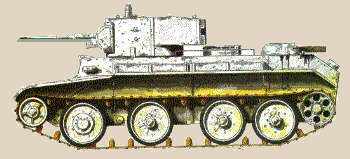
| By the time of the Brunete offensive, the 1st Armored Brigade had been raised in strength to its authorized level of three tank battalions, and there was a further reserve of about 30 tanks from the new battalion, bringing Republican tank strength to 129 T-26 tanks and 43 BA-3 and FAI armored cars. Under the plan for the offensive, the 1st and 4th Battalions with 70 tanks and 20 armored cars would support the main assault by the 5th and 18th Corps (one tank battalion per corps), while the 2nd Battalion with 30 tanks and 10 armored cars would support the separate offensive by the 2-bis Corps south east of Madrid. The Brunete offensive was intended to relieve Madrid by an enveloping offensive, emanating from west of the capital to the southeast, trapping the Nationalist forces on the southern approaches of Madrid. The attack by the 18th Corps on Villanueva de la Canada on 6 July began badly. The tank battalion advanced across an open field with the infantry from the 34th Division following behind, but the tanks were stopped about 500-600 meters from the town by the Nationalists' two well-concealed anti-tank guns and two field guns. Artillery and air support was requested. But four more attacks failed to overcome resistance in the town. One of the German 37mm guns had been mounted in a church steeple and was credited with a dozen tanks. The town was finally taken by the 15th Division, but the corps failed to reach its objectives during the first day of fighting. Although the 5th Corps made better progress, it too failed its main objectives. Over the next few days, the tanks were used to support the Republican infantry in a series of small local attacks, which largely failed to dislodge the reinforced Nationalist positions. Even after committing its reserve tank battalion, by 11 July, the 1st Armored Brigade in the Brunete sector was reduced in strength to only 38 tanks, all supporting the 5th Corps. On 18 July 1937, the Nationalists shifted to the offensive against the exhausted and demoralized Republican forces. They proved no more able to dislodge the Republicans, and the campaign ended in stalemate by the end of the month. Final Reinforcements The International Tank Regiment was the last Soviet tank unit deployed to Spain. By the summer of 1937, the Soviet Union had shipped 256 T-26 tanks to Spain for the various tank battalions. The last major shipment of 50 tanks were BT-5 fast tanks. In contrast to the T-26 light tanks, the BT-5 fast tanks were intended for deep maneuver operations, not for close infantry support. They were a license built copy of the American Christie tank, but with a Soviet-designed turret and gun, identical to that on the T-26. They were considered by the Soviet advisers to be the most modern and best tanks in Spain, and were held in reserve through the late summer and early autumn, waiting for a major opportunity to exploit their capabilities. While Pavlov's 1st Armored Brigade had been recruited from a unit trained and equipped to conduct close infantry support, Kondryatev's unit had been raised from the Soviet Union's premier mechanized formation, the 5th Kalinovskiy Mechanized Corps from Naro-Fominsk which had been the show piece formation for Tukhachevskiy's experiments with deep maneuver. As in the case of other Red Army units deployed to Spain, Soviet crews made up only a small fraction of the personnel in the regiment. However, the International Tank Regiment was allotted the cream of the Spanish trainees and the personnel from the International Brigades who had been set to the Gorkiy Tank School in the Soviet Union in the spring of 1937. The training of the unit, though far better than any other Republican tank unit, was far from complete. In the hopes of preserving the mechanical state of the equipment, training was limited to stationary exercises, and there were no opportunities for the unit to practice platoon or company field exercises. For many of the Soviet advisors in Spain, the International Tank Regiment was the last, best hope to display the power of tanks on the modern battlefield. These hopes would be crushed in the autumn of 1937 during the Saragossa campaign. Since August 1937, the Republican Army of the North had engaged the nationalist forces in the Aragon region, finally capturing the town of Belchite on 6 September 1937. In early October, another offensive was planned against the town of Fuentes de Ebro on the road to Saragossa. The immediate objective was the seize the town, but the hope was that the use of the International Tank Regiment would permit a breakthrough to Saragossa itself. The attack on the town would be conducted by Gen. Karol (Walter) Swierczewski's 35th Division consisting of the 11th and 15th International Brigades. The preparations for employing the tanks were slapdash and incompetent. The International Tank Regiment was given its orders at 23:00 the night before the attack, and had a hasty 50 km road march that night to the assembly area. On arriving and refueling near the front lines, the regiment learned only two hours before the start of the attack that it was to carry infantry on the tanks during the attack. This decision was opposed by the Soviet advisers as well as by the tank regiment officers who felt that it would put the infantry at too great a risk. The BT-5 was not well suited to carrying troops, and there were no experiments in doing so prior to this battle. Although the troops from the 15th International Brigade who would ride the tanks were regarded as good troops, the infantry unit that was supposed to accompany the tanks during the attack, the 120th Brigade, was notorious for refusing to leave its trenches. There was no infantry reserve. The mission was planned in such haste that the regimental staff had no time to conduct a reconnaissance of the battlefield, and the Spanish command did not provide adequate details of the battle area or likely Nationalist anti-tank defenses, considering such issues "trivial". This would prove fatal to the operation. There was virtually no artillery preparation since the paltry two batteries assigned the task were armed with 75mm guns captured a few weeks before with little ammunition. A T-26 battalion was supposed to be used in one of the neighboring sectors, but did not arrive in time to take part in the initial assault. The attack began shortly after noon. The forty-eight tanks of the International Tank Regiment started the attack with a salvo of their guns, and then set off at high speed "like an express train", with Spanish infantry clinging to their sides. In the din and dust of the attack, many of the infantry fell off the tanks, some to be run over and crushed by other tanks. Crossing the friendly trenches proved more complicated than expected as the Republican infantry had not been warned, and in the confusion there was some firing between the infantry and the tanks. Once clear of the friendly lines, the tank continued to race forward, only to find that the friendly positions were on a plateau about three to four meters over the plains below. The rushing tanks were brought to a halt, and the units had to find passageways to exit to the low ground. More discouraging still, the terrain in front of the enemy positions consisted of irrigated sugar cane fields, criss-crossed with irrigation ditches. The tanks continued their rush forward, but became bogged down in the cane and water-logged soil. They began to take fire from Nationalist field guns and anti-tank guns in neighboring buildings. The advance could not press forward due to the terrain, and there was not enough infantry to hold any territory that had been gained. After exhausting their ammunition, the tanks slowly began to make their way back to the start point with little direction or control, leaving behind several tanks stuck in the mud. The tanks rearmed and were instructed to return to extract the bogged down tanks. Instead, a T-26 battalion that was supposed to be employed in the original attack was sent out with some infantry support. The attempt to extract the tanks cost a further 80 troops. In total, the International Tank Regiment lost 19 of its 48 tanks in the attack and several more damaged, and a third of its tank crews were killed or wounded. An American tanker in the regiment wrote shortly after the attack: "Courage and heroism are plentiful in Spain and the Spanish people have no lack of it. What they need is tactics. And as for tactics, on 13 October, Regiment BT was bankrupt." In his report to Moscow, the commander of the 35th Infantry Division exonerated Kondryatev and his unit, and placed the blame squarely on the Army of the North commanders. With the Great Purges underway in Moscow at this time, the Soviet officers in the theatre undoubtedly thought it wise to explain their performance during the fiasco. This small battle on the afternoon of 13 October 1937 is undoubtedly the best documented of the entire war, with nearly a hundred pages of testimony being sent to Moscow by the regimental commander, his assistants, company commanders, and even several tank crewmen. Kondryatev was spared from political recriminations due to their testimony, but unlike most other major Spanish Civil War commanders, was denied the Hero of the Soviet Union decoration. He was severely wounded during later fighting in the Teruel campaign. The great expectations for the BT tank regiment had been foiled by the friction of war. The fiasco at Fuentes de Ebro on 13 October 1937 was the swan song of the Soviet tank force in Spain. While Soviet tankers would continue to act as advisers, the number of Soviet tank crews continued to diminish and the force became mostly Spanish by the end of 1937. The Soviet Union ended large shipments of tanks after the delivery of the International Tank Regiment's fifty BT-5 tanks. In October 1937, the head of the Republican tank forces, Col. Sanchez Perales, initiated a reorganization and consolidation of the force. The four armored brigades, one tank regiment, and assorted small units were to be merged into two armored divisions. These armored divisions should not be confused with World War 2 armored divisions as they were not combined arms forces, lacking organic infantry or artillery, and were smaller. With the end of Soviet tank shipments in early 1938, the Republican army attempted to make up for the equipment shortfalls by local production. There had been small scale production of a local tank design called the Trubia since 1926, but it was an archaic design and not very successful. Instead, large numbers of automobiles and trucks were converted into improvised armored cars using boiler plate and unhardened sheet steel. Some of these were quite professional, such as those built in Valencia, but many were slap-dash contraptions with little mobility, little real armor protection, and little firepower. As a result, in may 1938 the Republican armored force had 176 tanks and 285 armored cars, and in December 1938, 126 tanks and 291 armored cars. The character of the armored force continued to shift in the direction of a road-bound force tied to the improvised armored cars as the inventory of tanks shrank due to combat and mechanical attrition. The Republic had no success in purchasing tanks from other sources except for a dozen obsolete Renault FT tanks purchased from Poland. The last major campaign in which Soviet tank crews participated was the bitter fighting for Teruel from 15 December 1937 to 22 February 1938. The first of the new tank divisions was committed to the fighting, consisting of two T-26 battalions, the survivors of the International Tank Regiment, and other supporting units. A total of 104 tanks took part in the operations, the majority of the Republican tank force at the time. The division was not used as a unified force nor had it ever been intended to be used as such. Instead, component battalions were assigned to support various attacks. The fighting took place under difficult circumstances- extremely cold weather, heavy snow, poor roads, and in mountainous country. The tank units were praised for their efforts by the infantry they supported. While the Teruel campaign has seldom attracted much attention, it was carefully studied by the Red Army. What was striking about the campaign was that the tank force was able to function at all. By the end of 1937, the tanks had exceeded their expected mechanical life span, yet the tank units were able to maintain a respectable fraction of their tanks in combat on a daily basis and overall tank losses were modest under the circumstances- 24 tanks of which seven were captured by the Nationalists. A total of 63 tanks, more than half the force, required intermediate or capital overhaul, which was managed by the units in the field. It was a remarkable accomplishment, and reflected the growing skill of the Spanish tank crews, the maintenance units, and the tank support infrastructure created by Spanish industry. This legacy helps account for the ability of the Republican tank force to maintain its size and fighting potential for most of the remainder of 1938, in spite of the cut-off in Soviet technical aid. ~~~~~~~~ View the article "Soviet Tank Operations in the Spanish Civil War" by Steven J. Zaloga in its entirety at : http://www.libraryautomation.com/nymas/soviet_tank_operations_in_the_sp.htm |
|
|
| (The following is a condenced excerpt from "Soviet Tank Operations in the Spanish Civil War" by Steven J. Zaloga -scwmofs) |
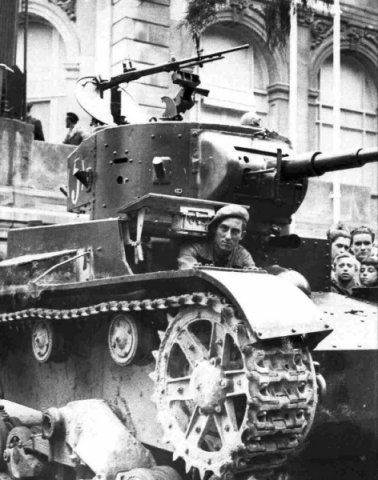 |
| T-26 Model 1933 -------------------------------------------------------------------------------- GENERAL DATA Formal Designation T-26 Model 1933 (sometimes T-26B) Manufacturer(s) Bolshevik Factory No.232 (in Leningrad) [later Factory No.185 Kirov Works (in Leningrad)], Factory No. 174 K.E. Voroshilov (in Omsk), Red Putilov Factory (in Leningrad) [later Factory No.100 Kirovskiy Works] Production Quantity about 5500 Production Period 1933-1936 Type Light Tank Crew 3 Length (overall) 4.8 m (15' 9") Barrel Overhang 0 Width (overall) 2.4 m (7' 10") Height (overall) 2.4 m (7' 10") Combat Weight 9400 kg (21000 lbs) Radio Equipment none -------------------------------------------------------------------------------- FIREPOWER Primary Armament 45mm Gun Model 32 Ammunition Carried 100 Traverse (degrees) Manual (360�) Elevation (degrees) -10� to +40� Traverse speed (360�) - Sight TOP Secondary Armament 2 x 7.62mm DT MG Ammunition Carried 2848 -------------------------------------------------------------------------------- MOBILITY CHARACTERISTICS Engine Make & Model GAZ T-26 Track Links 95/track Type & Displacement HO8 Track Width 26 cm (10") Horsepower (max.) 90hp@2200rpm Track Ground Contact 297 cm (117") Power/Weight Ratio 9.6 hp/t Ground Pressure 0.61 kg/cm2 (8.7 psi) Gearbox 5 forward, 1 reverse Ground Clearance 0.38 m (1' 3") Fuel Gasoline (Petrol) Turning Radius 13.0 m (42' 8") Range (on/off road) 180/120 km Gradient 32� Mileage (on/off road) 160/240 l/100km Vertical Obstacle 0.7 m (2' 4") Fuel Capacity 285 liters Fording 0.8 m (2' 7") Speed (on/off road) 30 km/h (max) Trench Crossing 1.8 m (5' 11") -------------------------------------------------------------------------------- ARMOR PROTECTION Armor Detail Front Side Rear Top/Bottom Hull 15mm@28� 15mm@90� 15mm@81� 6mm@0,8� 15mm@80�(nose) Superstructure 7mm@10�(glacis) 15mm@90� 15mm@90� 6mm@10� 15mm@90�(driver) Turret 15mm@90� 15mm@90� 15mm@90� 10mm@0,5� Mantlet 15mm@round - - - -------------------------------------------------------------------------------- References: ST, RT, RTAV, OOBTr, Russian Military Zone, George R. Bradford -------------------------------------------------------------------------------- � Copyright Ralph Zuljan 2000 Last Updated: April 05, 2000 |
| BT-5 Model 1934 -------------------------------------------------------------------------------- GENERAL DATA Formal Designation BT-5 Model 1934* Manufacturer(s) Factory No. 183 Kharkov Locomotive Works (KhPZ) Production Quantity about 1800** Production Period 1933-1935 Type Medium/Cruiser Tank Crew 3 Length overall/hull 5.5 m (18' 0') Barrel Overhang 0 Width 2.23 m (7' 4") Height 2.2 m (7' 3") Combat Weight (kg) 11500 kg (25400 lbs) Radio Equipment None/71-TK-1 *The model year provided here was not used by the Soviets but it serves to distinguish this tank from the original version of the BT-5 which used a modified BT-2 turret. *This estimate is based on an analysis of BT series production and Soviet tank production statistics. -------------------------------------------------------------------------------- FIREPOWER Primary Armament 45mm Gun M1932 Ammunition Carried 72/115* Traverse (degrees) 360� Elevation (degrees) -4� to +40� Traverse speed (360�) n.a. Sight TSMF, PT-1 Secondary Armament 1 or 2 x 7.62mm DT MG (coaxial, possibly turret) Ammunition Carried 2709 *With/without radio equipment installed. -------------------------------------------------------------------------------- MOBILITY CHARACTERISTICS Engine Make & Model M-5 Track Links 73/track Type & Displacement V12 Track Width 26 cm (10") Horsepower (max.) 400hp@2000rpm Track Ground Contact 360 cm (142") Power/Weight Ratio 34.8 hp/tonne Ground Pressure 0.61 kg/cm2 (8.7 psi) Gearbox 4 forward, 1 reverse Ground Clearance 0.35 m (1' 2") Fuel Gasoline (Petrol) Turning Radius 12.2 m (40' 0") Range on road 150(250)* km Gradient 40� Mileage on road 270(160)* l/100km Vertical Obstacle 0.75 m (2' 6") Fuel Capacity 400 l Fording 1.2 m (3' 11") Speed on road 52(72)* km/h Trench Crossing 2.0 m (6' 7") *The data refers to operation of the vehicle on tracks(wheels). -------------------------------------------------------------------------------- ARMOR PROTECTION Armor Detail Front Side Rear Top/Bottom Hull 13mm@31�(lower) 13mm@90� 13mm@90� 6-10mm@0� 13mm@70�(nose) Superstructure 13mm@28�(glacis) - - 10mm@0� 13mm@78�(driver) Turret 13mm@90� 13mm@90� 13mm@90� 10mm@0� Mantlet 13mm@round - - - -------------------------------------------------------------------------------- References: RT, ST, MM0182, MM0494, RTAV, TBTr, OOBTr, Russian Military Zone, George R. Bradford -------------------------------------------------------------------------------- � Copyright Ralph Zuljan 2000 Last Updated: March 28, 2000 |