 |
| Republican Cruisers |
|
|
| Cervera class |
 |
 |
|
|
 |
|
|
|
|
|
|
|
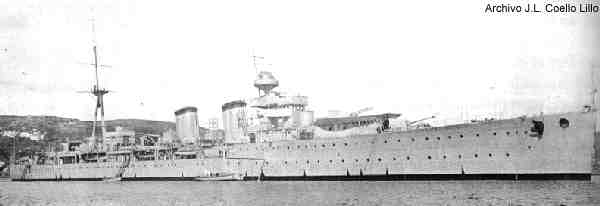
| These light cruisers were designed after the British "E" class ( Emerald and Enterprise), though differences in armament arrangement, funnels, torpedoes and other details made them considerably superior to their Royal Navy counterparts. Good ships, their main disadvantage being the main guns in opened mounts, oddly in two single and three double mounts. Handsome, fast and well armed for their displacement, at the beginning of the war they were among the most valuable assets for either navies. The three ships were built at El Ferrol and entered in service before the proclamation of the Republic. The Libertad and the Cervantes maintained their aspect during the war, but the Cervera lost the tripod mast (replaced by a pole mast) and received funnel caps. As with all the Nationalist ships, a black stripe was painted on the funnels. |
|
| Libertad (ex-Pr�ncipe Alfonso) |
|
| Laid down: 24 November 1922. Launched: 3 January 1925. Completed: 20 September 1927. Retired : 2 January 1970 |
| She was the most active and effective of the Republican ships. Flagship of the fleet during nearly all the war, she was involved in all of the most noteworthy actions. Originally she was named after the heir of the Crown (Pr�ncipe Alfonso.) At the beginning of the war the Libertad was in Ferrol, and with the Jaime I and Miguel de Cervantes she received the order to head for Cadiz. The officers were uncertain over which faction they wanted to side with. While underway the crew mutinied and took over the ships, arresting the officers. Already clearly on the side of the Republic, and following orders from the government, the fleet regrouped in Tangier. On July 20, the Libertad and several destroyers bombarded Ceuta, and on July 22, with the help of the Cervantes, Algeciras and La Linea. Eventually the International Committee ordered the Republican fleet to leave Tangier. From then on they would be homported in Malaga, and they would maintain the blockade of the strait. On August 5, the Nationalists succeded in forcing a convoy trough the strait. On August 7, the Jaime I and Libertad bombarded Algeciras and Cadiz. Near the end of August, the Libertad took part in the unsuccessful attempt at seizing Mallorca. On September 26, together with the Cervantes, Jaime I and five destroyers, the cruiser crossed the strait of Gibraltar heading North to help the isolated Republican-held territories in northern Spain. The strategic mistake was to have significant consequences. On September 29 , the Nationalist cruisers swept across the destroyers guarding the strait and had them flee. From that moment on the Nationalists would move Morocco-based troops onto the peninsula without hindrance. Over the following month the Republican fleet only carried on shore bombardments in the Bay of Biscay. They were then ordered back to the Mediterranean. While underway the fleet crossed enemy cruisers Canarias and Cervera at might without being spotted. The Republican Navy was later moved to Cartagena. On 23 April 1938, the Libertad, Jaime I, M�ndez N��ez and some destroyers bombarded Malaga. On their way back to the Cartagena harbor they were met and harassed by the Nationalist cruisers. On May 20 the Republican fleet encountered the Baleares in thick fog, which escaped after trading salvos with two destroyers . On September 7, the Libertad, M�ndez N�nez and seven destroyers, while escorting a convoy off cape Cherchell again spotted the Baleares . (see Baleares). While withdrawing to Cartagena, the Republicans were attacked by Nationalist and Italian airplanes. At the beginning of March 1938, the Republicans studied a possible operation using MTB's against the enemy cruisers, which were then in port at Palma de Mallorca. Cruisers Libertad and M�ndez N�nez and destroyers Sanchez-Barc�iztegui, Almirante Antequera, Lepanto, Gravina and Lazaga would distant cover to the mission. Bad weather prevented the use of MTB's and the battle of Cape Palos would briefly ensue (see Baleares). The Libertad, was again the flagship of the Republican fleet. This time the destroyers were used aggressively and succeded in coordinating their attack and were able to sink an enemy heavy cruiser. Having expended all their torpedoes and being the weather foul, the Republicans decided to head back to Cartagena. After that victory, the Republican cruisers did not accomplish much else. The Republican area of control was again divided in two in April 1938, but their navy was able to maintain communication between zones by using submarines and destroyers. The cruisers were kept at Cartagena until March 1939, when, following the fateful events at the end of the war, they were transferred to Bizerta (Algeria). After the war, the ship was renamed Galicia. Together with the Cervantes, she would be refitted and see service until the 60's. |
|
| Miguel de Cervantes |
|
| Laid down: March 1926. Launched: 18 May 1928. Completed: 14 February 1930 Retired : 1 July 1964. |
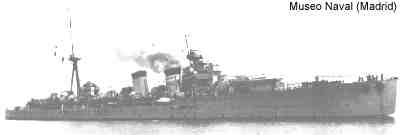 |
| She was the last in her class, her wartime activity was more limited than her sister's (the Libertad.) With the Libertad, the Cervantes was in El Ferrol at the beginning of the hostilities and during the first months they would share a common fate. On November 22, when the rest of the fleet was returning from a sortie in the Bay of Biscay, the Cervantes was hit by one or two torpedoes fired by Italian submarine Torricelli, while anchored off the port of Cartagena. Though badly damaged, the Cervantes was taken in tow and brought to the nearby harbor. In order to fit the cruiser, the small drydock in Cartagena had to be lengthened. A bomb later damaged her again, delaying the completion of the repairs until March 1938. After returning to service the Cervantes did not participate to any major operation. At the end of the war, with the rest of the Republican Navy, she fled to Bizerta. |
|
| M�ndez class |
| Displacement 4,780 tons standard, 6,045 full load Dimensions Length: 140.80 m (462') Beam: 14.02 m (46) Draft: 4.72 m (15' 6'') Machinery 4 Screws, Turbines Parsons, 12 Boilers (6- fuel and 6-coal) Yarrow 43,000 HP.= 29 knots. 5,000 miles/13 knots Armament 6x152 mm (6'') /50 cal. -4x47 mm. AA -4 machine guns AA -12 torpedo tubes 533.4 (21'') mm.(4 triple mounts) Armor V= 75-50 mm (3''-2'') H=25 mm (1'') Crew 320 |
|
|
|
|
|
|
|
|
|
|
|
| M�ndez N��ez |
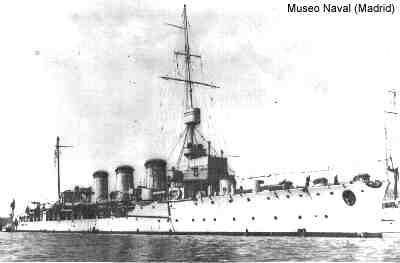
| The M�ndez N��ez had a sister ship named Blas de Lezo who accidentally sank in 1932. Both these cruisers were based on the British "C" class, but better armed. Over the entire life M�ndez N��ez maintained a mixed combustion machinery that handicapped her performance. When the war started, the M�ndez N��ez was in the Spanish colony of Guinea. After several incidents she managed to reach Cartagena. The cruiser did not participate in the campaign off the northern coast, but she was kept blockading the strait. After the return of the Republican fleet, the M�ndez N��ez followed in the footsteps of the Libertad (see Libertad and Baleares) in the more important actions, (Cherchell and Palos) but her low service speed was a serious hindrance to the Republicans. AT the end of the war she fled to Bizerta with the rest of the Republican Navy. Postwar M�ndez N��ez was converted to an antiaircraft cruiser, and was kept in service for many years. |
 |
|
| Laid down: 1915. Launched: July 1922. Completed: September 1924 Retired : 8 February 1964. |
|
|
| Libertad (ex-Pr�ncipe Alfonso) and Miguel de Cervantes (Republican Navy ), Almirante Cervera (Nationalist Navy ) |
| 7,975 tons standard, 9,240 full load |
| Length: 176.62 m (579' 6'') Beam: 16.61 m (54' 6'') Draft: 5.03 m (16' 6'') |
| 4 Screws, Turbines Parsons, 8 Boilers Yarrow 80,000 HP.= 33-34 knots. 4,950 miles/15 knots |
| 8x152 mm (6'') /50 cal (3 double mounts and 2 single mounts) -4x101.6 mm (4'') /45 cal. AA -2x47mm AA -12 torpedo tubes - 533.4 mm (21'') (4 triple mounts) |
| V=75-50 mm H=25 mm |
| 566 |
| Ships |
| Displacement |
| Dimensions |
| Machinery |
| Armament |
| Armor |
| Crew |