 |
|
| Information and images courtesy of J.A. Soler and J.C. Mimoso - http://www.geocities.com/spain_potez/ |
| Potez 54 |
| Photos |
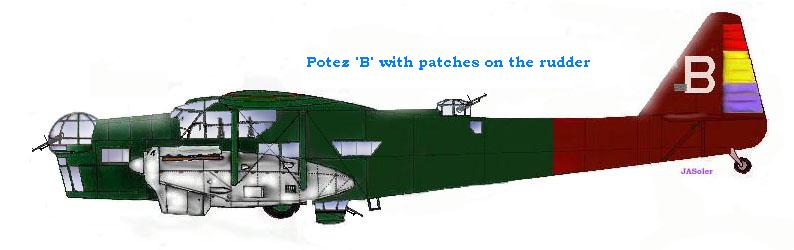
| The Escuadra Espa�a Led by Abel Guidez The Spanish ambassador in Paris, Juan Francisco de C�rdenas, pressed the Prime Minister Leon Blum for French military intervention. Because of his pacifist character, Leon Blum rejected this option, but he gave the Republicans about twenty newly-made Potez 54 bombers which hadn't yet been delivered to the French Arm�e de l'Air. In view of the protests from the right sector, the Minister of the Air, Pierre Cot, had to defend the legality of this measure and was able to do so thanks to a Spanish-French Treaty signed at the beginning of the year. At last authorization was conceded. But there was a limitation: the planes would be delivered disarmed and without any bomb-releases (essentials for a war plane!). Some weapon makers, from the main factory in Paris reached an agreement with the Spanish Embassy to appropriately equip these planes. But the material never reached its destination. It got lost during the transport due to the confusion of the Republic zone in that time. No exact reason for the confusion was ever discovered. So then, the Potez 54 bombers operated without any bomb-releases. For several weeks, the projectiles were thrown over the objective through the door plane, with the resulting lose of effectiveness. Also it was firmly demanded that none of Arm�e's military pilots in active service were to be at the disposal of the Republic. Meanwhile, the Spanish Ambassador C�rdenas, with nationalist inclinations, was replaced by Fernando de los R�os, a personal friend of Indalencio Prieto. De los R�os acted quickly and the Spanish Embassy in Paris became a recruitment center for volunteer pilots and a center for war material purchase. He entrusted Andr� Malraux (member of the World Antifascist Committee) to the administration and financial organization of the personnel recruitment service. Pierre Cot recommend to his cabinet chief, Jean Moulin, the help to the Republic, provided that decisions followed the guidelines determined by himself. According to this, the services of the Ministery of the Air licensed the avalaible military planes, including planes in production, with the intention to be sold for the construction societies. In this way they only found about twenty Potez 54, some prototypes of the Loire 46 and Spad 91/6 fighters, and a reconnaissance bimotor Br�guet BR.460 'Vultur'. The Loire 46 fighters were diverted to Spain although on paper they were purchased by the the Arabian Emirate of Hedjaz. This stratagem was afterwards used in the dispatch of two Dewoitine D.510. Given that the Lithuanian government had requested 14 Dewoitines D.372, it was agreed to exchange these planes for 14 monoplanes D.500 at the same price but not produced yet. In this way, fourteen D.372 were sold to the Republic. They also were sold the first ten D.371 produced and not delivered yet to the Arm�e de l'Air. Air France Society accepted transfer of eight old transport planes - Lat�co�re 28s. Besides of these official actions, a strong private sale of aerial material was developed, all privately and secretly Lucien Bossoultrot, a radical member for Paris. Jean Moulin provided to the embassy a list of the reservist pilots that could be volunteers. Another solution was accepting the request of non-salary licences. Malraux recruited commercial pilots that were going through a difficult time. Among them were also World War I pilots and aviators of fortune that returned from the Abyssinian, Chinese or Chaco Wars. But the first pilots recruited by Malraux were all professionals: Abel Guidez (Squad leader), Jean Darry (Guidez's assistant), V�ctor V�niel (in charge of the provisional operational command when Guidez or Darry wasn't available), Jean Labitte, Adrien Matheron, Castaneda di Campo, Fran�ois Pulain, Fran�ois Bourgeois, Gontcharov, Ivanof, Klein and Ren� Issart. Some of these men signed on for 50,000 francs monthly, payable in Spanish money, and life and accident insurance for 500,000 pesetas. At the beginning of August, The Escuadra Espa�a already had its first base in Barcelona, from where it was moved to Madrid in 16th August 1936. When it arrived, the Republic Staff disliked those well-payed and nearly independent mercenaries. So then, initially they only provided five Potez 54 (over those who Malraux painted the letters E,S,P,A,�) and some old Hispano-Nieuport 52 fighters, clearly inssuficient. Later it also received some Dewoitine fighters, armed with old 7mm Vickers machineguns over the wings (one or two bursts before the start-up system stopped). It only got a Loire 46 (with serial number 6 and French number-plate N-093). This Loire was very liked by squad's French aviators, and it was only piloted by V�niel and Guidez. But this aircraft was destroyed, together with other planes, by a bombing action of some nationalist Junkers Ju-52 at Getafe airfield in October 1936. At the end of September, the squad was provided with a fighter prototype from 'Jockey' program: the Spad 91/6 'L�ger'. It also received the only Boeing P-26 in Spain, but it was returned some days later. From the beginning, The Escuadra Espa�a was dedicated to building morale. It achieved some spectacular missions, especially the bombing of Franco's General Staff in Talavera de la Reina. The squad patroled and escorted other planes over the Sierras and engaged the enemy. Sometimes there were some special missions, for example flying to Barcelona an enemy Junkers F.13 landed by mistake in Barajas. V�ctor V�niel was the responsible to move the plane to Barcelona-El Prat airport, where there was a lack of transport. During his eventful journey, V�niel flew low to avoid the enemy planes, and he suffered the shots of republican soldiers every time he overflew a repubican post. That surprised him because Junkers F.13's shape wasn't very known. When he arrived in Barcelona a group of soldiers waited for him. Then V�niel realized that the lower surface of the Junkers hadn't been painted with the republican colors. He had flown low from Madrid to Barcelona with the enemy markings on the lower surface of his plane! The Russian chronicler Mikhail Koltsov ascribed to Guidez ten victories. That is an exaggeration, undoubtedly in response to the delirious communiqu�s of the enemy aviatiors saying they had shot down half of the Republic's aircraft in only two days. V�ctor V�niel attributed to Guidez about four or five victories, and some victories for Gouinet, Darry, Matheron and the Czech Jan Ferak. In 14th august, the pilots Darry and Gouinet (ex-official of French Arm�e de l'Air) claimed the destruction of two nationalist Br�guet 19s near Madrid. That is false, because that day the Nationalist didn't register any losses, and in that time they didn't approach Madrid, limiting their objectives to the Sierras zone. Some Ni-52 of the Spain squads were moved to Tabernas, near Almer�a. These planes were at an obvious disadvantage compared to the enemy Heinkel He-51s and Fiat CR.32s. On the 27th of October 1936, a time when Air Forces of the Rep�blic were small, three Potez 54 landed at night, piloted by Abel Guidez, Ren� Darry and V�ctor V�niel. Despite the three crews being heterogeneous and not all of them easily understanding one another, the operation was an outstanding success. The three Potez overflew Talavera airfield and calmly bombed all the barracks and visible installations. The plane piloted by Darry damaged the landing-strip. During the homeward journey, a little before entry into Republican zone, a group of enemy fighters sighted and started to pursue the Potez. When they were nearly within range, three Dewoitine D.372s of The Escuadra Espa�a came to escort them. This operation, together with the dispersal of the enemy columns in Medellin in 16th August, were the most successful actions of the squadron. General Ignacio Hidalgo de Cisneros, Leader of the Republican Airforce, expressed the following opinion about The Escuadra Espa�a: "Concerning the Air Force, the only acquisition we got during the firsts four months of the war were 12 Dewoitine fighters and 6 Potez bombers. Both the Dewoitines and the Potezes were old models and they came disarmed. These planes I could move from France to Spain by surprise. But when our 'friend' Leon Blum, leader of the French Government, found out, he made a great fuss and he ordered a special and strict vigilance in the frontier. The result was that the French authorities confiscated the arms of these aircrafts, because they was sent by land. In that time it was essential that we arm these planes, but despite the many times we attempted it, Mr. Blum didn't give the arms back. Three years passed, we lost the war and that armament was still in the French hands. Together with these planes came 12 or 14 French pilots, led by the writer Andr� Malraux. I can't say Malraux wasn't a progressive man in his own way. They possibly came to our country with the good intentions to help the Republican soldiers, maybe dreaming to act in Spain as Lord Byron did in Greece. However Malraux, who's personality as a writer could have been useful, lost his identity attempting to lead a squadron. Because he had never seen a plane, he hadn't any idea about the Air Force. He didn't realize that it isn't possible to play at being pilot without being one of them, and still less in a war. As for the airmen arrived with Malraux, I am sorry for disillusioning the many French that considered them a kind of romantic and freedom-loving heroes which participation in favour of the Republican people could redeem partially the dirty tricks commited by the French governors against the Spanish Republic during our war. Except for three or four real anti-fascist men that came to Spain for an ideal and they fought heroically, the rest were adventurers that didn't care about our fight. They were real mercenaries, attracted for the high salary (50,000 francs monthly in that time). During their stay in our country they never did anything useful, but they caused us many headaches. Malraux, as he didn't know a word about aviation, had to be in their hands. It is easy to understand the dirty tricks they could do without a leader able to control them. They were more a problem than a help for us. I tried to discharged them several times but the Government was opposed because of the unfavourable impression it might produce in France - the expulsion of these slacker and villainous people from Spain. An untrue propaganda had turned them into "heroic defenders of the freedom". Finally, I want to say that the representative of the French people wasn't Malraux and his airmen." The end of the Escuadra Espa�a The Escuadra Espa�a got to have 300 men, both pilots and other staff, and about 50 planes. But from the arrival of the Soviet Forces in October, the The Escuadra Espa�a lost a lot of his significance. The small human resources and material, damaged by the fight and the german bombing, didn't allow it to achieve effective actions. It also suffered serious disciplinary incidents. In November 1936 these incidents forced Malraux to dispense with the mercenary aviators. Except Jean Darry, they were all discharged, and those who wanted it were transfered to the republican aviation with the same conditions and salary. In this way, The Escuadra Espa�a rested almost without pilots and it tried to find vounteers at International Brigades. The squad moved to Alcantarilla and it even took part in Malaga battle. The Escuadra Espa�a was dissolved in February 1937. |
 |
|
|
|