 |
| Nationalist Cruisers |
|
|
| Canarias class |
 |
|
|
|
|
|
|
|
 |
|
|
| Ships |
| Displacement |
| Dimensions |
| Machinery |
| Armament |
| Armor |
| Crew |
| Canarias, Baleares (Nationalist Navy ) |
| 10,000 tons standard, 13,200 full load |
| Length: 193.90 m (636'') Beam: 19.50 m (64') Draft: 6.50 m (21' 4'') |
| 4 Screws, Parsons Turbines , 8 Yarrow Boilers 90,000 HP.= 33 knots. 8,000 miles/15knots |
| 1,200 |
| V=100-50 mm (4''-2'') H=75-25 mm (3''-1'') Turrets= 25 mm (1'') Bulges |
| 8x203 mm (8'') /50 cal. -8x120 mm (4.7'') /45 cal. AA;Canarias: -4x40 mm AA -4x20 mm AA;Baleares: -4x100 mm AA -4x20 mm AA |
|
|
|
|
|
|
|
|
|
|
|
| Ships |
| Displacement |
| Dimensions |
| Machinery |
| Armament |
| Armor |
| Crew |
| Libertad (ex-Pr�ncipe Alfonso) and Miguel de Cervantes (Republican Navy ), Almirante Cervera (Nationalist Navy ) |
| 7,975 tons standard, 9,240 full load |
| Length: 176.62 m (579' 6'') Beam: 16.61 m (54' 6'') Draft: 5.03 m (16' 6'') |
| 4 Screws, Turbines Parsons, 8 Boilers Yarrow 80,000 HP.= 33-34 knots. 4,950 miles/15 knots |
| 566 |
| V=75-50 mm H=25 mm |
| 8x152 mm (6'') /50 cal (3 double mounts and 2 single mounts) -4x101.6 mm (4'') /45 cal. AA -2x47mm AA -12 torpedo tubes - 533.4 mm (21'') (4 triple mounts) |
|
|
|
|
|
|
|
|
|
|
|
| Ships |
| Displacement |
| Dimensions |
| Machinery |
| Armament |
| Armor |
| Crew |
| Navarra (ex-Republica, ex-Reina Victoria Eugenia) (Nationalist Navy ) |
| 4,857 tons standard, 6,500 full load |
| Length: 140.82 m (462') Beam: 15.22 m (50') Draft: 5.59 m (18' 4'') |
| 2 Screws, Turbines Parsons, 8 Boilers (4-fuel, 4-coal) Yarrow 25,000 HP.= 25 knots. 4,000 miles/15 knots |
| 350 (?) |
| V= 75-50 mm (3''-2'') H=75 mm (3'') |
| 6x152mm (6'') /50 cal. -4x88mm (3.5'') /45 cal. AA |
| The heavy cruisers of the Canarias Class were designed by M.Watts after the British County class, whose general hull lines and main armament can be observed on the Spanish cruisers. The three funnels of the County cruisers were reduced to two and trunked into a single odd-looking uptake. The superstructures was also different, more modern and compact. Horizontal protection was similar to that of their British cousins, but vertical protection was increased. Torpedo bulges were boosted. The machinery was also enhanced in order to reach 33 effective knots. As with the Counties, these cruisers were good seakeepers. The antiaircraft armament consisted in eight 120 mm guns and smaller AA that changed during the war. They were designed to feature 12 fixed torpedo tubes and a catapult but none of these was ever fitted. The Baleares entered service with only three (two according to some other sources) of their 203 mm turrets. They were rushed to commission and would be completed during the war. Their construction began in 1928, political troubles delayed their completion and as of July 1936 they were still fitting at El Ferrol. They therefore fell in the hands of the Nationalists. Their speed and armament were to become among the most valuable Nationalist assets in the conflict. |
|
|
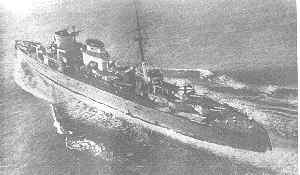
| Canarias |
| Laid down: 15 August 1928. Launched: 28 May 1931. Completed: September 1936. Retired : December 1975 |
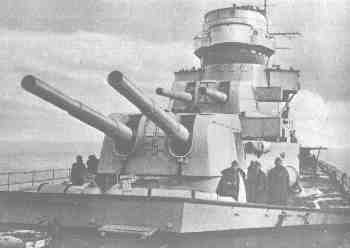 |
| The most famous and active of the ships of the Spanish Civil War entered in service in September 1936, with 102 mm guns instead of the 120 mm AA guns, and a director for land guns. As the ship was quickly commissioned and her crew (for the most part made up of young volunteers) mostly untrained, the Canarias was not used in the Bay of Biscay against the Republican fleet. The Canarias was instead sent with Almirante Cervera to the strait of Gibraltar after the bulk of the Republican fleet headed North. On 29 September, the cruisers spotted two Republican destroyers blocking the strait (Almirante Ferr�ndiz and Gravina). The Canarias opened fire against the Ferr�ndiz at 20000 mt. and scored a fatal hit with the third salvo, sinking the destroyer in a few minutes. The Gravina could manage to escape unscathed to Casablanca. In only a handful of minutes the Nationalists were able to wrest the control of the strait from the Republicans. Moving the Republican fleet to the Bay of Biscay turned out to be a major strategic mistake. In the following months (almost always with the Cervera) she alternated operations in the Bay of Biscay with those in the Mediterranean sea, bombarding the Catalan coast, and supporting the seize of Malaga. In October, the cruisers attempted to intercept the Republican fleet returning to the Mediterranean: the two squadrons crossed their paths at night without founding each other. On 12 December, Canarias sank the Soviet cargo ship Konsomol off Oran. The sinking spurred an international incident, and since then the Soviets would be much less willing to sacrifice their merchant ships to support the Republicans. In February 1937 the Canarias collided with a Greek freighter and she had to be repaired in Cadiz. Baleares then joined her and both cruisers were transferred to their new homeport in Mallorca. In March, she fought in the Bay of Biscay seizing several cargo ships. On April 25, Canarias and Baleares, after bombarding Malaga, entered the harbor of Cartagena and harassed the Republican fleet. After a short skirmish without consequences on either side, the Nationalist cruisers left before enemy shore guns (380 mm-15'') were able to join the fray. They then attempted to intercept the Jaime I which had run aground the previous day but could find shelter in time at Almeria. The Canarias, with the others cruisers, escorted convoys coming from Italy. The night of 23 September, somewhere off Calella (Menorca) the cruiser seized two transports bound for the island, after the three escorting destroyers had fled. In October 1937, after the fall of the northern front, the Nationalist fleet operated in the Mediterranean sea. In January 1938 the Canarias bombarded Barcelona, and in February the Nationalist cruisers bombarded various ports on the Republican controlled coast besides escorting several convoys. On 6 March 1938 the Baleares was sunk while on escort duty. The Canarias, astern in the line formation, took command and proceeded with her escort duty, leaving sailors from the unfortunate ship in the water. They were rescued by British destroyers and when Canarias and Cervera returned after the mission to recover the Nationalist sailors, they were met by a Republican air raid that fortunately didn't score any hit. The Republican Navy wasn't able to take advantage their victory, and cruisers Canarias, Cervera and Navarra, continued with their relentless job of blockading, escorting and bombarding. On 27 August, the Canarias intercepted enemy destroyer Jos� Luis D�ez sorting from Le Havre and bound for Cartagena. The Canarias was able to cripple the destroyer with a single hit but the hapless Jos� Luis D�ez could escape to Gibraltar. Until the end of the war, the only action worth of notice is the blockade of Cartagena in the last days of the war. After the war the Canarias underwent various modifications until she was withdrawn from service in 1975. |
 |
|
|
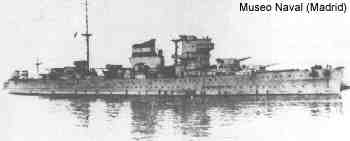
| Baleares |
| Laid down: 15 August 1928. Launched: 20 April 1932. Completed: 28 December 1936. Sunk: 6 March 1938 |
 |
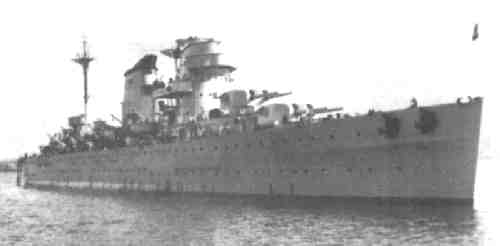 |
| Like her sister, at the beginning of the war the Baleares was laid up at El Ferrol . She entered in service, still unfinished, in December 1936. The Baleares did not carry the fourth turret until the summer of 1937. She accompanied the Canarias in the first missions at the beginning of 1937, but she operated almost always alone thereafter. At dawn on May 20, while escorting a tanker in fog, she crossed the bulk of the Republican fleet, (two cruisers and six destroyers) but was only able to spot the first two ships in the line and exchanged fire with them without consequences on either side. On 12 July, off Valencia the cruiser found six Republican destroyers escorting two ships. She scare them off with gunfire but the freighters could escape. In the morning of 7 September, alone again, the Baleares found a convoy of four westbound freighters, escorted by the Libertad, the M�ndez N�nez and seven destroyers off cape Cherchell (Algeria). Though in an unfavorable position, between land and the enemy force, the Nationalist cruiser engaged the two opposing cruisers while Republican destroyers would stay with the convoy.. Despite fire from the Baleares was far from accurate, she managed to score a hit on the Libertad, but received was in turn two shells from the enemy cruiser and one of them started a dangerous fire in the 120 mm magazine. While the other cruiser M�ndez N�nez was out of Baleares' range, the Libertad broke off the engagement and turned toward the convoy. The Baleares then started to shadow the enemy fleet. In the afternoon, after repeatedly losing contact, the Baleares was able to find the Republican cruisers again and another inconclusive skirmish started. She eventually broke off the contact and waited for the Canarias, steaming from Ceuta, to resume the chase. But the two Nationalist cruisers could no longer find the convoy that meanwhile had entered the port of Cherchell. Neither were they able to spot the enemy warships, enroute to Cartagena. Despite the damage the lonely Baleares could prevent the enemy convoy from reaching their destination in the Spanish Republic. In the following months she continued to team with the Canarias in nearly all her missions. The night between 5 and 6 March 1938, the three Nationalist cruisers were escorting two freighters, seemingly a routine operation (admiral Moreno the squadron commander, had just given the fleet to his subordinate admiral Vierna) met with a degree of overconfidence. The Republican admiral Ubieta had prepared a raid of MTBs against the cruisers in Palma de Mallorca with the distant support of the Republican fleet. The MTBs operation was cancelled due to the bad weather, but Ubieta decided to stay at sea. Thus the two forces were on a collision course, without either knowing one of the other, toward Cape Palos . At 00.36, almost at the same time, the cruisers Libertad and M�ndez N��ez and the five accompanying destroyers sighted the three Nationalist cruisers at 2,000 meters, but only one of the destroyers could manage to fire torpedoes before losing contact. The two forces made several course changes and at 02.00 the Baleares found the enemy squadron again and opened at some 2000 meters. But this time admiral Vierna made the mistake of firing star shells on the horizon, giving away his position to the enemy. Now the Republicans had time to respond: the Baleares was hit by gunfire from the Libertad and almost simultaneously by one or two torpedoes (probably from the Lepanto) that wrecked the ship and blew up the forward magazine and the bridge. The ship stopped dead on fire from bow to stern, quickly developing a list. The Canarias, right behind the Baleares, dodged the hulk, and guided the Cervera outside enemy range. The Republicans didn't pursue and left the area. Canarias and Cervera escorted the convoy until safely homed, then returned to rescue the survivors. Royal Navy destroyers joined in the operation but 700 men had already followed the cruiser to the bottom of the sea. As the destroyers purchased from Italy were aging and slow, the Nationalists Command could only use only their cruisers, despite the huge risks involved in engaging enemy destroyers and torpedo boats, especially at night. Four years later US and Australian cruisers off Guadalcanal would learn a lesson the hard way. |
| Cervera class |
|
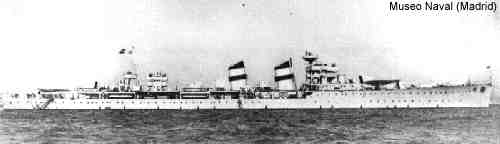
| These light cruisers were designed after the British "E" class ( Emerald and Enterprise), though differences in armament arrangement, funnels, torpedoes and other details made them considerably superior to their Royal Navy counterparts. Good ships, their main disadvantage being the main guns in opened mounts, oddly in two single and three double mounts. Handsome, fast and well armed for their displacement, at the beginning of the war they were among the most valuable assets for either navies. The three ships were built at El Ferrol and entered in service before the proclamation of the Republic. The Libertad and the Cervantes maintained their aspect during the war, but the Cervera lost the tripod mast (replaced by a pole mast) and received funnel caps. As with all the Nationalist ships, a black stripe was painted on the funnels. |
|
|
| Almirante Cervera |
| Laid down: 14 April 1923. Launched: 16 October 1925. Completed: 15 September 1928 Retired : 31 August 1965 |
 |
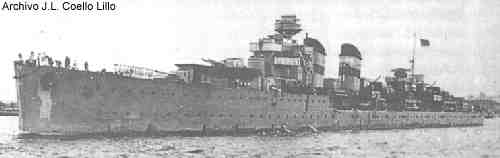 |
| When the war began, the Cervera was in dry-dock at El Ferrol, and fell in the hands of the Nationalists. On July 26, the cruiser departed to Gijon to support to the isolated Nationalist garrison. Over the following months, accompanied by battleship Espa�a and destroyer Velasco (the only one that sided with the Nationalists at the outbreak of the war) bombarded and attempted to blockade the Republican-controlled coast in the North. When the Republicans sent theirs ships to the North, the Cervera and Canarias forced the blockade of the strait. From then on, her destiny was to follow the path of Canarias and Baleares (see both). On 22 February 1938, Cervera was hit by Republican bombers and badly damaged. She was not to undergo an extensive refit like her sister and was kept in service with the Spanish Navy up until the 60's. |
|
| Navarra class |
|
|
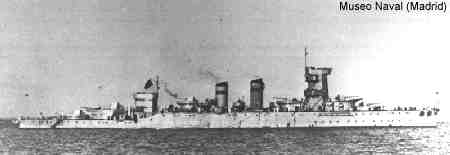
| Navarra (ex-Rep�blica, ex-Reina Victoria Eugenia) |
| Laid down: 31 march 1915. Launched: 21 1920 April. Completed: 6 July 1922 Retired : 3 December 1955. |
 |
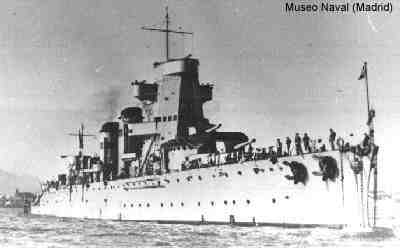 |
| Her first name was Reina Victoria Eugenia (the English Princess, King Alfonso XIII's wife). In 1931 the Republican Government renamed her Rep�blica (Republic). She resembled a 1913 Birmingham . When this cruiser entered service she was a already an obsolete ship, mostly because of her low speed. In 1936 she was moored out of service at Cadiz. Plagued by a serious lack of ships, the Nationalist Navy decided to tow her to El Ferrol in 1937 for an extensive refit. Modifications involved the reduction of funnels from three to two, a change in the arrangement of three guns, a new bridge, new AA and the replacement of her twelve aging boilers with eight of a newer type. In June 1938 the cruiser reappeared with a totally different aspect and with a new name: Navarra. The Navarra was to replace the sunken Baleares, but the low speed did not allow to keep pace with Canarias and Almirante Cervera. She was used in blockading the enemy coast over the last months of the war. Postwar the Spanish Navy hardly used her anymore due to the ship's obsolescence. |
|
|