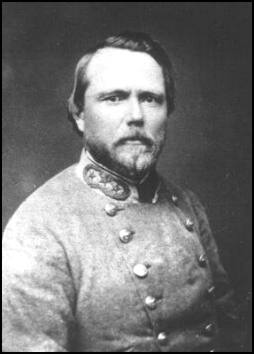
Brigadier-General Samuel McGowan was
born of Scotch-Irish parentage in Laurens county, October 19, 1819, and was
graduated at the South Carolina college in 1841. He embarked in the practice
of law at Abbeville, but answered the call of his country in 1846 and started
for the Mexican war as a private in the Palmetto regiment. He was soon appointed
to the general quartermaster's staff, with the rank of captain, in which
capacity he served during the war, first on the staff of General Quitman
and afterward with Generals Worth and Twiggs. As volunteer aide to General
Quitman at the storming of Chapultepec and the capture of Garita de Belen
he was distinguished for gallantry. On his return to South Carolina he continued
with much success the practice of his profession, and sat twelve years in
the lower house of the State legislature; but also retained his connection
with military matters, becoming major-general in the State militia. Upon
the secession of South Carolina he was commissioned brigadier-general in
the State army and assigned to command of one of the four brigades first
formed, and in that capacity assisted General Beauregard during the reduction
of Fort Sumter. Upon the transfer of the troops to the Confederate service
he joined General Bonham in Virginia, and served as a volunteer aide at the
battles of Blackburn Ford and First Manassas. Then returning to South Carolina
he was elected lieutenant-colonel of the Fourteenth regiment, and in the
spring of 1862, while in service on the coast, was promoted colonel. Soon
afterward, with Gregg's brigade, he began a distinguished career in the army
of Northern Virginia. He was wounded at Cold Harbor, where he led his regiment
in several daring charges; retrieved the ground lost by another brigade at
Frayser's Farm, and continued on duty in spite of his injury until after
Malvern Hill. For his gallantry in these battles he was recommended by General
Gregg for promotion. After fighting at Cedar Run he was wounded at Second
Manassas, and for some time disabled, but he rejoined his regiment after
the battle of Sharpsburg and commanded it at Fredericksburg. There General
Gregg was killed, and in January, 1863, Colonel McGowan was promoted brigadier-general
and became Gregg's successor in command of the gallant brigade. In this capacity
he served until the end of the war, receiving several wounds, the most severe
of which befell him at Chancellorsville and during the fight at the bloody
angle at Spottsylvania Court House. After the surrender at Appomattox he
returned to his home and resumed the profession from which he had been twice
diverted by war. He was elected to Congress in 1865, but was not permitted
to take his seat; made a thorough canvass of the State as an elector-at-large
on the Democratic presidential ticket in 1876; in 1878 was elected to the
legislature, and in 1879 was elected associate justice of the supreme court.
In the latter office he won lasting honor and distinction as he had upon
the field. of battle. His death occurred in December, 1893.
Confederate Military History Vol. 5,
pg. 412
|