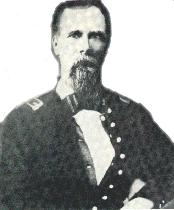
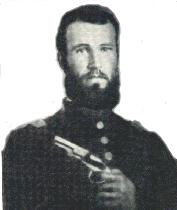
At the first battle of Manassas this company, led by Captain McAllister, captured near the famous "Henry House" 2 guns of Rickett's Battery and recaptured one of the guns of Imboden's Battery, which had been captured by the Federals earlier in the day; and also captured Captain Rickett and the battle flag of the First Michigan Regiment and quite a large number of prisoners. The three guns were turned on the enemy and contributed largely to the final rout of the enemy at and near the Henry House. An incident worthy of mention here is the fact that Major General (then colonel), Robert McAllister, of the 1st New Jersey Regiment, a brother of Captain Thompson McAllister, with his own and the 2nd New Jersey Regiment, formed these two regiments into a hollow square immediately across the public road from the Henry House, and in the direct front of Captain McAllister's company and these captured guns, to attempt to check the rout of the Federals, then becoming general, when the company, with the aid of these guns and the help of other fragmentary commands, by well directed aim, dislodged this hollow square and sent those two magnificent New Jersey regiments hurriedly to the rear, along with other Federal troops in their front, persued them across the stone bridge and thence until ordered to desist.
Of the original eighty-two men enrolled in this company, it seems remarkable that, after the lapse of nearly forty-four years, there are still living twenty-eight, as follows: Captain John C. Carpenter, Lieutenants George B. McKendree, William T. Lambie, Samuel S. Carpenter and Charles O. Jordan. Non-commissioned officers and privates: James T. Baker Jr., Joseph M. Boswell, George T. Boyd, Littleton T. Dickey, Clarence A. Fonerdon, Wm. C. Fudge, Jos. T. Fudge, James Grady, James Glenn, James W. Hammond, Peter Jones, Charles Lafferty, John W. Matheny, James R. Montague, William Moran, William M. McAllister, Virginius B. Otey, William D. W. Pitzer, Henry B. Ray, Jas. M. Rose, Jas. A. Rogers, Thomas W. Rosser and John S. Sawyers. Of these survivors, Captain John C. Carpenter, John W. Matheny and John S. Sawyers each lost an arm and Lt. W. T. Lambie lost an eye in battle, whilst nearly every other survivor more or less severely, at least once, and many of them several times in one battle. (This article originally written in 1905.)
Most of these survivors have proven, in civil as well as in military life, their true and unfaltering heroism and patriotism, for they have made reputations for themselves and are self supporting and successful in their respective callings and occupations since the war as they were brave and unfaltering in every duty during those trying times from 1861 to 1865, the time that "tried men's souls." |