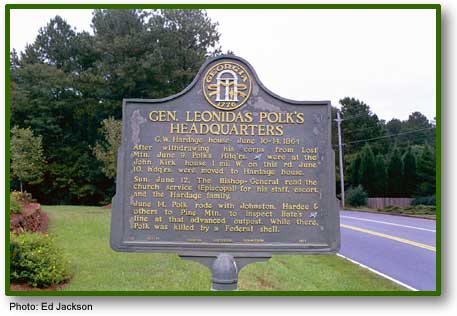
Gen. Leonidas Polk's Headquarters State Historical Marker Located on Burnt Hickory Rd. one mile west of Carnes Rd. in Cobb County, Ga.
(Text) GEN. LEONIDAS POLK'S HEADQUARTERS G.W. Hardage house; June 10-14, 1864 After withdrawing his corps from Lost Mtn. June 9, Polk's H'dq'rs. [Confed.] were at the John Kirk house 1 mi. W. on this rd. June 10, h'dq'rs. were moved to Hardage house. Sun. June 12. The Bishop-General read the church service (Episcopal) for his staff, escort, and the Hardage family. June 14. Polk rode with Johnston, Hardee & others to Pine Mtn. to inspect Bate's [Confed.] line at that advanced outpost. While there, Polk was killed by a Federal shell.
Burial: Christ Church Episcopal Cathedral. New Orleans, La. Orleans Parish
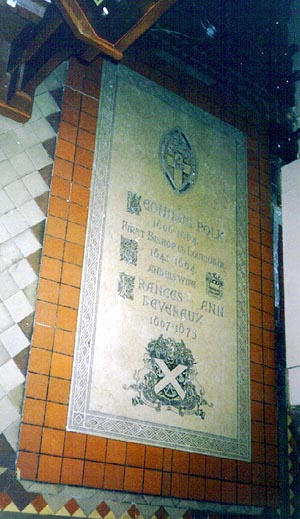
Polk's Tomb
Time line of Events
- 1806 April 10 He is born in Raleigh, North Carolina.
- 1821 Attends the University of North Carolina.
- 1823 He earns an appointment to West Point and becomes a leader in the cadet corp.
- 1827 Graduates from West Point eighth in a class of 38. He is commissioned a Second Lieutenant of Artillery.
- 1827 December 1 He resigns his commission soon after graduation.
- 1831 Attends Virginia Theological Seminary and is ordained at 24 as an Episcopal minister. As a minister in Louisiana and Mississippi in the 1830s he travels by boat, mail coach, horseback spreading the word of God.
- 1838 He is named missionary bishop of the Southwest and the next year he held the first religious service in Shreveport.
- 1841 He becomes the first Episcopal bishop of Louisiana
- 1842-1854 Operates Leighton Plantation near Thibodaux
- 1855 He is the rector of the Trinity Church in New Orleans from 1855 to 1860
- 1860 He resigns to devote more time to the founding of the University of the South in Sewanee, Tennessee
- 1861 June 25 Appointed a Major General in the Confederate Army and assumes command of Department No. 2 at Columbus, Ky. He accepts his commission in the new army as his duty to God. He has severed his relationship with the Protestant Episcopal Church of the United States and discontinues prayers to the president of the U. S. He will be known as the Battling Bishop.
- 1861 September 15 Reassigned as commander of the first Division of the Department.
- 1862April 6-7 Battle of Shiloh in Tennessee, commands the I Corps, Army of the Mississippi.
- 1862 September Leads a corp of the Army of Tennessee undert General Braxton Bragg.
- 1862 October 10 Promoted to Lieutenant General after being cited for gallantry at the Battle of Perryville Kentucky.
- 1863 October 23 Commander of the Army of Mississippi
- 1863 December 23 Commander of the Department of Alabama, Mississippi and East Louisiana
- 1864 June 14 Killed by Union artillery at Pine Mountain, Georgia.
- 1864 June 29 after funeral in atlanta , his body was escorted to Augusta and buried at St. Paul's church.
- 1945 May 2 his body was removed to New Orleans and re-interred in Christ Church cathedral.
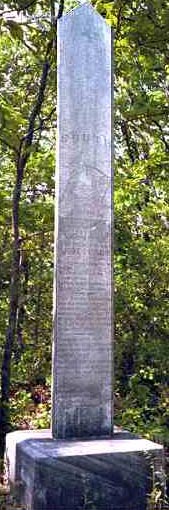
Polk Monument on Pine Mountain, Ga
This obelisk is in memory of Lt. General Leonidas Polk. On the front in large letters is inscribed: "SOUTH". There is a battle flag below that and the date 1861-1865. "He fell on this spot June 14, 1864. Gen. Leonidas Polk folded his arms across his breast as he stood gazing on the scenes below, turning himself around as if to take a farewell view. Thus standing a cannon shaft from the enemy�s gun crashed through his breast and opened a wide door, through which his spirit took its flight to join his comrades on the other shore. Surely the earth never opened her arms to allow the head of a braver man to rest upon her bosom. Surely the light never pushed the darkness back to make bright the road that leads to the Lamb. And surely the gates of heaven never opened wider to allow a more manly spirit to enter therein." Erected by J.Gid and Mary J. Morris, 1902. On the back it reads: "North". Under that it reads:" Veni, Vidi,Vici. "I Came, I Saw, I Conquered" , the boast of Julius Caesar. Under that was added " with Five to One."