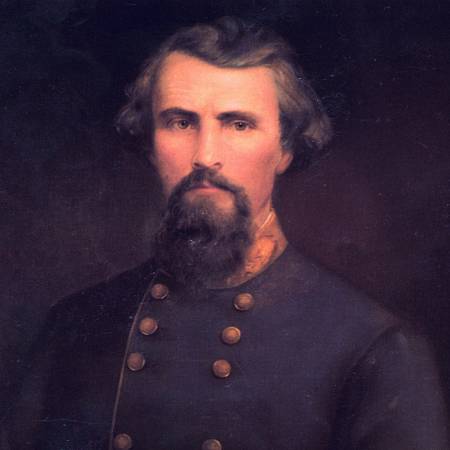
| General Nathan Bedford Forrest will be the program of the next meeting of Captain James W. Bryan Camp 1390 at 7 p.m. Tuesday, Nov. 12, at Meemaw's Kitchen, 504 N. Beglis Parkway in Sulphur. Compatriot Gordon Gold, a native of Memphis, Tennessee and whose Confederate ancestor served under Forrest, will present the program. Also at the November meeting we will elect officers for 2003. Please make every effort to attend this most important and informative meeting. |
Please attend if possible. If you would like to play a more active role in the future of the Bryan Camp then here are the requirements:
1: uphold the "Charge"
2: uphold the duties of the office elected to
Members of the Bryan Camp and Semmes Battery will be participating in the First Annual Fall Fest at Sam Houston State Park the first weekend of November. We will have a Confederate encampment set up on the river bank.
Many members of the Bryan and Cooper Camps will be present all weekend "guarding" the river. all re-enactors are encouraged to attend and all non reenacting members are urged to attend and support our Camp members as we preserve the memory of our ancestors.
In the event it is not the will of the Bryan Camp to reelect me as it's Commander, I would like to take this opportunity to thank you all for allowing me to serve you. I would also like to thank you all for being members of this Camp and caring about your ancestors in a world full of people who don't. You are an elite group of individuals. Our ancestors are proud of you just for being members.
God bless you all,
God Bless the South and Her people,
Terrance Lee cmdr
Elective offices include:
Commander
First Lieutenant Commander
Second Lieutenant Commander
Adjutant
Please consider running for the office of your choice and help make Captain James W. Bryan Camp the best in the entire confederation.
Activities will include craft booths, demonstrating artists, Cajun cuisine, live music and a War for Southern Independence Soldier Encampment.
The hours will be 10 a.m. until 7 p.m. Saturday, and Sunday, Noon until 6 p.m.
There will also be kid's corner, canoe tours and hikes.
The regular park admission fee is $2 per vehicle with up to four passengers, plus 50 cents per each additional person.
The Civil War Soldier Encampment will include cannon and musket firing in between sets of music, a park spokesman said.
Terrance L. Lee, commander of Semmes Battery First Confederate Light Artillery, will be coordinating the firing demonstrations.
For more information call Sam Houston Jones State Park at 855-2665.
BATON ROUGE, La. (AP) - The Confederate Museum, which is facing eviction, got another leader in its battle to keep its downtown New Orleans home: Gov. Mike Foster.
Foster pledged Thursday to fight for the museum to stay in its current location at Confederate Memorial Hall. The governor said he's got his staff fighting for the museum and "heads will roll" if the museum is booted.
"If it's somebody that I can get to through my job that is responsible for doing that, there'll be a head roll. I've sent that message through my staff," Foster said on his weekly live radio show.
Foster said he believes the museum will be allowed to stay put - if he has any pull in the situation.
"I said, 'Look and find a way to leave these people alone.' I mean it, and I think I can make it stick," the governor said.
The red-brick building that is home to the Confederate Museum houses about 5,000 artifacts, including Gen. P.G.T. Beauregard's uniforms, a crown of thorns given to imprisoned Confederate President Jefferson Davis by Pope Pius IX and one of four original, hand-woven Confederate banners.
In July, a judge ruled that the University of New Orleans owns Memorial Hall. The university intends to evict the Confederate Museum to make way for the new Ogden Museum of Southern Art.
The Confederate Museum filed an appeal with the state 4th Circuit Court of Appeal to overturn the ruling. The appeals court hasn't ruled on the request.
(Editor's Note: If you'd like to thank Gov. Foster for his efforts on behalf of the Confederate Museum you may write him at: Governor Murphy J. "Mike" Foster, P.O. Box 94004m Baton Rouge, LA 70804-9004)
Reenactors are supplied with generous amounts of hay, firewood and water. There is always a Saturday evening meal provided and usually a Camp Dance is the order of the day. Scripted battles are fought on Saturday and Sunday.
The camping and battle are done on sacred ground....the battle being fought on what was the Parade Ground and parts of Camp Tracy. In addition, we always have some type of memorial service to honor those men who came through Camp Moore. Registration is very simple and may be done by email.
The contact for the reenactment is: Dennis Neal
The public is especially welcome to attend this event. There is only a nominal entry charge. Sutlers will be on site as well as food vendors.
Come on out, we enjoy your company! Take a step back into time.....wear the wool, sing the songs, rush out to put on the equipment and grab your musket as the drummer beats the "long roll".....double quick into line at right shoulder shift.....infantry massing on your front! The captain yells to "LOAD!"........"PREPARE TO FIRE BY COMPANY!" .........."READY!" .........."AIM!" .........FIRE!" .........It is as close as you'll ever get!
The recent rebroadcast of Ken Burns' documentary "The Civil War" on PBS once again slandered the South in many subtle ways. The series would better be named "The Biased New England Version of the So-Called Civil War."
The whole documentary is biased, slanted and directed to perpetuate wartime Northern propaganda as history, which it isn't. Beginning with the name of the series, "The Civil War," the "history" presented is unquestioning drivel meant to slam anything and everything Southern.
Of course the term "Civil War" is the very first subtle bias. To be a civil war, the conflict would have had to have been a fight between two factions over control of the central government. That, it most certainly was not! The people of the Southern States were simply exercising their God-given human right, as outlined in the Declaration of Independence, to govern themselves in the same voluntary association created in 1776. What the Lincolnite leftist revolutionaries did was violently transform the very nature of the original union of states from a voluntary association of sovereign, independent states, as the Founding Father's intended, to an involuntary union of captive, exploited states. But you don't get the truth in the Burns' propaganda piece.
Next, Burns' perpetuates the distortion and gross misrepresentation the South was fighting solely to preserve slavery. Hogwash! While he ignores the words of top leaders such as President Jefferson Davis and General Robert E. Lee that the cause of the South was State Sovereignty, the Northern propagandist dwells "ad nauseum" on slavery as the sole cause of the war. He ignores the powerful economic and political issues that drove the South to seek Independence.
No one should be fooled by the pleasing music and pretty pictures of Ken Burns' "The Civil War." It is a slap at the South and meant to poison the minds of present day Americans against the noble cause Southern Independence.
Mike Jones, editor
"This bill is a tremendous step forward for battlefield preservation," remarked CWPT President James Lighthizer. "The bill will allow nonprofit groups to save thousands of acres of battlefield land that would have otherwise succumbed to the bulldozer's blade.
The Civil War Battlefield Preservation Act officially authorizes a matching grant program funded by Congress in the fiscal 1999 and 2002 Interior Appropriations bills. Since its creation, the program has helped protect nearly 8,000 acres of historic battlefield land in 12 states, including key parcels at Antietam in Maryland; Champion Hill in Mississippi; Malvern Hill and Manassas in Virginia; and Harpers Ferry, West Virginia.
The bill was introduced by California Congressman Gary G. Miller (R) and cosponsored by a bipartisan group of ten House members. In his remarks from the House floor, Miller noted the educational benefits of protecting battlefield land, stating: "I believe by preserving history we teach future generations not only where we are from, but also what we are about, and where we are heading. These battlefields are living classrooms to remind future generations of our national history."
The Civil War Battlefield Preservation Act formally establishes a program that targets priority War for Southern Independence battlefields outside National Park Service (NPS) boundaries. Grants from the program are competitively awarded by the American Battlefield Protection Program (an arm of NPS). By requiring matching funds, the program gets both the public and private sector actively involved in saving battlefield land. A similar bill (S. 2968) introduced by Sens. Paul Sarbanes (D-Md.), James Jeffords (I-Vt.) and Jeff Sessions (R-Ala.) is currently pending in the Senate.
With 42,000 members, CWPT is the largest nonprofit battlefield preservation organization in the United States. Its mission is to preserve our nation's endangered Civil War battlefields and to promote appreciation of these hallowed grounds.
A formal opening ceremony was held Oct. 19.
Camp Ford was built in the spring of 1862 as a training camp for Confederate soldiers. The present day location is in Smith County, Texas, along US Highway 271. The camp existed from about July 1863 until May 1864 and held about 5,500 prisoners, literature states.
Activity at the camp lessened about six months later, and in July 1863, the first Union prisoners were brought in, said Randy Gilbert, president of the Smith County Historical Society, which worked with Smith County to acquire the land where Camp Ford once stood.
Camp Ford now features a historical walking trail and interpretive exhibits organized by the Smith County Historical Society. Defining the boundaries of the Camp Ford site was a part of the archeological work done by Texas A&M University, Gilbert told the Tyler (TX) Morning Telegraph.
At one point they had a stroke of luck when the Historical Society received a lithograph of Camp Ford from a woman related to its creator, James McClain, drummer of the 120th Ohio, who was captured May 3, 1864. He was also in the final group of prisoners to leave Camp Ford when it closed.
The Historical Society has used the lithograph to help confirm the exact location of Camp Ford's walls and cabins.
After being awarded the grant, work included "a lot of clearing, building a visitors entrance, parking lot and historical trail, for people to walk through," he said. Posted throughout the trail are historical descriptions giving details of happenings at Camp Ford. A kiosk also gives an overview of materials, organizers said.
Gilbert said he hopes those who visit gain an "appreciation of history, but not just local history, it is a national site," adding those with family ties to Camp Ford events and history are far-reaching.
The upgrades were financed with a $295,000 Transportation Enhancement grant for developing the Smith County site received in 1995, along with numerous private donations. Prior to the improvements, the site was the site was a roadside park and was marked with a historical plaque, Gilbert said.
During the dedication ceremony, authentically clad actors depicted prison activities, including tunnel digging and cabin construction, along with other events will bring alive historical events of the time at the site.
Courtesy of:
Civil War Interactive: The Daily Newspaper of the Civil War - www.civilwarinteractive.com
"The greatest Civil War movie I have ever seen, and I have seen them all." - James I. Robertson (historian and biographer of Stonewall Jackson).
More of Dr. Robertson's detailed comments on the movie will be forthcoming.
"Gods and Generals" is now scheduled to open nation-wide February 21, '03.
A thirty minute special preview of "Gods and Generals" will be screened on opening night of the Virginia Film Festival in Charlottesville on October 24. vafilm.com
NEW! Gods and Generals Storyboards available for purchase now.
Bob Dylan's new song for Gods and Generals is "a haunting, moving ballad, reminiscent of his earliest works with the added insights of a lifetime."
After hearing the song, performed by Dylan and his band, for the first time, Ron Maxwell reported, "In this song Dylan has in a sense returned to his roots as a folk-country balladeer - the same roots that nourished the mountain men of western Virginia, the home of Thomas Jonathan Jackson, and countless others who fought for both the Blue and the Gray. It isn't easy for a single song to evoke the feelings of an entire war. But Bob Dylan's new song, written expressly for our film, achieves this elusive goal. It is at once specific to our characters and story and universal in its statement on the tragedy of war and the poignancy of the lives swept up in it. The poetry of the lyrics, the driving rhythms, the melodic line - it's classic Dylan."
The song, entitled, "Cross the Green Mountain," and running approximately seven minutes, will be featured over the closing titles of the film and be available on the sound-track album to be released this Christmas on SONY records.
The court had been asked if a descendant of a Confederate soldier may fly the ' flag daily at a Maryland Civil War cemetery. Justices refused without comment to consider the issue.
A federal judge had rejected the government's argument that the flag could provoke racial controversy or demands for counter-demonstrations, but two federal appeals courts backed the government policy.
The Veteran's Administration flies the American flag continuously at Point Lookout Confederate Cemetery, and allows frequent private displays of some other flags, including the familiar black and white "POW/MIA" flag.
The Confederate flag, however, may fly only two days a year.
Patrick J. Griffin, a former leader of the Sons of Confederate Veterans, went to court after cemetery administrators turned down his request to fly what he described as a historically accurate Confederate battle flag. The flag was intended to memorialize the fact that all of the approximately 3,300 soldiers buried at Point Lookout served the Confederate army, Griffin said.
CHARLESTON, S.C. (AP) - Scientists studying both traditional electrolysis and cutting-edge cold plasma technology also will investigate a third way to preserve the Confederate submarine H.L. , the first sub in history to sink an enemy warship.
During the next year, scientists will experiment to see if supercritical fluids may prove the best choice for conserving the sub that sank with its crew of eight in February 1864, after sinking the Union blockade ship Housatonic. The Hunley was raised off Charleston's two years ago and brought to a conservation lab at the old Charleston Navy Base.
"We're working on setting up some experiments to explore using super- and subcritical fluids to remove corrosive salts," said Michael Drews, the materials scientist who heads the Clemson University research team helping with the Hunley conservation.
The traditional method of conserving large marine artifacts, and one that takes years to complete, has been electrolysis in which an electrical current removes corrosive salts from metal artifacts in water.
However, the electrical field often doesn't penetrate behind pieces bolted or riveted together as would be needed with the Hunley, scientists say.
On September 21, 1876, he attended a reunion of the 7th Tennessee Cavalry, in one of the companies of which he had volunteered as a private soldier in June of 1861.
General Wheeler, who had not seen Forrest in several years, said, "I could but notice the startling change which had come over him. He was greatly emaciated, as a result of an exhausting diarrhea from which he was hopelessly suffering, and the pale, thin face seemed to bring out in bolder relief than I had ever observed before the magnificent forehead and head. Every line or suggestion of harshness had disappeared, and he seemed to possess in these last days the gentleness of expression, the voice and manner of a woman."
Although he had scarcely passed the meridian of life, the tremendous expenditure of energy which he had made in the four years of terribly earnest warfare such as he had carried on had at last told upon the constitution even of this man of iron. In the intensity of his devotion to the cause of the South he had violated the first of nature's laws - the preservation of self. In battle, on the march, or in the camp he had permitted to mind or body only the minimum of rest. He was now demonstrating the truth of the axiom that he who disregards the laws of nature curtails his own existence.
Early in the summer of 1877, his faithful friend, Major Charles W. Anderson, was asked to visit him at Hurricane Springs, in middle Tennessee, where Forrest was spending the hot months in the hope that the waters would prove beneficial to his health. Major Anderson was quick to observe a softness of expression and a mildness of manner which he had not noticed in the trying times of war, and he must have shown something of a surprise at this in his expression, for Forrest, as if reading his thought, said: "Major, I am not the same man you were with so long and knew so well. I hope I am a better man now than then. I have been and am trying to lead another kind of life. Mary has been praying for me night and day for all these years, and I feel now that through her prayers my life has been spared and I have passed safely through so many dangers."
Although he received the tenderest and most watchful care, this could not stay the dread disease which was destroying his life. In the early autumn he returned without improvement to his home in Memphis, where he died on October 29, 1877, at the early age of 56.
His death created a profound impression throughout the country, and called forth universal expressions of sympathy and respect. Many of those against whom he had fought in battle, uniting with the South, paid respectful tribute to his memory. The ex-President of the Confederacy and some of the surviving members of the Confederacy cabinet, and thousands upon thousands of high and low degree, followed the funeral cortege to Elmwood Cemetery, where, with imposing ceremony and glowing tribute, the body of this great soldier was returned to the dust from which it had sprung.