SEPTEMBER 2002
Next Meeting
The next meeting of Captain James W. Bryan Camp 1390 will be at 7 p.m. Tuesday, Sept. 10, at Meemaw's Kitchen, 504 N. Beglis Parkway, Sulphur. The program will be a roundtable discussion about things of interest to the camp. Please come with ideas on how we may improve our camp, and guests, especially potential new members, are most cordially welcome. Also don't forget 2003 dues came due on Aug. 1.
COMMANDER'S COMMENTS
Compatriots,
We need your help! September will be a busy month for us. Sept. the 7th & 8th is Sabine Pass. Sept. 14th is our adopt-a-hiway clean-up scheduled for 8am. Sept. 21 & 22nd is the Jennings event.
We need participation at all these events! Contact me at 433-8054 if you are able to help in any way.
We need people at the clean-up and at the recruiting table in Jennings. These are things we can do right now to preserve our heritage!
Please help.
Our heritage is not going to preserve itself. We must actively uphold the Charge. Our ancestors would expect no less!
Our "war" is winnable. We must not lose our focus. If you have not attended a meeting lately for whatever reason, please try to make our Sept. meeting at MeeMaws in Sulphur. Let's pull together. It will take all of us if we are to succeed. And succeed we shall. Our organization is becoming offensive instead of defensive. It is an exciting time to belong to the S.C.V. Please come and hear how we are changing our tactics.
We have talked the talk long enough , now it is time to walk the walk!
MOS&B Chapter to Have Reorganization Meeting
The Lt. Isaac Ryan Chapter 205, Military Order of the Stars and Bars will have a reorganizational meeting at 2 p.m. Saturday, 14 September in the meeting room of the Southwest Louisiana Genealogy Library, 411 Pujo St., Lake Charles. Eligibility for the MOS&B is based on being a member in good standing with the SCV, and having an ancestor who was a commissioned officer in the Confederate Armed Forces, member of the Confederate Congress or an elected or appointed member of the Confederate executive branch of government. The organization provides an avenue of activity for SCV members who want to specially honor their officer ancestor and have additional responsibilities.
Founded in 1994 by our late Compatriot Claudius A. Mayo, this chapter of the Military Order of the Stars and Bars is named in honor of 2nd Lt. Isaac Ryan of Company K (Confederate States Rangers), 10th Louisiana Infantry Regiment, CSA. Born in 1839 in Calcasieu Parish, Ryan was named in honor of his uncle, who died at the Alamo in 1836. His father, Jacob Ryan Jr., was known as the "Father of Lake Charles." He was an engineer by profession and joined the Confederate States Rangers in July 1861. Isaac was wounded at the 2nd Battle of Manassas, Chancellorsville and was captured at Spottsylvania Court House. Exchanged 11 October 1864, Ryan was scheduled to go on leave when he chose to remain and lead his company in the charge on Fort Stedman, 25 March 1865, where he was mortally wounded.
Our MOS&B chapter has been inactive for several years but a number of members would like to get it reactivated. The main project of the group is to hold an annual banquet in honor of President Jefferson Davis on his birthday, 3 June, which is Confederate Memorial Day in Louisiana. However other projects could be started as well. For more information on the MOS&B contact Mike Jones.
General Hebert Reburial to be 26 October
CECILIA - The Gen. Franklin Gardner Camp 1421, of Lafayette, wishes to invite one and all to attend the Re-Internment of Brig. Gen. Louis Hebert and his wife.
Here is an opportunity to participate and be involved in an event that you do not see every day. The date of this solemn event will be October 26th, 2002.
This event will be held at Pellerins Funeral Home in Cecelia, Louisiana beginning at 10:00 AM. There will be a Funeral Procession from the Funeral Home to the Church, where Services will be held.
After the Church Services the Funeral Procession will then proceed to the Cemetery, where a SCV Burial Ceremony will be held. There will be a Reception following the Ceremony with place to be announced.
For Christ and the Cause,
Troy Chandler
" Chaplain "
Gen. Franklin Gardner 1421 SCV
Gov. Alexandre Mouton 120 MOSB
Lafayette, LA
New Officers Elected, Appointed
MEMPHIS, Tenn. -- New leadership for the Sons of Confederate Veterans was elected at the recent 107th Reunion in Memphis. Our commander-in-chief is Ron Wilson of South Carolina, and Denne Sweeny of Texas, lieutenant commander in chief.
Elected Army of the Trans-Mississippi Department officers were John Perry of Texas, commander, and Mark "Beau" Cantrell, councilman.
Commander Wilson announced the following appointments to the General Executive Council:
Chief Of Staff, Ron Casteel; Adjutant In Chief, John Adams; Judge Advocate In Chief, Roy Burl McCoy; Editor In Chief, James N. Vogler, Jr., and Chaplain In Chief, Pastor John Weaver.
All proposed amendments were either withdrawn or defeated.
Confederate Museum Appeals Court Ruling, But May Move Out of Louisiana if Evicted
NEW ORLEANS - The Confederate Museum, housed in historic Memorial Hall at 929 Camp St., filed an appeal with the 4th Circuit Court of Appeal Aug. 9, against a July 19 ruling that said the University of New Orleans owns the 111-year-old building, the oldest museum in the State of Louisiana.
It also rejected an informal offer from James Sefcik, director of the Louisiana State Museum, to house the Confederate Museum's collection of Louisiana Confederate memorabilia, from battleflags and weapons, to a number of items donated by the family of President Jefferson Davis, including a crown of thorns personally made by the Pope when Davis was being held a political prisoner after the War for Southern Independence.
Several years ago, Sefcik angered many Americans of Confederate heritage when he reportedly compared the Confederate battleflag to a Nazi symbol.
James Carriere, the Confederate Museum's vice president, reportedly said that under Sefcik's control only parts of the $22 million collection would go on display.
He told a New Orleans newspaper, "Sefcik over the years has come around the museum and has expressed an interest in parts of the collection. Sefcik's overtures have always been rejected for the simple reason that at his museum he possesses the most valuable Confederate flag in existence and he refuses to display it because he considers it equal to a Nazi flag."
Louisiana State Museum owns the original Confederate flag of Gen. Pierre Beauregard, one of the first four made for the Cary sisters when Beauregard suggested the Confederate army needed a unique battleflag that could not be mistaken in the smoke of battle for the U.S. flag.
Sefcik denied the criticism and said the state museum spent $10,000 to restore the Beauregard battleflag, and only occasionally displays it for preservation reasons.
The University of New Orleans, a state institution, intends to evict the Confederate Museum to make way for its new Ogden Museum of Southern Art.
Carriere said if evicted, the Confederate Museum may move to another city, or out-of-state entirely. He said in that eventuality, they may move to Houston, Richmond, Va., the Mississippi Gulf Coast, or Slidell.
Anchor Found Near Hunley
CHARLESTON, S.C. - Archaeologists still looking at the site four miles off the coast of Charleston where the C.S.S. Hunley was found two years ago, found a grappling hook in August about 18 feet from where the first successful submarine in history was found.
The grappling hook was found under 10 feet of silt and it's thought to be either the Hunley's anchor, or possibly from a Union ship that was dragging the bottom looking for the craft following the sinking of the USS Housatonic 17 Dec. 1864.
A spokesman for the project said the researchers are also still looking for part of the shroud that covered the submarine's propeller.
The Hunley is being preserved at a specially built laboratory in North Charleston and the eight crewmen recovered are expected to be buried in the fall of 2003. A decision on a permanent home museum for the Hunley has been delayed until October.
Progress Seen in Repair of Vicksburg La. Monument from Lightning Damage
Aug. 21, 2002--When it was constructed in 1920 the Louisiana Monument at Vicksburg National Military Park was the tallest structure in Warren County, Mississippi. It has not held that distinction lately, however. Since being struck not once but twice by lightning during a severe storm in 1999, the Grecian column has been lying in pieces, and the eternal flame symbolizing peace has been dark.
Finally, with $900,000 appropriated by Congress through the National Park Service headquarters, the restoration process is under way but nowhere near completion. "Even with the funding, we'll only begin the construction late this calendar year or early next year," said Terri Winschel, park historian. "The wheels of bureaucracy grind slowly."
The lightning strikes over Memorial Day weekend three years ago did not knock the memorial column over, but damaged it so severely it was a hazard to park visitors. Park service workers laid the column in more than 30 broken pieces next to its pedestal. "Our original request had been for $1.2 million," Winschel said. "But the money we have now is enough to get us started, and hopefully, we'll get more if we run short." Congress appropriates about $5 million each year for the Storm Damage Fund of the National Park Service, but since 1999 was a particularly bad year, with hurricanes along the East Coast and storms elsewhere. Vicksburg was forced to wait its turn for the repair funds.
Heavy lobbying efforts of the Louisiana congressional team finally got the funding early this year. Money is only the first step in the repair process though.
Plans for the restoration have been drawn up by Hartrampf Inc., an Atlanta engineering firm employed by the Southeast Regional Office of the National Park Service. Those plans still need the approval of the state historic preservation offices in Louisiana and Mississippi. Louisiana because it provided the monument, and Mississippi because it provided the location to place it.
"The park is the one taking the lead on the reconstruction because the monument is in Mississippi," said Duke Rivet, an archaeologist at the Louisiana State Historic Preservation Office in Baton Rouge. "But they've kept us abreast of everything and we'll review the plans."
"We just don't want to see major ground disturbance," Rivet said. "You want to maintain the topography as much as possible," he said.
The approval procedure - called the compliance process - is to ensure that the repair plan complies with the National Historic Preservation Act. The act stipulates that federal agencies have to consider the effect of their actions on historic properties and get views from interested parties before acting. Since all the interested parties are entirely in favor of repairing the monument, this part of the process is not expected to be difficult.
Besides restoring the monument to its original appearance, lightning protection will be installed in hopes of preventing future damage from the same source.
Courtesy of: Civil War Interactive: The Daily Newspaper of the Civil War www.civilwarinteractive.com
The Typical Confederate Soldier
[Ed. Note: Written by G.H. Baskett, Nashville, Tenn., published in the Confederate Veteran, Vol. I, No. 12, Nashville, Tenn., December 1893.]
Nearly thirty-three years have passed since the alarm of war called from their peaceful pursuits the citizens who were to make name and fame as Confederate soldiers. The stirring scenes and the dreadful carnage of a memorable conflict have been removed by the lapse of time into the hazy past, and a new generation, however ready it may be to honor those who fought the battles of the South, is likely to form its idea of their appearance from the conventional military type. The Confederate soldier was not an ordinary soldier, either in appearance or character. With your permission I will undertake to draw a portrait of him as he really appeared in the hard service of privation and danger.
A face browned by exposure and heavily bearded, or for some weeks unshaven, begrimed with dust and sweat, and marked here and there by the darker stains of powder - a face whose stolid and even melancholy composure is easily broken into ripples of good humor or quickly flushed in the fervor and abandon of the charge; a frame tough and sinewy, and trained by hardship to surprising powers of endurance; a form, the shapeliness of which is hidden by its encumberments, suggesting in its careless and unaffected pose a languorous indisposition to exertion, yet a latent, lion-like strength and a terrible energy of action when aroused. Around the upper part of the face is a fringe of unkempt hair, and above this an old wool hat, worn and weather-beaten, the flaccid brim of which falls limp upon the shoulders behind, and is folded back in front against the elongated and crumpled crown. Over a soiled, which is unbuttoned and button less at the collar, is a ragged grey jacket that does not reach to the hips, with sleeves some inches too short. Below this, trousers of a nondescript color, without form and almost void, are held in place by a leather belt, to which is attached the cartridge box that rests behind the right hip, and the bayonet scabbard which dangles on the left. Just above the ankles each trouser leg is tied closely to the limb - a la Zouave - and beneath reaches of dirty socks disappear in a pair of badly used and curiously contorted shoes. Between the jacket and the waistband of the trousers, or the supporting belt, there appears a puffy display of cotton shirt which works out further with every hitch made by Johnny in his effort to keep his pantaloons in place. Across his body from his left shoulder there is a roll of threadbare blanket, the ends tied together resting on or falling below the right hip. This blanket is Johnny's bed. Whenever he arises he takes up his bed and walks. Within this roll is a shirt, his only extra article of clothing. In action the blanket roll is thrown further back, and the cartridge is drawn forward, frequently in front of the body. From the right shoulder, across the body pass two straps, one cloth the other leather, making a cross with blanket roll on breast and back. These straps support respectively a greasy cloth haversack and a flannel-covered canteen, captured from the Yankees. Attached to the haversack strap is a tin cup, while in addition to some odds and ends of camp trumpery, there hangs over his back a frying pan, an invaluable utensil with which the soldier would be loathe to part.
With his trusty gun in hand - an Enfield rifle, also captured from the enemy and substituted for the old flint-lock musket or the shotgun with which he was originally armed - Johnny reb, thus imperfectly sketched, stands in his shreds and patches a marvelous ensemble - picturesque, grotesque, unique - the model citizen soldier, the military hero of the nineteenth century. There is none of the tinsel or trappings of the professional about him. From an esthetic military point of view he must appear a sorry looking soldier. But Johnny is not one of your dress parade soldiers. He doesn't care a copper whether anybody likes his looks or not. He is the most independent soldier that ever belonged to an organized army.
He has respect for authority, and he cheerfully submits to discipline, because he sees the necessity of organization to affect the best results, but he maintains his individual autonomy, as it were, and never surrenders his sense of personal pride and responsibility. He is thoroughly tractable, if properly officered, and is always ready to obey necessary orders, but he is quick to resent any official incivility, and is a high private who feels, and is, every inch as good as a general. He may appear ludicrous enough on a display occasion of the holiday pomp and splendor of war, but place him where duty calls, in the imminent deadly breach or the perilous charge, and none in all the armies of the earth can claim a higher rank or prouder record. He may be outre and ill-fashioned in dress, but he has sublimated his poverty and rags. The worn and faded grey jacket, glorified by valor and stained with the life blood of its wearer, becomes, in its immortality of association, a more splendid vestment than mail of medieval knight or the rarest robe of royalty. That old, weather-beaten slouch hat, seen as the ages will see it, with its halo of fire, through the smoke of battle, is a kinglier covering than a crown. Half clad, half armed, often half fed, without money and without price, the Confederate soldier fought against the resources of the world. When at last his flag was furled and his arms were grounded in defeat, the cause for which he had struggled was lost, but he had won the faceless victory of soldier ship.
Carmack's Pledge to the South
(Ed. Note: Edward Ward Carmack, former Congressman from Tennessee wrote what has become known as "Carmack's Pledge to the South."
These words, cast in bronze on the base of his statue in Nashville, were taken from a speech he delivered in the United States House of Representatives:)
"The South is a land that has known sorrows; it is a land that has broken the ashen crust and moistened it with tears; a land scarred and riven by the plowshare of war and billowed with the graves of her dead; but a land of legend, a land of song, a land of hallowed and heroic memories. To that land every drop of my blood, every fiber of my being, every pulsation of my heart, is consecrated forever. I was born of her womb; I was nurtured at her breast; and when my last hour shall come, I pray God that I may be pillowed upon her bosom and rocked to sleep within her tender and encircling arms."
Source: Southern by the Grace of God, by Michael Andrew Grissom, Pelican Publishing Company, Inc., 1101 Monroe Street, Gretna, Louisiana 70053, Copyright 1988, 1989
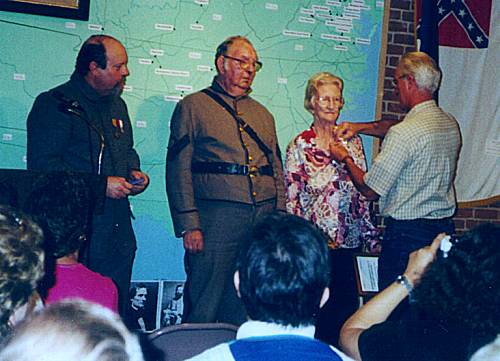 | Captain James W. Bryan Camp 1390 presented a Real Daughter Medal at Camp Moore, July 27. Pictured from left are Mike Jones, Benjamin Warren Burns, and Mrs. Frankie Alfrod Penny, who receives the medal from her son, Jake Penny. Mrs. Penny is the youngest child of Seaborn Lochran Alford, who served as a private in Companies A and C in the 3rd (Wingfields) Louisiana Cavalry. Records show that he joined at Camp Moore and was captured and paroled at Port Hudson in July 1863. (Photo Courtesy of Jerry Alford) |
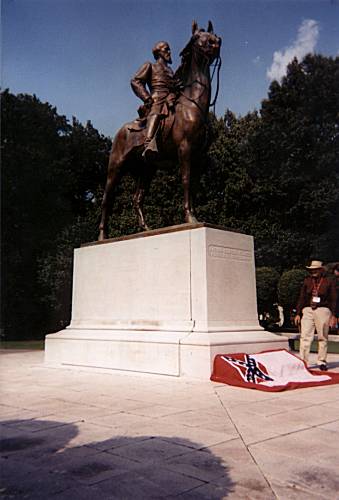 | A new headstone was unveiled at the foot of the Gen. Nathan Bedford Forrest equestrian stature for the general and his wife who are buried under the monument in Forrest Park in Memphis, Tenn. during the 107th reunion of the SCV. (Photo by Mike Jones) |
Click here to read another newsletter
Click here to go back to main page