Tina Granger, the local Order of the Confederate Rose President, Jan Cravens and myself are in agreement that our three organizations can and should work closely together in the future to preserve our heritage.
Don't forget to bring a canned good for our food drive!
Also I would like to thank Franky Gragg, Austin Willis and Les Pace for recently attending the Memorial Day Ceremony at the VFW in Beaumont, Texas. They attended as members of Semmes Battery as well as representatives of the Bryan Camp to honor all of America's fallen heroes. The event was organized by members of the Dick Dowling Camp who are also Semmes Battery members.
Also thanks are in order for Doug Meyers, Jack Christ, Austin Willis and member of our local O.C.R. chapter Tina Granger and Renee Willis for attending our adopt-a-highway program. Sadly they were alone. We must participate more.
Terrance Lee, commander
Captain James W. Bryan Camp 1390, SCV
It is a project of the Conservative Citizens Foundation, Inc. which has set up a Confederate Statue Fund at the Landmar Bank of Wynnewood.
According to the project web site, the monument is to be 20 feet tall and topped with a 7 foot tall bronze statue of a Confederate soldier with a Confederate battle flag draped over his shoulder, sitting on a 12 foot stone base.
The overall cost is projected to be $45,000, and, according to the web site, a little over $10,000 has been raised. The sculptor and the stone carver will be of the highest quality.
Sohail, prot�g� of the noted sculptor, Paul Moore, will sculpt the bronze figure. Red Dennis, resident stonecutter at the University of Oklahoma, carves in the tradition of the old masters, assuring us of superb stone work on the granite pedestal.
Those who would like to contribute in memory of their Confederate ancestor or anyone they choose to honor, may make a contribution of at least $25.00 for each person so memorialized. The names of all donors and those honored by memorial contributions will be entered in a permanent book kept in the Museum.
The name of any INDIVIDUAL or GROUP (such as the UDC or SCV) contributing $5,000 or more will be permanently engraved at the base of the monument as a MAJOR CONTRIBUTOR.
The Conservative Citizens Foundation, Inc. is a 501(c)(3) organization.
Please make checks payable to: CCF and mail to:
Museum of Southern History
P.O. Box 215
Wynnewood, Oklahoma 73098
The following list of candidates is from the SCV web site, www.scv.org, where those online can go to learn more information about the candidates and their platforms.
If you do not have a computer, you can go to any public library and access the SCV web site for free. Please inform yourself and vote for the men you believe will the best leaders for the organization.
Commander-in-Chief
Patrick J. Hardy, MD
Frank B. Powell, III
J. Troy Massey
Ronald Wilson
Lt. Commander-in-Chief
Denne A. Sweeney
The bronze and granite statues were placed at battlefield sites throughout the park between 1870 and 1920. The pieces depict Union and Confederate soldiers, their leaders and horses. It's one of the largest collections of outdoor sculptures in the nation.
But a special group of conservators has identified a dozen monuments that are showing more than a little wear.
Conservation experts and University of Delaware graduate students in art conservation are carefully scraping off acrylic coatings applied in the 1980s that did more harm than good.
A conservator had sandblasted the metal and applied the acrylic coating to make the bronze sparkle the way it might have when the statues were erected, according to park service officials.
"They stripped the metal down to what it looked like when the foundry first cast it," said Dennis Montagna, director of monument research and preservation for the National Park Service. "Now, as everyone knows from watching 'Antiques Roadshow,' you don't strip off history."
The work started last summer; conservators hope to average two a year.
Only 10 of the more than 1300 monuments at Gettysburg National Military Park were treated with lacquer in the 1980s. The Louisiana Monument was not one of them--it is in good condition. The monument was waxed in September 1999, and was powerwashed in May 2000. It is due for another waxing soon.
The article you read was not quite accurate when it stated that lacquer finishes on monuments cause "harm." Lacquer is still used (although not at Gettysburg NMP). It was the surface preparation of the bronze, using glass beads to grind down the finish that was harmful. That caused small amounts of original material to be lost and changed the surface texture of the bronze. It is a technique no longer used in national parks.
I hope this answer is helpful to you. Let me know if you have further questions. Thanks for your interest in the National Parks Service.
Katie Lawhon
Public Affairs Specialist
Gettysburg National Military Park
Jefferson Davis
Jefferson Davis (1808-1889) was born, like Abraham Lincoln, in Kentucky.
His family seems to have been of modest circumstances, and soon moved to the newly opened southern frontier in Mississippi. Possessing great intelligence and imagination, Davis was educated at a number of institutions, including Transylvania University before entering West Point, from which he was graduated. Robert E. Lee was a fellow cadet.
Davis then served in the army at a number of posts in Wisconsin and Illinois, and he (like Lincoln) served in the Black Hawk War in 1832. He resigned from the army in 1835, married the daughter of Colonel Zachary Taylor, who was the commandant of Davis's post at the time, and returned to Mississippi as a planter. Davis's marriage was cut short by his wife's sudden death three months later of malaria. For ten years, Davis tended to his plantation, "Brierfield," read extensively, and made only infrequent excursions outside his community.
In 1845, Davis strengthened his ties to the Mississippi planter class by marrying a woman from a socially prominent family. At the same time, his career became more public when he was elected to Congress as a Democrat.
With the outbreak of the Mexican War, however, Davis resigned his seat in order to command a Mississippi regiment. His bravery at the battles of Monterrey and Buena Vista won him acclaim.
Davis was then elected to the United States Senate where he became a leading spokesman for southern rights. Although willing to accept the extension of the Missouri Compromise line to the Pacific, Davis argued the right of slavery to go into the territories, and he adamantly opposed the admission of California as a free state. Davis's stand proved too extreme for Mississippi in the aftermath of the Compromise of 1850. In 1851, in a complicated political maneuver, Davis stepped down as senator to run against a pro-compromise "Union" candidate for governor, and lost.
Davis's return to the life of a planter proved only temporary. In 1853 he became secretary of war in the cabinet of President Franklin Pierce, where he demonstrated his southern expansionist leanings. With the close of the Pierce administration, he returned to the Senate and became a leader of the southern Democratic defense of slavery and its constitutional right to protection in the territories. More controversially, he advocated the revival of the slave trade.
Although he did not advocate immediate secession following Lincoln's election, Davis accepted his state's decision to leave the Union. With the formation of the Confederacy, he hoped for a high military position, and when news arrived at Brierfield of his selection as provisional President, his wife described him as "so grieved that I feared some evil had befallen our family." Davis, nevertheless, accepted the position, and on February 18, 1861 was inaugurated President.
Davis was described by a contemporary as "a gentleman," having a "slight, light figure, little exceeding middle height, and holds himself erect and straight." He had high, prominent cheek-bones, thin lips, and deep-set eyes, one of which was nearly blind from an illness. To all but a few intimates, Davis was reserved and severe in manner. Both indecisive and stubborn, his inflexibility, moral rectitude, and lack of humor did not help him in dealing with opponents.
Davis was passionately committed to the cause of the Confederacy, and his labors on its behalf took a heavy personal toll. While contemporaries and, later, historians have found much to criticize about his leadership, most scholars consider that he guided the Confederacy as ably as one could expect, given its situation.
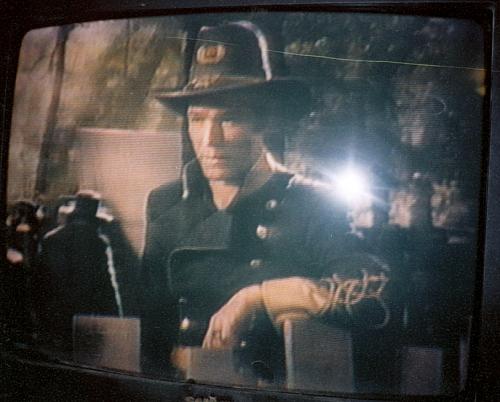
| Roy Rogers, the late great western cowboy star, is seen here as a Confederate officer in "Dark Command", a 1940 movie loosely based on William Quantrill. In real life Rogers was the grandson of a Confederate cavalryman, Arthur Womack of Kentucky. (Photo taken from movie for educational purposes only). |
Interestingly, Roy Rogers, whose real name was Leonard Slye, was the grandson of a real Confederate cavalryman. According to family sources, Roy's grandfather, Archer Womack, was an excellent horseman from Kentucky and fought with the Confederate cavalry in Virginia, where he was wounded in battle.
While recuperating in a Virginia hospital, Archer Womack met his future wife, Roy's grandmother.
Having survived the war, Archer Womack was described in old age as having a flowing white beard and was a dedicated Confederate to the end.
Broadfoot's lists an Archer Womack serving with the 3rd Virginia Cavalry, but it isn't known for sure if this is the unit Roy Roger's grandfather served in.
June 1 & 15, Fort Pike State Historic Site, New Orleans - Rifleman, 10 a.m. - 4 p.m. each day. An 1860s-era uniformed soldier will demonstrate loading and firing of a Mississippi Rifle. The demonstration will include weapon safety and how bullets were made during the 19th century. Call 1-888-662-5703 toll free or 504-662-5703 locally for more information.
June 22, Mansfield State Historic Site, Mansfield - Civil War Soldier Life, 11 a.m., 1 and 3 p.m. A costumed interpreter will explain the uniforms, equipment, and armament used by a Civil War infantryman. A black powder musket demonstration is included. Call 1-888-677-6267 toll free or 318-872-1474 locally.
June 29 & 30, Fort Pike State Historic Site, New Orleans - Independence Day Celebration, 10 a.m. - 4 p.m. each day. Events include Black Powder Cannon & Rifle demonstrations, a 19th century medical demonstration, and crafts such as basketweaving, beadmaking and candlemaking. There will also be games to entertain the children and a special performance of "Taps." Call 1-888-662-5703 toll free or 504-662-5703 locally for more information.
July 7, Port Hudson State Historic Site, Zachary - Firepower! 1 - 3 p.m. From cannon blast to small arms fire, visitors will see demonstrations of weapons used during the Civil War. Call 1-888-677-3400 toll free or 225-654-3775 locally.
July 20 - 21, Mansfield State Historic Site, Mansfield - Living History Encampment, 9 a.m. - 4 p.m. Saturday, and 9 a.m. - 2 p.m. Sunday. Using a period Civil War camp as background, authentically uniformed volunteers will interact with park visitors, describing what life was like for the Civil War soldier in the field. Call 1-888-677-6267 toll free or 318-872-1474 locally.
July 20 - 21, Mansfield State Historic Site, Mansfield - Living History Encampment, 9 a.m. - 4 p.m. Saturday, and 9 a.m. - 2 p.m. Sunday. Using a period Civil War camp as background, authentically uniformed volunteers will interact with park visitors, describing what life was like for the Civil War soldier in the field. Call 1-888-677-6267 toll free or 318-872-1474 locally.
July 20, Fort Pike State Historic Site, New Orleans - Rifleman, 10 a.m. - 4 p.m. An 1860s era uniformed soldier will demonstrate the loading and firing of a Mississippi Rifle. The demonstration will include weapon safety and how bullets were made during the 19th century. Call 1-888-662-5703 toll free or 504-662-5703 locally.
July 27, Port Hudson State Historic Site, Zachary - Genealogy, 10 a.m. - 4 p.m. Site staff will assist visitors in researching their Port Hudson Civil War ancestors in this program. Call 1-888-677-3400 toll free or 225-654-3775 locally.
The University of New Orleans Foundation purchased property on both sides of Memorial Hall and is constructing an art exhibition facility. Following their purchase of the adjacent properties, the UNO Foundation contacted Memorial Hall seeking an agreement allowing the construction of a connection between their properties by way of a passageway through the basement of Memorial Hall. In return, Memorial Hall would receive some much-needed building repairs. However, four years of negotiations over this agreement recently broke down when it became apparent that the UNO Foundation would not live up to its promised commitments.
During these "good faith" negotiations, the UNO Foundation proceeded to challenge Memorial Hall's ownership of the museum's building when it obtained a quit claim deed from Tulane University for the old hall. The UNO Foundation alleged that Tulane had assumed title to the Memorial Hall building through Tulane's assimilation of the Howard Memorial Library Association, a corporation established by the Howard family, to construct and oversee the maintenance of Memorial Hall and the adjacent Howard Library.
The UNO Foundation demanded that Memorial Hall's officials remove the museum's collection and vacate the building, because it viewed Memorial Hall's Confederate association as distasteful and not fitting with modern New Orleans. It considered the museum's Confederate military artifacts as not an appropriate neighbor of its art exhibition facility.
Memorial Hall asserts that it has title to the Confederate Memorial Hall building by virtue of a donation from the Howard Memorial Library Association through Mr. Frank . Howard in 1891. Memorial Hall has retained attorneys from a prestigious New Orleans law firm and has filed lawsuit against the UNO Foundation to confirm Memorial Hall's ownership of the building.
Memorial Hall will fight for its home. Memorial Hall's building is a nationally registered landmark and has been the home for the Confederate Museum for 111 years. It houses the second largest collection of Confederate memorabilia in the world. As President of the Confederate Museum's financial support organization, the Memorial Hall Foundation, I ask you to rally to and financially support our cause. I am confident that UNO Foundation's misguided eviction efforts and its narrow-minded vision of Memorial Hall, as an unwelcome relic from the past, will be opposed on all fronts. Your Financial commitment to Memorial Hall will send a strong message to the University of New Orleans and is essential for our success in defeating this threat. All contributions to the Memorial Hall Foundation, Inc., and IRS recognized non-profit corporation, are tax deductible to the fullest extent allowed by law. Your contribution can be sent to the museum at 929 Camp Street, New Orleans, LA, 70130. Our telephone number: 504-523-4522.
Please help us in our hour of need.
Keith Oldendorf, President
Memorial Hall Foundation, Inc.
email: [email protected]
Memorial tributes to soldiers of the Confederacy and to Jefferson Davis, president of the Confederate States were given by Robert E. Lee chapter of the United Daughters of the Confederacy and Fitzhugh Lee chapter Sons of Confederate Veterans Wednesday at a picnic at the Alexander camp on West Fork.
The service, held annually at this time, is the regular observance of the birthday of Jefferson Davis.
The tribute to Davis, a reading of exerpts from the farewell address to the Southern Senate, was presented by Mrs. J.T. Hood, Sr., and prepared by Mrs. Amelia Heidt.
A poem, �Who Love the Gray,� honoring soldiers of the Confederacy, was read by Mrs. Delia Tarkington.
Lucius Moss, past national commander in chief of Sons of Confederate Veterans, gave a memorial speech address. Other members of the organization who addressed the group were N.G. Clifton, Carl Bankston, Judge J.T. Hood, Sr., Van Andrus and A.U. Alexander.
UDC�s and guests gave a vote of thanks to Mr. and Mrs. A.U. Alexander, at whose camp the event took place.
Miss Katherine Tuten was presented a certificate of membership.
A tribute to the late Mrs. Rudolph Krause, who was active in both state, national and local work for UDC, was read by Mrs. J.B. Hollomon, Sr.
Confederate flags and the American flag flanked the steps at the entrance to the camp house. Dinner tables held bowls of magnolias, among which were placed Confederate flags. The birthday cake, commemorating the Southern president�s birthday, was iced in UDC colors and decorated with flags.
Miss Maude Reid, one of the hostesses, served the cake. Other hosts were Mr. C.C. Smith, Mr. C.I. Bankston, (and hostesses) Mrs. Blanchard Iiles of Oakdale, and Miss Marie Ryan.
About 40 attended. Guests were Sons of Confederate Veterans and their wives.
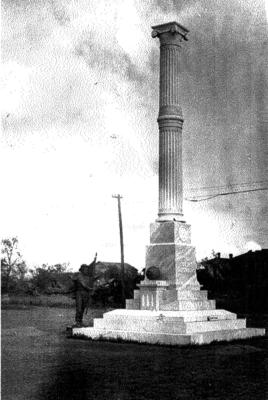 | This is a picture of the South's Defenders Monument in 1918 when the Confederate Colorbearer statue was blown off its pedestal during a hurricane, did a complete flip and landed on his feet. The monument is now 87 years old. (Photo courtesy of Diane McCarthy) |