MAY 2002
NEXT MEETING
The next meeting of Captain James W. Bryan Camp 1390 will be at 7 p.m. Tuesday, May 14, at Meemaw's Kitchen (formerly called Nan's) at 504 N. Beglis Parkway, Sulphur. The progam will be on "The War Between the States in Southwest Louisiana."
Commander's Comments
As I write this we near the end of Confederate History Month, a time of observance and reflection upon Louisiana's War Between the States history of 1861-65. Louisiana men of those times had no questions about the morality of their actions and were completely devoted to their cause, which is now our cause! Like men of today, these men loved life and the pursuit of happiness and did not choose to go to war and risk life and limb. These men went to war to preserve the Constitution, to preserve the South and to protect their families and property, they did their duty. Robert E. Lee once said "You must do your duty in all things, nothing more, nothing less."
We must not think of our memberships in the S.C.V. as a hobby or club. It is our duty to preserve the memories of our ancestors and to protect their good names. The only legacy these men left that survives today is you!
At 7 p.m. Saturday, May 25, our camp will once again partake in the adopt-a-highway program to clean our stretch of Prien Lake Road between Ryan and Lake streets. Two things will be different about this one. First, this one will be part of the Great American Clean-Up held every year nationwide. I must remind you that there is some publicity involved in this for us so we need to be in full strength. The second thing to be different is participation. We are a non-profit organization and benevolent. This clean up is a benevolent activity, voluntary public service.
Basically the State lets us have a parade down the side of Prien Lake Road and all we have to do is pick up the trash along the way. Our forum for preserving our Heritage is the S.C.V. so we must do what we can to promote our organization which will gain us numbers. There is great strength in numbers.
Let us remember that our Embattled Banner is in origin a Christian Banner and the men who flew it believed in Christian morals and values. Their cause was a just one, so our duty is clear, and our determination must be absolute.
Your obedient servant,
Cmdr. Terrance L. Lee
Hat Courtesy Called For at Meetings
The following resolution was passed at the April meeting of Captain Byran Camp. Please read and take note of it.
RESOLUTION:
Whereas the task listed in the "heart" of "The Charge" we received to defend the Confederate Veteran, was to "emulate his virtues";
and whereas one of the many, but most widely recognized, virtues He and other Southerners are known for is "good manners";
and whereas no Southern Gentleman would have ever worn his hat publicly indoors, and especially at the dinner table; and whereas the picture we present to the public directly affects our recruiting and the overall image of The Sons of Confederate Veterans;
Therefore be it resolved, that neither hats nor caps, are allowed to be worn during meetings of "The Capt. James Wesley Bryan, Camp 1390, Sons of Confederate Veterans" except by the uniformed members of "Color Guards", or other "details", authorized by Camp Officers; and only while in the performance of their duties.
Submitted to the membership of "Camp 1390" this 16th day of April, 2002; to be read, discussed, voted on, and adopted immediately upon it's passage.
Submitted by:
Gordon D. Simmons
Past Commander & member-in-good-standing
Capt. James Wesley Bryan, Camp 1390, S.C.V.
Beauregard Bust Project Halfway to Goal
The General Beauregard Statue Project is about halfway to its goal of raising $10,000 for a life-size bust of Gen. Pierre G.T. Beauregard to be placed in the Rotunda of the Beauregard Parish Courthouse in DeRidder, Louisiana, according to Shawn Martin, coordinator.
He said a plaster bust of the general was broken when it was accidentally knocked over in the courthouse a couple of years ago. The only other representation of Beauregard in his namesake parish is an old and rather faded potrait.
Martin said sculptor John A. Lanzalotti, M.D., has made a rendering of the bust and posted it on the "Civil War" page of his web site, www.williamsburgsculpture.com.
He said they are seeking donations and may also offer miniature busts of Beauregard to help raise the remaining amount needed.
For more information contact Shawn Martin at 337-463-3785 or [email protected].
SCV Member Becomes Head of 'Civil War Preservation Trust'
(Washington, D.C.) - Alabama businessman Paul W. Bryant, Jr. was recently elected by the Board of Trustees of the national Civil War Preservation Trust (CWPT) to serve as its new chairman. With 39,000 members, CWPT is the largest nonprofit battlefield preservation organization in the United States. Bryant will assume the chairmanship at CWPT's annual conference on April 24, 2002.
"Paul Bryant's lifelong commitment to the preservation of Civil War history is legendary," remarked Princeton historian James M. McPherson, author of Battle Cry of Freedom. "Few people are more passionate about the need to protect this nation's hallowed battlegrounds. His enthusiasm and leadership will be enormous assets for CWPT."
CWPT has been active in rescuing some of the most hallowed ground in America, including key parcels at Antietam and South Mountain, Md.; Gettysburg, Pa.; Shiloh and Stones River, Tenn.; and Brandy Station, Malvern Hill and Manassas, Va. Over the years, CWPT has helped protect more than 14,000 acres at 75-plus historic sites in 18 states.
University of Virginia historian Gary Gallagher, editor of the Military Campaigns of the Civil War series, applauded Bryant's selection as chairman: "I have long been struck by the quietly effective way in which Paul Bryant goes about supporting things he considers important. He has a remarkable record as an advocate for Alabama's Civil War heritage. I look forward to a period of splendid accomplishment for CWPT under his leadership."
Former National Park Service historian Robert K. Krick, author of Stonewall Jackson at Cedar Mountain, joined in the praise of Bryant: "Paul Bryant is admirably equipped to lead the drive to save those priceless pieces of our national heritage. Bryant's lengthy record of generosity to educational programs in Alabama, and his years of involvement in historic preservation projects, makes him the ideal candidate for this post."
Bryant succeeds Carrington Williams, who became chairman of CWPT in November 1999. Bryant is President of Greene Group, a privately held diversified holding company. He is trustee of the University of Alabama System; chairman of the University of Alabama Crimson Tradition Foundation; trustee of the Museum of the Confederacy, Richmond, Va.; and member of Sons of Confederate Veterans.
CWPT is a 501(c)(3) nonprofit battlefield preservation organization. Its mission is to preserve our nation's endangered Civil War battlefields and to promote appreciation of these hallowed grounds.
Artifacts From Sunken War for Southern Independence Vessel May Wind Up in Avoyelles
FORT DERUSSY, La. - A Union gunboat now lying in 80 feet of water in the Mississippi about 35 miles from New Orleans, could help draw War for Southern Independence buffs to Avoyelles Parish in the future.
The U.S.S. Arizona saw action during the war and sank in 1865.
Artifacts that might be recovered from the Arizona, which was involved in a gun battle on the Red River, may wind up being featured at Fort DeRussy, located near Marksville in Avoyelles Parish.
Putting the artifacts on display could help lure tourists, especially those interested in the War for Southern Independence. Fort DeRussy is being renovated to help recapture some of its past glory. The earthen fort was built in 1862.
Remains of what is believed to be the Arizona were found in the Mississippi River on June 28, 2001, during an expedition led by Castle Rock, Colo., history teacher Rob Christopher.
The battle-worn Arizona capsized on Feb. 27, 1865, but not by gunfire. It succumbed to an onboard furnace fire fueled by kerosene-laden decks. Out of a crew of 98, five men died - three drowned, one died from smoke inhalation, and one was burned alive.
In proposed salvage efforts, the Arizona would not be raised, as was the case in 1965 with the raising of a ship in Vicksburg, Miss.
Raising the Arizona would cost millions, so Fort DeRussy President Steve Mayeux and other advocates have opted for artifact extraction instead.
Questions have recently surfaced over whether the ship found was actually the Arizona. Christopher and his team will revisit the site this summer.
With or without artifacts from the Arizona, the revival of Fort DeRussy should prove beneficial to the area, officials say.
"It's already had a positive effect on the community. People have come together to make this happen," Mayeux said.
"We've gotten everything we need" from the area. The USS Arizona started its Civil War career as a Southern blockade-runner but was captured in 1862 while attempting to enter Mobile Bay with a load of munitions.
The Arizona was seized by the USS Montgomery. It was then converted to a gunboat and put in Union service.
In May of 1863, the Union ships Arizona, Estrella and Albatross came up the Red River as part of a Union offensive to capture Alexandria. As the three ships reached Fort DeRussy, they were confronted by two Confederate gunboats, the Cotton and Grand Duke.
After a deadly battle, the Union gunboats were driven away by the Confederate boats. However, the Union ships returned several days later, and Union forces found the fort was abandoned and the Confederate boats were gone.
The Arizona proceeded upriver toward Alexandria, arriving ahead of other forces, thereby "capturing" Alexandria although the area had been abandoned by the Confederate forces.
The Queen of the West, a Union boat, ran aground at Fort DeRussy during a February 1863 battle and was captured by the Confederates. The Queen, once repaired and refitted by Confederates, later traded gunfire with the Arizona in a river skirmish.
Construction on Fort DeRussy began in November of 1862.
A year after first being captured by the Union in 1863, Fort DeRussy was recaptured by the Union in case Confederate forces attempted to reoccupy it.
In a best-case scenario, the rebuilding of Fort DeRussy will be completed so it can be publicly unveiled in five or six years.
Both the Louisiana Office of State Parks and La Commission des Avoyelles have purchased additional land for the Fort DeRussy Historical Site.
The boat believed to be the Arizona was found 20 minutes after a sonar equipment search began last summer.
Christopher apparently established a good rapport with the U.S. Navy. He has been granted permission to further investigate the wreck site.
If the ship is, indeed, the Arizona, the possibility exists the Navy will allow artifacts to be removed from the wreck.
"This is going to bring many visitors to the area," Mayeux said of Fort DeRussy. 'We've had a man from Australia and a couple from Canada. Another man was from Michigan. Once we get it developed, there'll be plenty visitors."
WFSI Books Guide Historic Journeys, in Person or Imagination
"In the Footsteps of Stonewall Jackson" by Clint Johnson, published in February, is both travel guide and history book. It tells readers why certain sites are relevant in Jackson's life, then describes how to get to them.
"The idea started coming out as you're never going to meet Robert E. Lee, Stonewall Jackson or any other dead figures," Johnson said. "The closest is trying to see the same things they saw."
Johnson, who lives in Winston-Salem, N.C., tracks Jackson from his birth in Clarksburg, W.Va., through his student days at West Point, N.Y., and an early posting at Fort Hamilton in New York City's Brooklyn borough, then to the house outside Fredericksburg, Va., where he died during the war.
The book is written for armchair and mobile audiences.
Johnson wrote a 1996 book on touring War for Southern Independence sites in North and South Carolina, and one in 1999 on sites in Virginia and West Virginia. He also put out a book on tactical blunders by the war's military leaders in 1997.
He decided to write the books on Lee and Jackson as "a way to expand the history traveler idea."
"There were other places these generals had served or lived that were not Civil War sites but were important to them," Johnson said. '"In the Footsteps' was a way to go and see places that formed them, sites where they might have been 20 or 30 years before the Civil War started."
For War for Southern Independence buffs, there's no substitute for visiting a battlefield in person. Johnson himself is a regular visitor; he has participated in War for Southern Independence battle re-enactments for 25 years.
The Lee book takes readers to the general's birthplace at Stratford Hall, Va., as well as to the places where he rescued his dog and adopted a wartime pet chicken.
Both books feature Fort Hamilton, where both men served.
Johnson writes about how Jackson was accidentally shot by one of his own men at Chancellorsville - where his severed arm is buried - and was taken to a plantation office building, where he died eight days later, on May 10, 1863.
Travelers who want to find the spot, or any other where he served in the Army before the war, can get directions from boxes printed before each chapter.
One site Johnson enjoyed the most during his research was a spa that Jackson frequented when he taught at Virginia Military Institute in Lexington, Va. The spa was in Warm Springs, Va., and the same round, wooden building where Jackson once soaked away his aches and pains still is in use.
"The neatest thing that everybody can still do that Stonewall Jackson did is take a bath where he did," Johnson said.
"You are bathing in the same waters as George Washington, Thomas Jefferson, Stonewall Jackson, Robert E. Lee and about four or five presidents."
On the Net:
Blair Publishing: http://www.blairpub.com
US Circuit Court Okays SCV Logo Display on Virginia License Tags
May 1, 2002--The 4th US Circuit Court of Appeals has cleared the way for the issuance of special license plates for members of the Sons of Confederate Veterans which bear the group's logo, including a Confederate flag.
The unanimous ruling stated that t0he law forbidding the display of the logo was unconstitutional.
Under Virginia law at least 350 members of an "affinity group" may request a special license plate be issued by the state. Brag Bowling, an official with the state chapter of the Sons of Confederate Veterans, said that they had far more than the required minimum.
"We will be heading down to the DMV ([Department of Motor Vehicles] in the next couple of days and getting the process going," Bowling said.
Virginia Attorney General Jerry W. Kilgore's office said that they had not yet seen the ruling and had no comment on it.
Bowling said that he doubted the state would attempt any further appeals, noting his group's belief that the opposition to the "Rebel flag logo" was started by a former Virginia governor seeking political gains with black voters.
"The Confederate battle flag is really a powerful symbol," Bowling told the Richmond Times-Dispatch after the ruling came down.
"I understand how some people can consider it a symbol of hate," he added, "but there are other people who look on it as a symbol of heritage, other people who look on it as a symbol of constitutional rights, of freedom...It has a lot of meanings."
The state General Assembly authorized the issuance of SCV license plates in 1999, but added a provision to the law stating "No logo or emblem of any description shall be displayed or incorporated into the design of license plates issued under this section [law]."
The SCV sued, claiming discrimination. Judge Jackson Kiser of the US District Court, who ruled in the SCV's favor, noted that the state of Virginia had authorized more than 300 different "affinity tags" but that only the SCV was forbidden to display their logo as part of the design.
"In sum," Kiser said in his ruling at that time, "the Commonwealth [of Virginia] seeks to bar the Sons from making their
Such a restriction seems to be exactly the type the First Amendment was meant to disallow."
The SCV was aided in their legal efforts by the Rutherford Institute of Charlotteville, VA, described as a conservative civil liberties advocate. The Institute had assisted a group in Maryland with a similar case.
Courtesy of:
Civil War Interactive: The Daily Newspaper of the Civil War www.civilwarinteractive.com
http://community.webtv.net/lousianacatholi/StaroftheSouth
http://community.webtv.net/lousianacatholi/CONFEDERATEMONUMENTS
http://community.webtv.net/lousianacatholi/9thBattalion
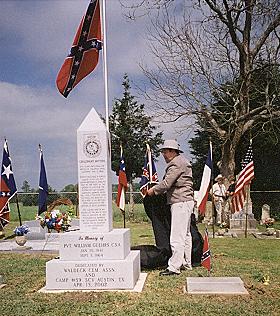 | Michael Jones of Captain J.W. Bryan Camp 1390 unveiled the Pvt. William Guehrs Monument April 13 in Waldeck, Texas. |
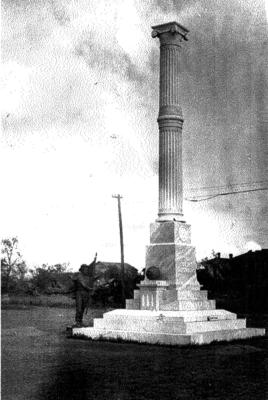 | Confederate monument at Weiss Park in Beaumont, Texas. |
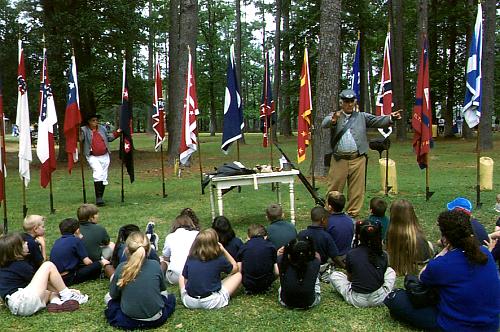 | Jimmy Moore, standing at the right, and Jimmy Wise, holding flag, are members of the TM Scott Sons of Confederate Veterans Camp, Southern Guard, who took part in the Living History Encampment held April 12 at Niblett's Bluff Park. They explained to second-graders from Starks Elementary School the hardships faced by people and how soldiers lived during that time period. Also taking part was Semmes Battery. |
Click here to read another newsletter
Click here to go back to main page