 All of the fury, all of the drama of one of the most significant actions
on the Mississippi River during the South's quest for independence is
captured in this magnificent artwork.
All of the fury, all of the drama of one of the most significant actions
on the Mississippi River during the South's quest for independence is
captured in this magnificent artwork.
Our last meeting was very productive. In case you missed it, we decided to start an ongoing canned food drive so remember your can for the meeting.
Our adopt a highway cleanup is coming up March 30 at 4 p.m. and we'll assemble in the parking lot of Wendy's at Prien Lake Road and Lake Street. I hope you come out and join us as we serve our community and promote our heritage. Let's show Lake Charles who we are and what we're about.
If you have not made a meeting lately, we would appreciate your presence as well as your input.
Your obedient servant,
Terrance Lee, commander
Captain James W. Bryan Camp 1390
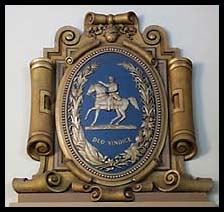 Like any other sovereign, independent nation, the Confederate States of
America has a beautiful coat of arms. Here is some information on it and a
beautiful rendition:
Like any other sovereign, independent nation, the Confederate States of
America has a beautiful coat of arms. Here is some information on it and a
beautiful rendition:
Confederate States of America
The coat of arms of the Confederate States was adopted but never used. The emblem depicts George Washington within a wreath made of tobacco, rice, corn, cotton, wheat, and sugar cane with the motto Deo Vindice (God being our protector).
We, the People of the Confederate States, each State acting in its sovereign and independent character, in order to form a permanent Federal Government, establish justice, insure domestic tranquility, and secure the blessing of liberty to ourselves and our posterity, invoking the favor and guidance of Almighty God; do ordain and establish the Constitution for the Confederate States of America. -Preamble to the Confederate Constitution
"Our Civil War battlefields are vanishing at an alarming pace," warned CWPT President James Lighthizer during the news conference. "Once lost, these hallowed battlegrounds can never be replaced."
The Most Endangered Battlefields report is composed of two parts: the first section cites the 10 most endangered battlefields in the nation, with a brief description of their history and preservation status; the second section lists 15 additional "at risk" sites that round out the top 25 endangered battlefields in the country.
The sites mentioned in the report range from the famous to the nearly forgotten. However, all have a critical feature in common - each one or part of one is in danger of being lost forever. The battlefields were chosen based on geographic location, military significance, and the immediacy of current threats. "With so many Civil War sites under siege from urban sprawl, we could easily have selected a hundred," Lighthizer noted.
Brian Pohanka, WFSI author, emphasized, "Real people risked their lives at these battlefields for ideals they cherished above life itself. Allowing these sites to fall prey to development dishonors the memory of their courage and sacrifice."
The top 10 endangered battlefields cited in the report are:
* Atlanta, Ga.
* Bentonville, N.C.
* Chancellorsville, Va.
* Corinth, Miss.
* Franklin, Tenn.
* Gaines' Mill and Cold Harbor, Va.
* Gettysburg, Pa.
* Harpers Ferry, W.V.
* Richmond, Ky.
* Stones River, Tenn.
"These battlefields are the last tangible reminders of the valor of those who donned the blue and gray," Lighthizer stated. "They must be preserved."
With 36,000 members, CWPT is the largest nonprofit battlefield preservation organization in these United States. Its mission is to preserve our nation's endangered WFSI battlefields and to promote appreciation of these hallowed grounds.
Members of various Confederate veterans camps will perform a reenactment of the Battle of Calcasieu Pass with cannons.
A barbecue beef meal will be served at 1 p.m. at Cooper Farms, on Waldeck Road about 2 miles from the cemetery, for $6 per person. Please reserve your meals by 1 April 2002 by sending payment payable to the Waldeck Cemetery Association and mail to Marceil Malak, treasurer, 7444 Meiners Road, Ledbetter, Texas 78946.
Signs will be posted in the general area, but you may call for specific directions if needed: Ralph Mueller, president (979) 249-5485 Harvey Meiners, Program Co-ordinator (979) 249-5349 Della Markert, Secretary (979) 249-3381 Marceil Malak, Treasurer (979) 249-5940
March 23, Mansfield State Historic Site, Mansfield - Researching Civil War Units and Battles, 11 a.m. and 2 p.m. Site staff will present information, including source listings and guidelines, for researching information on Civil War units and battles. Call 1-888-677-6267 toll free or 318-872-1474 locally.
March 23 - 24, Port Hudson State Historic Site, Zachary - The Battle of Port Hudson Reenactment, 10 a.m. - 4 p.m. Visitors are invited to the annual reenactment and living history program that recreates the Civil War engagement for which the site is named. Meet and mingle with costumed reenactors. Call 1-888-677-3400 toll free or 225-654-3775 locally.
All of the fury, all of the drama of one of the most significant actions
on the Mississippi River during the South's quest for independence is
captured in this magnificent artwork.
This release from the late Artist Joe Umble, of Virginia, is a colorful historic work depicting the highly accurate fire of Port Hudson's Confederate River Batteries upon a portion of the Union fleet of Admiral David G. Farragut. The grounded and burning USS Mississippi lies helpless as the bonfires on the western bank backlight her and provide a perfect silhouetted target for the gray gunners to continue her destruction by the blasting of deadly accurate hot shot. Her fate is sealed. The attempted passage lasted three hours and would cost the Union Navy 110 casualties and the loss of the USS Mississippi. It was this single Confederate victory that incited the Union forces to lay siege in order to silence the guns of this "Bastion on the Mississippi".
"Contemporaries and historians have labeled the passage a tactical failure and not because of Confederate gunfire. Yet they also generally described it as an important strategic victory. The failure of five out of seven vessels to pass the batteries confirms the first conclusion, but the Confederate gunners deserve the credit." - Lawrence Lee Hewitt, "Port Hudson, Confederate Bastion on the Mississippi" LSU Press
This beautiful piece of historic artwork is available as an artist signed limited edition print ($135 including shipping) through the Captain James W. Bryan Camp 1390 Sons of Confederate Veterans Lake Charles, LA All proceeds go to further the cause of our Confederate Heritage. Contact the camp commander for purchasing the print.
Through a partnership with Southeastern Louisiana University's Center for Southeast Louisiana Studies, the public will be allowed to view the original constitution of the West Florida Republic as well as other artifacts connected with this dramatic event from Louisiana's past. The documents can be viewed weekdays from 8 AM to 4:30PM at Sims Memorial Library on Southeastern Louisiana University's campus. The exhibit will remain there through the Center's annual War for Southern Independence Symposium in June. In the future, the Secretary of State's office hopes to display the historic items in every parish that was once a member of the West Florida Republic.
Long revered as the Great Emancipator, Abraham Lincoln is portrayed in this provocative book as a man not so much interested in ending slavery as in building an American empire. According to author Thomas J. DiLorenzo, Lincoln's dream of an empire not only clashed with the Constitution but may well have led to the bloodiest war the United States has ever fought. DiLorenzo shows the sixteenth president as a man who devoted his political life to transforming the federal government from its limited origins into a powerful, activist state. Standing in his way, however, was the South, with its independent states, its resistance to the national government, and its reliance on unfettered free trade. The result was the Civil War, whose wounds haunt us still. In The Real Lincoln, you will discover another side of Lincoln and gain a deeper understanding of the reasons behind a bloody and, perhaps, unnecessary war.
SCV member Patrick J. Buchanan has gives an outstanding evaluation of current population trends and culture wars in his new book "The Death of the West: How Dying Populations and Immigrant Invasions Imperil Our Country and Civilizations."
Southerners will be particularly interested in his chapter on attacks on Confederate heritage and how it fits in with the larger culture war being waged against everything and institution of traditional America.
Buchanan shows conculsively that this culture war is no accident, but a concerted attack by leftists to destroy the traditional American way of life. He notes that what Marxists were unable to accomplish through physical revoluntion, they are accomplishing through cultural revolution.
Combine that with dramatic population and immigration trends, left unchanged America will be unrecognizable by the mid 21st Century.
While some accuse Buchanan of doom and gloom, he actually gives many positive suggestions in the book on how to reverse these trends, however he notes that current politicians show little inclination to change the direction of the country.
The book is well-written, easy to read and very informative. You can get it at a $10 dicount through Amazon.com. And if you access Amazon.com on the Internet through the SCV web site, www.scv.org, the SCV will benefit from the sale as well.
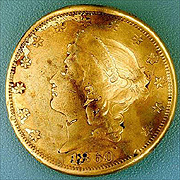 CHARLESTON, S.C. The famous $20 gold piece recovered from the remains
of Lt. George Dixon on the CSS Hunley is going to be displayed at the Warren
Lasch Conservation Center when a suitable display case can be designed,
according to the Friends of the Hunley organization.
CHARLESTON, S.C. The famous $20 gold piece recovered from the remains
of Lt. George Dixon on the CSS Hunley is going to be displayed at the Warren
Lasch Conservation Center when a suitable display case can be designed,
according to the Friends of the Hunley organization.
The famous coin saved Dixon's life at the Battle of Shiloh when it stopped a bullet. Still bent from the bullet's impact, the gold piece was a gift from his sweetheart in Mobile, Ala. when he left for the war.
Archaeologists were surprised it carried a personal inscriptions by Dixon, which showed the legend of the coin was indeed true.
The exact date in March when the coin will go on display has not been decided, because no final decision has been made on a secure display case, says Lasch, chairman of Friends of the Hunley, a private group raising money to support the Hunley conservation project. The artifact has been valued at $8 million to $10 million.
Minted in 1860, the Lady Liberty gold piece was given to Confederate soldier George Dixon by his Alabama sweetheart, Queenie Bennett. Dixon carried it in his trousers pocket into battle at Shiloh, Tenn., in 1862, where a bullet struck him. The coin stopped the bullet and was dented. Afterward, Dixon had it inscribed with, "Shiloh, April, 6, 1862, My Life Preserver," and included his initials, G.E.D. He carried it with him after becoming the Hunley's last commander. The submarine, which was financed by New Orleans lawyer Horace Lawson Hunley, was initially a disaster as a naval weapon. It sank twice during trial runs, killing 13, including Hunley.
Later, under the command of Dixon and with a crew of eight, the submarine rammed a 135-pound explosive into the hull of the USS Housatonic, a warship taking part in a Union blockade of Charleston in 1864. The explosion that followed sunk the Housatonic in minutes, killing five of its crew.
But inexplicably, the Hunley also went down and remained undiscovered for more than a century. It was finally pulled from the bottom of Charleston Harbor two years ago. Archaeologists have found a wealth of artifacts, including a ship compass with its glass intact, a leather wallet, a kind of joystick used to maneuver the craft, the submarine's depth gauge, buttons and fragments of clothing, eight sets of shoes and eight canteens. Blocks of sediment removed from the craft, but not yet excavated, have been X-rayed and appear to show objects such as a pocket watch and binoculars, along with what could be a ship's log.
Remains of all eight crewmembers were found. The youngest is thought to have been perhaps a teenager and the oldest in his 40s. Forensic specialists hope to determine ages, ancestry, injuries and physical characteristics and eventually conduct facial reconstruction.
(Picture of coin courtesy of Friends of the Hunley).www.hunley.org
Q. What state provided the Union with only about 500 fighting men, who served in the Second Massachusetts Cavalry?
A. California
Q. During the Civil War, what was the westernmost region represented by a delegate to the C.S.A. Congress?
A. The Territory of Arizona
Q. Late in 1862, voters of what state adopted a constitutional provision that barred immigration of blacks?
A. Illinois, the land of Lincoln.
Q. Across the borders of what states does Lookout Mountain sprawl?
A. Alabama, Georgia, and Tennessee.
Engagements and Battles
Below are the states and the number of engagements that took place in them:
Alabama, 78
Arizona, 4
Arkansas, 167
California, 6
Colorado, 4
Dakota Territory, 11
District of Columbia, 1
Florida, 32
Georgia, 108
Idaho, 1
Illinois, 1
Indiana, 4
Indian Territory, 17
Kansas, 7
Kentucky, 138
Louisiana, 118
Maryland, 30
Minnesota, 6
Mississippi, 186
Missouri, 244
Nebraska, 2
Nevada, 2
North Carolina, 85
New Mexico, 19
New York, 1
Oregon, 4
Pennsylvania, 9
South Carolina, 60
Tennessee, 298
Texas, 14
Utah, 1
Virginia, 519
Washington, 1
West Virginia, 80
Q. What was the immediate objective of Union forces sent to engage in the first pitched battle?
A. Fairfax Court House, Virginia.
Q. At what site was Thomas J. Jackson first called Stonewall?
A. Henry Hill, Manassas, Virginia.
Q. What C.S.A. position was attacked by Union forces in March 1865, with Lincoln watching the action?
A. Fort Stedman, Virginia.
Q. Where was the largest Confederate prison in Texas, which at one time held 5000 men?
A. Camp Ford, northwest of Tyler.
Q. Upon capture of Jefferson Davis by Federal troops, where were his children sent?
A. To Canada, for refuge with Varina Davis's mother.
Q. Although Lincoln promised never to invade it, what state was repeatedly ravaged by Federal and Confederate armies?
A. Kentucky.
Q. After the war, while most Southerners accepted their fate, a colony of former Confederate slave owners was established in what South American state?
A. Sao Paolo, Brazil.
Q. At what site did Confederate bullets kill a soldier standing close to President Lincoln?
A. Fort Stevens, Washington, D.C.
Q. What 3 cities did Lincoln call "the brain, heart and bowels of the rebellion"?
A. Richmond, Virginia; Chattanooga, Tennessee; Vicksburg, Mississippi.
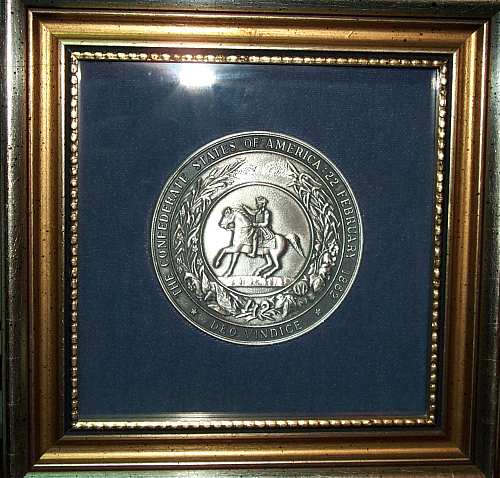 | This is a picture of a replica of the Confederate Seal, owned by Keith Coleman. The actual diameter of the medallion is about 3.5 inches. |