A Confederate Living History Encampment will be held at Cocodrie Park just off 1-10 in Jennings from 8 a.m.-5p.m. Saturday, Sept 29, and Sunday, Sept 30. The SCV will have an information booth in addition to the authentic Confederate encampment with musket and artillery firing demonstrations throughout each day by Semmes Battery First Confederate Light Artillery and the 28th Louisiana Infantry. Non-reenacting members are also needed to help man the SCV information booth. Please contact 1st Lt. Cmdr. Terry Lee for more information by calling 433-8054.
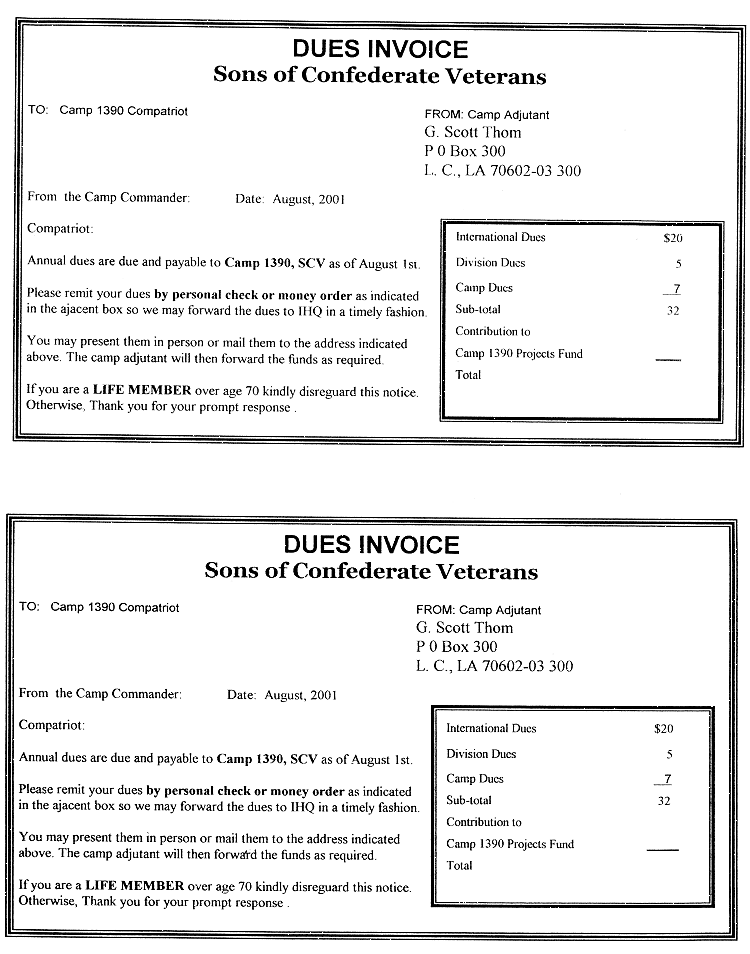
I know that we are all proud of our association with this venerable organization and even more so of our respective ancestors service in the Cause of Southern Independence. The Sons of Confederate Veterans is the largest and strongest organization devoted to "... the defense of the Confederate soldiers good name..." your dues and contributions help to maintain that vigilance. Renew your membership now! Don't find yourself regretful when the time comes to look your forebear in the eye. Be able to say, not only did I not forget your sacrifice but I upheld that charge presented to me on your behalf.... "To you, Sons of Confederate Veterans, we submit the vindication of the cause for which we fought. Scott Thorn, adjutant Captain James W. Bryan Camp 1390
Emma Sansom Chapter, Louisiana Society Order of the Confederate Rose proudly presents Emily Lapisardi as Rose ONeal Greenhow in "If This Be Treason," at 7p.m. Saturday, 29 September 2001 at the War Memorial Civic Center in DeRidder, Louisiana.
The presentation reviews the life of Rose O'Neal Greenhow, reveals some techniques used in espionage and summarizes her imprisonment, trial, and exile to the South. It is this Great Lady of the South the OCR honors in their organization name. A dinner will be served prior to the presentation. The cost to attend the dinner and presentation is $15 per person. To purchase tickets, contact Johanna Pate at 337-463-7692 (home), 337-4638555 ext. 3 (work) or [email protected]. Tickets must be purchased by 22 September 2001.
Rose Greenhow was born in Montgomery County, Maryland in 1817. She was a leader in Washington society, a passionate secessionist, and one of the most renowned spies in the War Between the States. She developed a network of Confederate agents, which secured and passed information to General Beauregard and others. She spied so successfully for the Confederacy that Jefferson Davis credited her with winning the First Battle of Manassas.
Friends,
This is to serve notice that the date for the Guehrs Monument dedication has been set for Saturday, April 13, 2002, at 11:00 AM at Waldeck cemetery in Fayette County Texas. The Major George W. Littlefield Camp #59 in Austin, Texas CSA and the Waldeck Cemetery Association in Fayette County, Texas CSA are proud to be working together to erect this monument to a Confederate Medal of Honor recipient. We are in the process of getting some flyers together that will have maps, a listing of local bed and breakfasts establishments and motels, dinner registration forms, etc.. There will be a BBQ dinner available for $5.00 a plate after the event at Cooper Farm about 2 miles from the cemetery in an air conditioned meeting hall that holds about 500 people. We have almost got the inscriptions on the monument finalized and sent to the company in Georgia and everything is going good. The monument to Pvt. Guehrs will be a 7 foot gray Georgia granite obelisk with baffle flags on two sides of the monument. The facing will have a rendition of the Confederate Medal of Honor at the top with Pvt. Guehrs story as the text. There will also be a 15 foot flag pole directly behind the monument that will fly the Confederate Battle Flag. We will also be dedicating 14 granite footstones for other Confederate veterans buried there, most of whom served in Creuzbaur's Battery. I will send out more updates when they become available. A Program will be printed for the event and a listing of donors of $50.00 or more will be listed. Donations can be made to: Marceil Malak, Treasurer Waldeck Cemetery Assoc. 7444 Meiners Rd. Ledbetter, Texas 78946
Thank you all for your interest and hope to see y'all next spring!
Respectfully, and Devoted to the Cause,
H. W. Irby
Commander Camp #59
Austin, Texas CSA
NIBLETT'S BLUFF - On the old east channel of the Sabine River, Nthletts Bluff Park binds Louisiana and Texas through a shared history that is important to both states, according to Allen Connel of Orange, Texas.
Connel spoke recently at the meeting of Capt James W. Bryan Camp 1390, Sons of Confederate Veterans. Connel, Gulf Coast Brigade commander of the SCV in Texas, shared some of his years of research on the history of Niblett's Bluff.
Niblett's Bluff was a major link between Louisiana and Texas on the Old Spanish Trail during colonial times and through much of the 19th century.
The area was officially surveyed in 1840 by a commission representing the Republic of Texas and the United States. It was known then as Millspaw's (Millspaugh's), and the settlement was called Jericho.
The community took the name of an early landowner, but is spelled slightly different than its namesake: Dr. Robert C. Neblett, who moved to Texas and settled in Grimes County. Over the years, the community saw the passing of cattle drivers, riverboat men, shiftless gamblers, lumber-men, military men and pioneers, such as Jim Bowie.
Treasure hunters have looked for booty allegedly buried by Jean Lafitte in the area. Lafitte supposedly scuttled a schooner near Niblett's Bluff; but no treasure has been found there. Connel said that during the War Between the States, the bluff became strategically important for funneling troops and supplies to the Confederacy and as a defensive bastion against possible Northern invasions of Texas through Southwest Louisiana.
One of the thousands of Confederate soldiers who passed through the area on his way to eastern battlefields was BA. Nabours of Company G, 5th Texas Infantry. Nabours wrote of passing through Niblett's Bluff in August 1861.
"The Port of Galveston being blockaded by United States war vessels, we could not get to New Orleans by steamer; so we had to take the land route from Houston to Beaumont, walking most of the distance, thence to Niblett's Bluff ,La."
He wrote at Niblett's Bluff they put their baggage on Creole carts and followed on foot through a low, flat country of pine woods and marshes, sometimes wading in water from four inches to waist-deep all day, and it was difficult to find a place above water to make our beds at night. It was then that the hardship's ofa soldier's life began for us. On to Lake Charles, New Iberia, and Lafayette Niblett's Bluff was also linked by the Confederate Military Road to Alexandria, where Gen. Richard Taylor had his headquarters. The road was infested by jayhawkers, who were know to waylay and kill Confederate messengers.
In a 1965 interview for the American Press, the late Eustis Dunn recounted a story his father, William M. Dunn, a Confederate messenger, told to him about that danger.
"My father was riding a fast mule to Alexandria with a message for the Confederate headquarters and almost lost his life."
It seems that the mule that the elder Dunn rode was a long-winded, fast runner and never tired or stopped unless pulled to a halt.
Dunn told his son, "I never had a horse as fast as that mule."
On one errand he came across a group of Army deserters.
"The Jayhawkers would have killed me, but I storied my way out," father related to son. He told them he had ridden there to join the deserters. William Dunn said the outlaws believed his story and let him go. He carried the message through and got back safely to Niblett's Bluff several days later. Casualties occurred at Niblett's Bluff in the winter of 1863, when 30 soldiers died in a measles epidemic. A marker erected in 1958 by the United Daughters of the Confederacy of Texas and Louisiana commemorates their deaths.
The earthen fort, traces of which can still be seen in the park, was built that winter on the command of Captain George W. O'Bryan of Company E, 11th Battalion.
Other commands that were stationed at Niblett's Bluff during the war included Gen. Alfred Mouton's Louisiana Brigade and Col August Buchel's Texas Cavalry.
Semmes Battery First Confederate Light Artillery was also stationed there. The living history group of the same name has adopted the park and presents historical demonstrations.
Connel noted that Niblett's Bluff Confederate Historical Society has been formed to preserve the history and heritage of the historic site.
Tim Steadman
Fighting Joe Wheeler 1372
Birmingham, Alabama
Guests included members from two chapters of the Louisiana Society of the Order of Confederate Rose: Eugenia Levy Phfflips Chapter of Lake Charles, and the Emma Sansom Chapter of DeRidder.
Mike Jones of Captain James W. Bryan Camp 1390, Sons of Confederate Veterans, gave a presentation on the "Battle of Calcasieu Pass," the only battle to take place in southwest Louisiana during the War Between the States.
The site of the Battle, along with a graveyard of both Confederate and Union soldiers is located on Monkey Island in Cameron, Louisiana.
General Grant was the last of the United States Presidents that bought, owned, and worked a slave. The slave's name was William Jones. In 1858, while attempting to make a go in civilian life as a farmer near St Louis, Missouri, Ulysses S. Grant bought the slave, William Jones, from his brother-in-law. Grant also became the owner of record of his wife's inheritance of four slaves, but as was the case at the time, women could not actually own slaves, so they were under the control of Grant. There is no record of these slaves having been freed prior to emancipation in Missouri in 1865. In 1862, U.S. General Ulysses S. Grant's army had become encumbered by runaway slaves. Grant decided to go into the cotton business, using the runaway slaves to pick cotton in the Mississippi fields. Gen. Grant did pay them though- a small wage which was just enough to cover the cost of their food that was provided for them. The cotton was shipped back to factories in the North, with Grant collecting the profit. Grant did not own the land or the crops! General Grant owned slaves that were not freed until the passage of the 13th Amendment.
It is interesting to note some of the thoughts of General Grant informed his family that his only desire was, "to put down the rebellion. I have no hobby of my own with regard to the Negro, either to effect his freedom or continue his bondage. I am using them as teamsters, hospital attendants, company cooks and so forth thus saving soldiers to carry the musket . . . it weakens the enemy to take them from them. "Robert E. Lee personally owned at least one slave, an elderly house servant that he inherited from his mother. It is said that Lee continued to hold the slave as a kindness, since he was too feeble to have made his way as a free man. Although it is commonly believed that Lee owned the Arlington Plantation and the associated slaves, these and two other plantations totaling over 1,000 slaves were the property of Lee's father-in-law, George Washington Parke Custis. Upon Mr. Custis's death in 1858, Lee did not personally inherit either the plantations or slaves, but was named the executor of the estate. Mr. Custis willed that his slaves should be freed within 5 years. Legal problems with the fulfillment of other terms of the will led Lee to delay In the execution of the terms of manumission until the latest specified date.
On 29 Dec 1862, Lee executed a deed of manumission for all the slaves of the Custis estate who were still behind Confederate lines. Arlington was in Union hands by that time in history.
References: "Lee & Grant", by Gene Smith. "The Civil War: Strange and Fascinating Facts", by Burke Davis; "Let Us Have Peace: Ulysses S. Grant and Politics of War and Reconstruction", by Brooks D. Simpson.
We normally hold the election in November since the December meeting is a Christmas social. The new officers are then sworn in at the January Lee-Jackson Banquet. For more information call Cmdr. Thorn. 625-8473 or the editor, 582-6154.
Corporation Cemetery: it is the desire of the Camp to beautify this hallowed ground through the reclamation of the overgrown areas, the restoration of the existing tombs and tombstones, the placement of veterans tombstones where it is applicable, the creation of a simple yet appropriate memorial to those resting there and the installation of a more suitable fencing around the entire perimeter of the cemetery. There is also being considered the addition of a historical flags of Louisiana display. Estimated Cost: $10,000.00+ Southwest Louisiana Genealogical & Historical Library The Camp has committed to the purchase of the National Archives microfilmed Compiled Service Records Of Confederate Soldiers from the State of Louisiana. There are more than 400 rolls in this collection at a cost of $19.95 each. It is an integral tool in any research effort involving a Louisiana Confederate Soldier. These can be purchased in increments. Compatriots may wish to donate one or more rolls which include their Louisiana ancestors records. Estimated Cost: $ 8,200.00 Flag Restoration Southwest Louisiana is very fortunate to have in its possession an original Confederate Flag. The naval ensign of the CSS Tennessee is housed in the Imperial Calcasieu Museum. This second national pattern flag is in good condition but in order to assure its preservation for future generations the Camp is raising the necessary funds to have it inspected by a textile preservation specialist. After such an inspection is made the Camp intends to see to it that the recommendations of the specialist are met and the flag is properly encapsulated to provide for it's maximum protection. Estimated Cost: $ 3,000.00+
Confederate Memorial Hall in New Orleans is home to the second largest single collection of Confederate Flags in existence. Many of these glorious artifacts are in perilous condition and are in need of immediate preservationist care. The Camp has also dedicated its efforts to the raising of funds for this cause. A specific flag has yet to be chosen as the direct recipient of our efforts but consideration of the many banners in need is ongoing. Estimated Costs are limited to those needed for the status evaluation fees charged by a textile specialist until a flag is chosen: $ 500.00 - $1,000.00
Captain James Wesley Bryan Bust - In 1996 the Camp began It's search for a suitable sculptor to commission to create a life size bronze bust of our camp's namesake. Before raising a local company for Confederate service and serving as it's commander, Capt. Bryan was a member of the first Calcasieu Parish Police Jury and later served as the first mayor of the City of Lake Charles. Additionally, he founded one of the early newspapers The Lake Charles Echo, in the region and also served as one of it's early educators. It is our desire to present the sculpture to the city so that it may be placed upon the grounds of the restored old City Hall. Thereby, adding to both the artistic and historical integrity of our community. Estimated Cost: $ 6,500.00
A more detailed description of each project and costs is in progress, for more information or to learn how you might assist, please contact Scott Thorn at 439-3217.