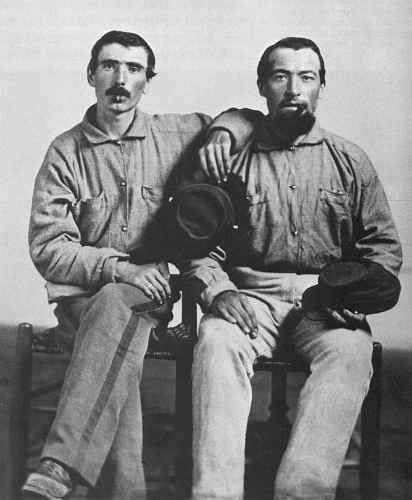
| These unidentified Confederate infantrymen belonged to General Harry Hays's Louisiana Tiger Brigade, which swarmed over Ricketts' battery on Cemetery Hill. Mostly French-speaking Creoles, the Louisianians were "the best marchers in the army and gay and grand in battle," according to an admiring South Carolinian who saw them in action. Picture is from the Chicago Historical Society. |
He also has some very nice quality 3 inch by 3 inch Confederate battle flags for $1.25 each. These are excellent decoration for an almost unlimited variety of uses.
For more information or to purchase an item, contact M.L. Weaver at 2802 Smith Ferry Road, Westlake, La. 70669, or call (337) 436-1853.
Jones said the reason he was running was because it was obvious there are serious differences of opinion on the way the Louisiana Division should be run. He said he believed the only honorable way to contest those differences and give members a real choice is through the election process. In addition, he said the Louisiana Division is big enough and mature enough that it should have regular elections for state offices, rather than continuing to allow a small group of people to hand pick state leaders and just announce them at the annual state convention without any real campaign.
He said the three main planks in his platform are to safeguard the constitutional rights of the local camps, reduce the power of the state executive council and to cut state dues in half.
Jones said his campaign theme is "Your Camp Rights Candidate" because he believes the Louisiana Division should be the very model of a "Confederacy." He said to him that means local camps should be sovereign and independent, the state executive council small and with only a few inexpensive duties and the general constitution of the Sons of Confederate Veterans should be strictly followed to the letter and without any "interpretation" by lawyers.
He said although he could only propose changes to the state executive council to reduce its power, he said he would propose the following: end lifetime membership on the council for former division commanders; end voting privileges by non-elected appointees to the council; cut the division staff in half, and follow the correct constitutional procedures for discipline of members, which means the local camp is the "court" of origin, the division level is the first "court of appeals" and the general executive council is the last "court of appeals."
Jones said state dues (taxes) are too high at $5 per member. He said he would propose that state dues be slashed in half, for a beginning. The candidate said every dollar drained from local camps weakens heritage defense and advancement at the local level. He said he would set the example for economy and efficiency by pledging to pay his own expenses for attending meetings and conventions, rather than expecting the members of to Louisiana Division to pick up his tab.
This is not intended to be an implication or criticism that any current division officer is being paid for any SCV business, or that any current practice of the division is in anyway wrong. It is a statement of how I would personally operate if elected division commander, and not a reflection on anyone or any policy that may or not be in place about reimbursing necessary business expenses of the division.
[Jones said he has also been informed that the above suggestion concerning expenses is already standard operating procedure for the division. He commended the division for the policy and pledges to continue it if elected. He also said he wants to run a clean campaign and acknowledge his mistakes, retract any incorrect information and apologize for them, as in this case.]
The association surveyed 400 vexillologists (people who study flags) to determine the ranking of state, provincial and territorial flags in North America. The state flag of New Mexico was voted the best flag and Georgia's the worst flag.
The new Georgia flag features the state seal on a blue background with five tiny flags underneath, which represent former Georgia flags and the U.S. flag.
"We are mandated to see to it that the truth about our heritage is preserved and presented to future generations," McCredie said. He said the general public knows very little of this except what it sees and hears -- or doesn't see and hear - in the media.
McCredie said public demonstrations are a radical departure from the norm of the SCV. The protests were designed to take South's case directly to the American people, who SCV officials believe are largely ignorant of the ethnic cleansing of Southern culture, McCredie said. McCredie cited the following serious cases of persecution of Southerners:
* Bill Calliham, whose truck bears a Sons of Confederate Veterans license plate, was followed for miles across Columbia, S.C., then beaten senseless in his own front yard. He was eventually able to identify his assailant, but cannot obtain a warrant for the attacker's arrest. The incident received only passing notice in the local press.
* Ryan Zane Oleichi, 13, of the Houston, Texas area, was hospitalized after being savagely kicked and beaten for carrying a book with a Confederate flag on its jacket. The book came from his own school library. Ryan had previously undergone three days suspension from the school for wearing a small Confederate flag patch on his T-shirt. His assistant principal said Ryan should be made an example of "because he is a racist."
* Shots were fired from a passing car into the yard of a Sumter, South Carolina, couple who was hosting a barbecue for a Southern heritage group. The vehicle was identified but police made no arrests, saying the presence of Confederate flags in the yard was an invitation to violence. A reporter who sought to follow up the story was asked, "Do you have some kind of ties to these people?"
* The Dupont Company's video lecture on racial discrimination depicts two unsavory characters it calls "good ole boys," one with a Confederate flag on his toolbox. The flag is cited as a "racist symbol."
McCredie said these cases and literally hundreds more like them are the reason why the SCV took to the streets in a day of protest against the nationwide attempt to obliterate Confederate heritage.
The boy's mother and lawyer believe the actions of school officials set the stage for the attack.
A week ago, the Southern Legal Resource Center sent out the story of Ryan Zane Oleichi to its distribution list as part of its May 30 update. Many recipients found the account so hard to believe, the SLRC felt the need to confirm its accuracy in an electronic newsletter on Thursday.
April 26 is Confederate Memorial Day in Texas. In his first-period class at the Labay Middle School outside Houston, Ryan was looking at a history book he had checked out of the school library to do an assigned report. On its cover was a small Confederate battle flag.
The account of what followed comes from the SLRC newsletter, written by Executive Director Neill H. Payne. It derives from Payne's conversations with Ryan and the boy's mother, Melinda Hill. Payne's account also draws on Kirk D. Lyons' interviews of Ryan and Hill as well as a letter from their family doctor. Lyons, SLRC's chief trial counsel, represents Ryan.
As reported in the newsletter, a black classmate asked Ryan what he was looking at.
"What is that?" he asked.
"It's a book."
"Why do you have that flag on it?"
"It's the only one in the school library," Ryan responded.
At that point, a Hispanic student chimed in, "You racist. I'm gonna kick your a--," followed by other invectives.
When Ryan was leaving the classroom, the first student slammed him against the lockers and issued his own threat to harm him.
After school, the two caught Ryan outside the fence. The first beat Ryan to the ground, and the second kicked Ryan in the head repeatedly until he lay unconscious at their feet.
Ryan spent three days in the hospital before being released to convalesce at home.
Lyons and Payne believe that school officials stigmatized Ryan, increasing the likelihood of the attack. On Feb. 19, Hill was called to school by an assistant principal, who told her that her son would start three days' suspension for wearing a small Confederate patch on his shirt.
Although violations of the school dress code call for only one day's suspension, the assistant principal told Hill that an example had to be made of Ryan because "he is a racist."
Hill was concerned by this turn of events. She described her son as a good student and not a troublemaker, but a boy who loves his Southern heritage. He is not a racist, Hill said. In fact, "he is half Lebanese." Nevertheless, Ryan was suspended for three days and forced to apologize to all the black students for being a "racist." Payne wrote that this "set in motion the wheels of persecution that led to Ryan's beating."
Students began verbally abusing and harassing Ryan. On April 20, a girl walked up to Ryan, slapped his face and threatened to sic her "posse" on him.
After Ryan was hospitalized and returned to school, he received more verbal abuse and death threats. Ryan learned that the Hispanic student who kicked him was saying that he was "not satisfied and won't be until Ryan is dead."
Lyons told UPI that the school did nothing when it learned of the incident and tried to represent it as a fight instead of assault and battery. The local district attorney has refused to file charges, Lyons said. Hill withdrew Ryan one week after he returned to class. She will school him at home.
UPI, 08 June, 2001
The following are the displays to be added to the tours:
- Four Plates Removed For Unobstructed Viewing Of The Incredible Interior
- Lighted Tank & Underwater Camera Detail The Innovative Design & Inner Workings
- The Spar that Delivered The History-Shaking Explosion
- Latest X-Ray Images Of Artifacts Including The Lantern, Pocket Knife, Canteen & Wallet
- Life-Size State-Of-The-Art 3D Hunley Laser Scan of the Sub's exterior
- Artifacts Photo Gallery Including ID Medallion & Lt. Dixon's Life-Saving Gold Coin
Senator McConnell, Chairman for the Hunley Commission remarked that, "This is a rare opportunity to see the inside of the submarine where the light has returned after 137 years and to have the submarine and its crew silently speak to you. Seeing the actual Hunley before the final phases of excavation begin in the fall is the last chance to see the submarine with some of its contents on board. With the exhibits you can climb aboard a replica, get a picture of what it was like and see photos of the artifacts. You will be Hunleytized."
As always, merchandise will be available with over 100 official collectibles, gift items and more. Purchase of these official Friends of the Hunley and Hunley Commission items in our gift shop benefits the ongoing restoration. (Tickets are not necessary for gift shop).
Tickets are available online through ETIX at www.etix.com or toll free by phone at 866-866-9938.
The recognition of Memorial Day should have been cause for each of us to pause and reflect upon the sacrifices of those who have served our country in times of armed struggle. Throughout American history these men and women have paid dearly to insure our safety and freedom as well as that of our allies and business interests. In looking back, one can easily ascertain that a very large proportion of these defenders have been Southerners. This is understandable, when you consider the examples set forth by our predecessors and theirs before them. George Washington, Francis Marion, Daniel Boone, Andrew Jackson, David Crockett, Sam Houston, Zachary Taylor, Jefferson Davis, Robert E. Lee, "Stonewall" Jackson, Alvin York, George S. Patton Murphy to name only a few of the many.
Louisiana is blessed as one of the most multi-cultured states in the entire country, and this was just as true at the time of her fight for Southern Independence (1861-1865). Men of all ethnic backgrounds, religions and social stations fought, suffered, bled and even died for the right of Louisianians to decide what was right for our state as well as in defense of their families, homes and property. Their sacrifices were many and their cause, pure and noble, contrary to what some modern revisionists of factual history would have us believe.
These heroes were first memorialized on April 25, 1866, about one year from the beginning of the end of the War. Credit for the first Memorial Day most often goes to a group of Southern Ladies in Columbus, Miss., who arranged to place flowers upon the graves of both Union and Confederate soldiers in a cemetery near town. However on June 9, 1866, the schoolgirls of Petersburg, Va., placed flowers upon the graves of the 30,000 Confederates who died defending that city. Two years later, a Union Army officer, whose wife had witnessed the Petersburg Memorial Day requested that May 30 be recognized as the day to place flowers upon the graves of the Union soldiers. The annual ceremony spread across the country and was eventually recognized as a federal holiday in 1971.
June 3 is recognized here in Louisiana as Confederate Memorial Day. This is also the anniversary of the birthday of the only President of the Confederate States of America, the honorable Jefferson F. Davis, and was chosen for that reason. In the days leading up to Confederate Memorial Day, flags will be placed upon the final resting places of Confederate veterans all across the state as well as here in Southwest Louisiana. We of the Sons of Confederate Veterans invite you to join with us as we pay tribute to those men White, Black, Red, Brown, Catholic, Protestant and Jewish who all made the sacrifices for the possibility of a free Louisiana at 3 p.m. Sunday, June 3 at "The South's Defenders" Monument, Calcasieu Parish Courthouse Grounds.
G. SCOTT THORN
Past Commander Capt. James Wesley Bryan Camp 1390, Sons of Confederate Veterans Lake Charles
The suit concerns the unlawful removal of two Confederate dedicatory plaques from the Texas Supreme Court Building. A 1954 amendment to the Texas Constitution transferred money from the Confederate Pension Fund to build the Supreme Court Building. By that amendment, the building was to be a memorial to Texans who served the Confederacy, and be "properly designated."
On June 9th, 2000, under pressure from the N.A.A.C.P., then-Governor George W. Bush ordered the removal of the plaques The plaques were removed after normal business hours, without legislative process or public input. In the last year, members of various state heritage groups have spoken to the General Services Commission, demanding the plaques be returned or a formal public hearing be granted.- The GSC has done nothing to address the issue.
The Sons of Confederate Veterans have held a daily vigil at the Supreme Court Building since the plaques were removed. Members in uniform have stood outside the main entrance holding various Confederate flags.
For more information, contact Marshall Davis 512-413-7400.
"President Bush did not lay the actual wreath," says Tom Findtner, public affairs specialist for the U.S. Army Military District of Washington. "The White House military office coordinates the wreath-layings every Memorial Day.
"According to our historian, it's been going on forever," he says of the presidential wreaths.
However, Vicki Heilig, president of the D.C. chapter of the United Daughters of the Confederacy, says she's never seen a presidential wreath at the Confederate Monument until now.
"As usual, I took our United Daughters wreath to the Confederate Monument and was flabbergasted to see a wreath already there," she says. "When I read the card and it simply said 'The President,' my heart skipped a beat."
To those who have reservations at either the Hilton or the Acadiana: if you have not already done so, you must secure your reservation by credit card guarantee OR by mailing a check for, at the minimum, the first night's room and tax as a deposit. You must do this so that the hotel receives this by July 17. After that date, any reservations which have not been secured by one of the means described above will be released.
To those who paid Early Registration for our Convention in Charleston last year: the only thing that was paid at that time was your Registration which, at that time, was $40.00. If you paid Early Registration, we have a record of it. No one paid for any events at this year's Convention because the prices had not been set. If you want to attend any event(s) for which payment must be made, copy the Registration Form which appears in the Confederate Veteran, write legibly in the area of the Form regarding Registration that you paid your Registration in Charleston, complete the rest of the Form with the events you wish to attend and the number in your party and send your Form in. You do NOT owe another $20.00 in Registration fees.
REMINDER: ONLY MEMBERS REGISTER. Spouses and dependents do NOT pay Registration. HOWEVER, ALL who wish to attend the events which require payment must be paid for in order to attend.
REMINDER: as is stated on the Form, if you send $60.00 and your mailing is postmarked after July 1, your check and your Form will be returned. Registration postmarked after July 1 is $75.00 per member--no exceptions.
REMINDER: if you wish to attend any event involving a meal of any kind for which payment must be made, your Form and a check for the correct amount must be RECEIVED by July 27. No registrations for meals of any kind received after July 27 will be honored--no exceptions. For the Thursday tours... we will be 30 miles from the Gulf of Mexico. It will be August. While I am expecting that the air conditioning will function for indoor events, plan to dress comfortably for the Thursday tours. For the Ladies' tours on Friday, you all will be joining the members at the Memorial Service so you will wish to be attired accordingly. Edward O. Cailleteau Chairman, 2001 Convention Host Committee