 |
 |
 |
 |
 |
 |
|
| Caution-Manatee Zone |
 |
 |
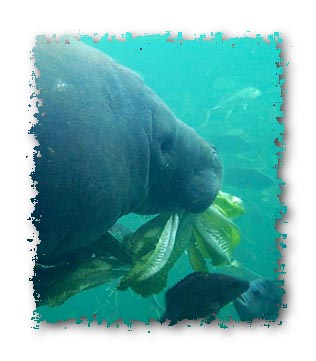
| DOC has returned to Blue Spring every winter since 1976. He is an adult male, nearly ten feet in length. Doc is one of the few manatees frequently spotted in the spring in the summer |
 |
| Our Class has Adopted a Manatee!!! We are very excited to learn about manatees while helping them at the same time. The manatee we adopted is named Doc and he is a regular at Blue Spring State Park in Florida. Although we live in Missouri we thought it was important to help save an endangered animal. We decided this was one example of being a good citizen! |
| Manatees average 10 ft. and 800�1,200 lb. Manatees have paddlelike tails and foreflippers, and no hind limbs. Manatees belong to the mammalian order Sirenia. There are three species of manatee: the Amazonian manatee, the West African manatee, the West Indian manatee. Scientists also recognize two subspecies of West Indian manatee: the Florida manatee, and the Antillean manatee. All manatees inhabit tropical and subtropical waters of North and South America and Africa. The West Indian and West African manatees live in rivers, bays, estuaries, and coastal areas. They can move freely between freshwater and saltwater habitats. The Amazonian manatee is restricted to the freshwater Amazon basin. All manatees are herbivores. The Florida manatee feeds on more that 60 varieties of grasses and plants. A manatee�s only teeth are molars, for grinding vegetation. Some research suggests that manatees periodically require fresh water. West Indian manatees have been seen congregating at river mouths and drinking from hoses, culverts, and sewage outfalls. A female manatee, called a cow, gives birth about once every three years. Gestation lasts about 12 months. At birth, West Indian manatees measure about 4�4.5 ft and weigh 60�70 lb. A calf nurses from teats under the mother�s pectoral flippers. Florida manatees are highly susceptible to cold; it�s not unusual for them to die during extremely cold weather. But human activities pose a much greater threat to manatees. Each year, many Florida manatees are killed and injured by watercraft, the greatest human-induced cause of Florida manatee deaths. Other threats include entanglement, poaching, and habitat destruction. All manatees are threatened or endangered. They are protected by national and local legislation in every country in which they are found. Information from Sea World |
 |
| A manatee can move each side of its lip pads independently. This flexibility allows the manatee to "grab" aquatic plants and draw them into its mouth. Manatees do not have eyelashes. Their eye muscles close in a circular motion, much like an aperture on a camera. They have a lid-like membrane (called a nictitating membrane) that closes over their eyes for protection when they are under water. Manatees can hear very well despite the absence of external ear lobes. A manatee's heart beats at a rate of 50 to 60 beats a minute. The heart rate slows down to 30 beats a minute during a long dive. Manatees have no "biting" teeth, only "grinding" teeth. A manatee's teeth (all molars) are constantly being replaced. New teeth come in at the back of the jaw and move forward about a centimeter a month. The front molars eventually fall out and are replaced by the teeth behind them. This tooth replacement is an adaption to the manatee's diet, as it consumes plants that may hold a lot of sand. Manatees have only six cervical (neck) vertebrae. Most all other mammals, including giraffes, have seven. As a result, manatees cannot turn their heads sideways, they must turn their whole body around to look behind them. The manatee's rib bones are solid, there is no marrow. They make red blood cells in their sternum where marrow is found. The manatee has pelvic bones, but they are not attached to its skeletal frame. They are remnants of a time when manatees lived on land. The bones are found in a cartilage tissue area of the body in the vicinity of the reproductive organs and the urinary bladder. The bones are soft when the manatee is young and later harden as they mature. Other remnant bones found in the manatee are the hyoid bones located near the neck region. These bones are similar to the Adam's apple in humans. Today, there is no known use of these bones in the manatee. The manatee's lungs lie along its backbone instead of along its rib cage as is found in most mammals. The lungs are long (1 meter or more in adults), wide (20 cm), and thin (5 cm or less). Besides breathing, the lungs help the manatee with buoyancy control. The bones in a manatee's flipper are similar to a human hand. The jointed "finger bones" of the flipper help the manatee move through the water, bring food to its mouth, and hold objects. Three or four nails are found at the end of each flipper. The adult manatee averages about 10 feet long and weighs about 1000 pounds. |
 |
 |
 |
 |
| Manatee's are our Friends |
| Help Save the Manatee's |

|
| Thanks for stopping by!!! |
| Great Manatee Links: |
| Wonderful Manatee Lesson Plans |
| Come See! |
| Manatee Acrostic Poems A few examples students wrote in class |
| Mammal Animal Nurse their babies Average 55-95 pounds of food a day Tail paddle-shaped Elephant is their closest relative Eat seaweed and grasses by: Kiara |
| Move slowly Alone a lot Newborns are called calves Aquatic Teeth grind Endangered Eyes are very small by: Rayiana |
| Manatees can live up to 60 years Are very gentle Never bother other water animals Are able to hold breath for about 20 minutes Tails move them through water Eat only plants Engage is social activities by: Kalen |
| Males and females Adoptable Never bite Are hurt by boats propellers Teeth are strong Eat 6 to 8 hours a day Enjoyable by: Antione |
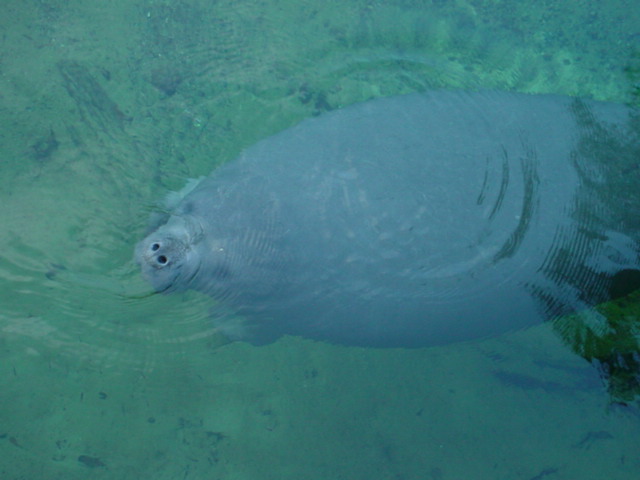
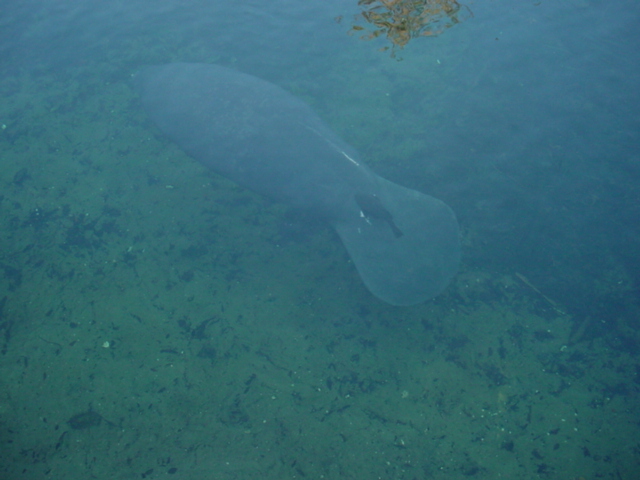
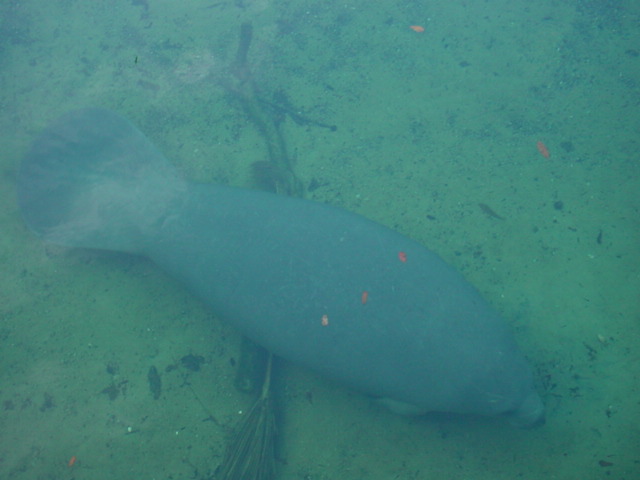
| I have been lucky enough to visit Blue Spring State Park twice. The first time was on December 27, 2003 the second time was December 27, 2005. The first time I was at the park in 2003 there were 88 manatees in the warm spring water. Doc was there, I was so excited to see him. The manatees come in from the river when the water is cold. I have never seen so many manatees in one place, it was overwhelming! There is no gaurantee you will see any because they are free to move in and out of the park as they like. I have to say watching these gentle creatures move through the water is an amazing sight. The second time I saw the manatees at Blue Spring in the winter of 2005 there were 94. They were very playful on this trip, the manatees kept doing belly rolls in the water! I hope to return in the winter again! |
 |
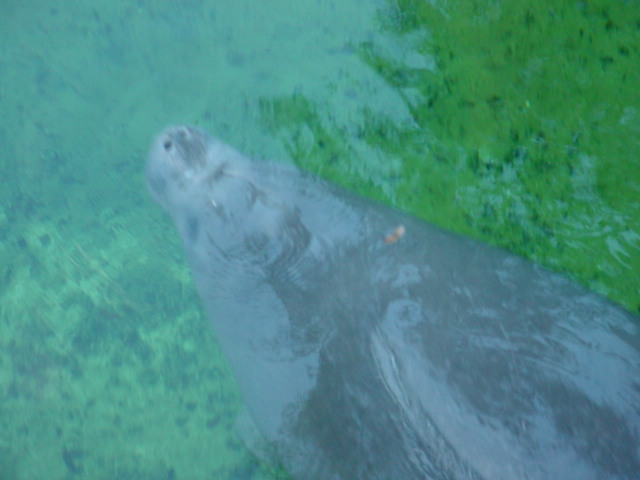 |
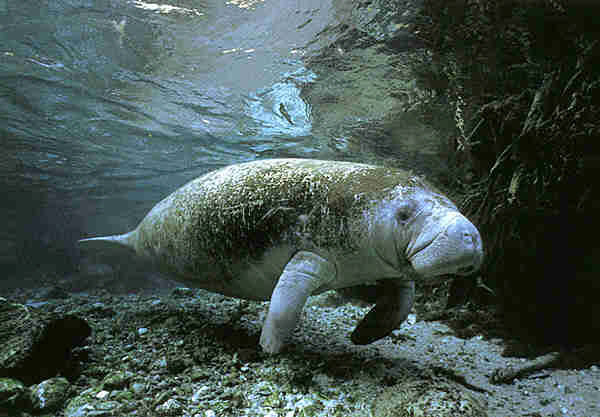
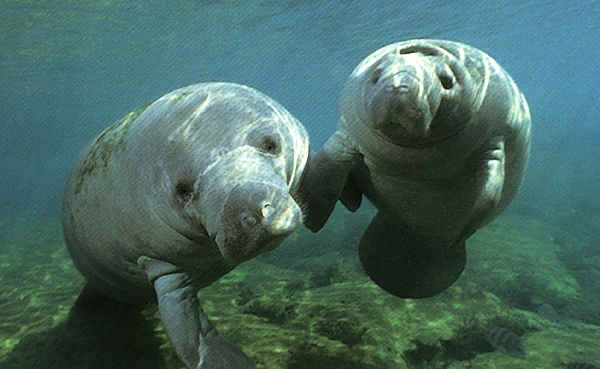
| Ms. Steffens took these four pictures below at Blue Spring State Park! |
 |
 |