Richard Hoare – The Founder of Kerrytown
Hoare Surname
The Hoare surname is traditionally descended from Phillipe
le Hore, an Anglo-Norman invader under Strongbow in the 12th
century. Several Hoares also came to Ireland as Cromwellian officers and adventurers.
The name is mostly associated with County Wexford and County Cork, although it
was also common in County Kerry in the 1800’s.
In England the Hoare name is associated in banking circles. Sir Richard Hoare established the Hoare banking empire in the late1600’s. This bank is still in existence today as Hoare Govett Ltd. This Hoare family owned Stourhead estate in Wiltshire.
Ireland
Richard (Dick) Hoare was born about 1838 to Irish tenant farmer Patrick Hoare and his wife Catherine Seeler. Other children in the family we know about are his brother Dennis and sisters Mary and Margaret. Richard was probably named after his grandfather, also a Richard Hoare.
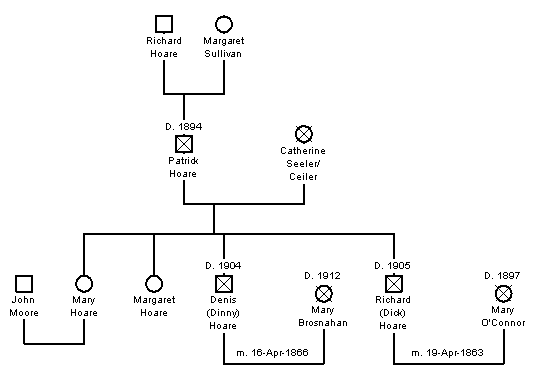
The family lived on a farm at Dromcunnig in the O’Dorney (Abbeydorney) parish of County Kerry, Ireland. Kerry is the farthest corner of Ireland. Abbeydorney village is 5 miles from Tralee, the main town in Kerry. The farm was 68 acres which was a good sized farm in the Irish setting, but as Patrick was a tenant at will, he was open to the loss of his tenancy at any time with no compensation for any improvements to land or buildings which he might have made. The Irish at that stage were not allowed to own land.
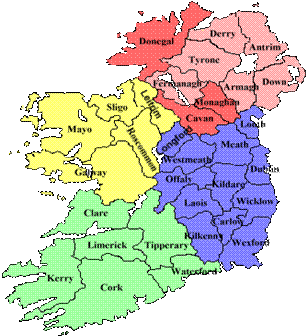
Figure 1 Ireland Counties
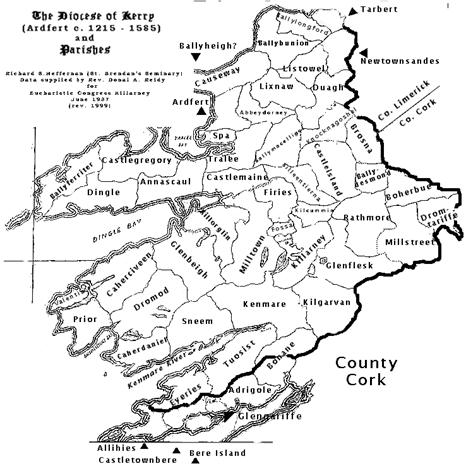
Figure 2 Abbeydorney (O’Dorney) Parish
During Richard’s childhood, a disaster took place that was to change the face of Ireland forever. The potato crops were the main source of food for Irish peasants, and they failed when affected by a fungus. Coupled with a lack of response from the ruling English politicians, this caused a great famine. This lasted from 1845 to 1849, and caused many deaths from starvation and disease, as well as encouraging large-scale emigration. In County Kerry an estimated 32,000 people died and many more emigrated. Between the 1841 and 1851 census, the population of Kerry dropped from 293,000 to 238,000. Other secondary effects of the famine were a big decline in the practice of traditional Irish customs, and a big reduction of the number of small land holdings.
Emigration
As work in Ireland was difficult to find, Richard would travel to Scotland for work in the busy harvest season. It was probably during one these trips that Richard heard about emigration to New Zealand. The Free Church of Scotland was keen to bring new immigrants to it’s settlement in Otago, and would be happy to fill the ship with Irish if it could not find enough willing Scots.
Early in 1860 Richard boarded the ship “Robert Henderson” in Glasgow as an assisted immigrant bound for Otago. The Robert Henderson was built in 1857 especially for the emigrant traffic to New Zealand. The book “White Wings” describes this ship as having every convenience and comfort. The book further describes this ship:
This smart little ship was a contrast to the general run of vessels sent out to the colony in the early days. For her size – her tonnage was only 586 – she made a remarkable run out to Otago on her first voyage. In all Robert Henderson made eleven voyages to New Zealand, one to Auckland, one to Lyttelton and the balance to Otago.
522 gross tons, length 158 ft (48.15m) x beam 28.3 ft (8.62m), a three masted ship rigged vessel, wooden hull. Built at Aberdeen, Scotland, in 1857, for P. Henderson’s Albion Line (hence the name). Slim and fast with excellent emigration accommodation. The saloon was 50 ft (15.24m) long between the fore and main masts. Acquired by Shaw Saville in 1871 and sold to J. Hay & Co. London 1872. Condemned and scrapped in 1882.
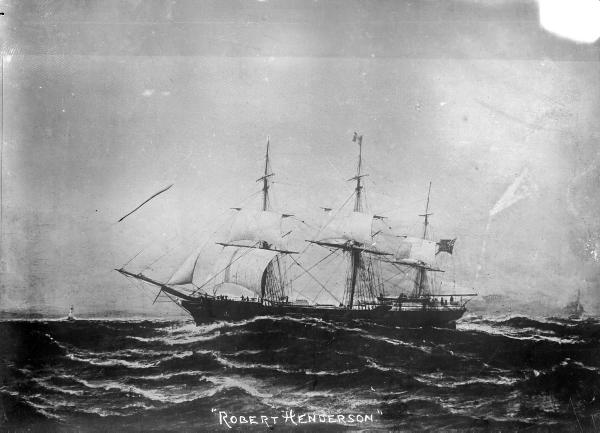
Figure 3 Robert Henderson
Life in New Zealand
When Richard Hoare arrived in Dunedin in 1860, this settlement was only 12 years old. There was plenty of work for those with farm labouring experience, and it is probable that Richard would have worked as a labourer.
Then in June 1861, Gabriel Reid found gold at Tuapeka, near Lawrence. This was the first major find of gold in Otago, and it created a gold rush. The population of Otago quickly went from 12,700 in Dec 1860 to 30,000 by Dec 1861. However the rush at Tuapeka was over just as quickly as it began. In Jan-Mar 1862 170,770 oz of gold was exported and in the next three months, Apr-Jun 1862, this dropped to 81,205 oz, and in June 1862 alone, only 16,513 oz was exported.
Richard Hoare was fortuitous enough to be in the Otago region when the gold rush began. He is reported to have done well out of goldmining, but left before the next gold rushes began. In August 1862 through 1865, further gold fields were discovered in Otago at Dunstan, Bannockburn, Arrow, Cardrona, Nokomai, and the Shotover.
By March 1862, Richard had left Otago and was in the Timaru area as a farm worker, probably for Rhodes on his run the Levels. By 1863 he is listed as a landowner, holding some acres near to the Levels on the southern bank of the Opihi River. He continued to work in the area on other farms as well as farming on his own account.
More Immigrants from Kerry
The Canterbury Provincial Government ran a nomination scheme, whereby persons already resident in Canterbury could nominate their family for a free passage to New Zealand. In this way, once one Irishman was through the net in this most Anglican of colonies, a whole family of Irish can make it through. Richard used this process to bring out his family and friends.
From the Brosnahan book, we find the following story about Richard Hoare:
One oral tradition has it that his employers, the Rhodes, were so impressed by his work that they encouraged him to get his friends and family to follow him and promised work for them on the Levels. This ties in with the pretty well with what happened.
Another family story is that Richard was a shrewd businessman, and having bought land for farming, he needed workers. With labour in short supply, he bought out his family members to work on his farm. Once here, they could never afford the trip back to Ireland, so were stuck working for him.
On December 16 1862, the second immigrant ship to Timaru, the “Echunga” arrived with the following family members and fellow Kerrymen:
Patrick Hoare (his father)
Catherine Hoare (his mother)
Denis Hoare (brother)
Margaret Hoare (sister)
John Moore (brother-in-law)
Mary Moore (sister)
John and Mary’s four children
Elizabeth Connor
Brosnahan Family (including Mary who married Richard’s brother Denis Hoare)
From the Lyttelton Times of December 24, 1862 we have these two records of the journey, and the subsequent refusal of some passengers to disembark:
Arrived - Dec. 23, ship Echunga 1007 tons, Cooper, from London, via Timaru
Immigrants At
Timaru
From the "Lyttelton Times" December 24, 1862
It is stated that a considerable number of the immigrants on board refused to be landed at Timaru, in opposition to the wishes of the Resident Magistrate, who appears to have stood in place of the Government on this occasion. On the part of the immigrants, it is said that there was no accommodation provided, and that there contract tickets were made out for Canterbury and did not bind them to be landed at Timaru. We have heard it stated that the barracks which were supposed to have been provided for these same immigrants months ago, had only risen about three feet from the ground: that tents were begin put up only after the landing or the first batch, which took place during heavy rain; that no drains had been dug around these tents to carry off the surplus water; that no firewood had been provided; and that there was not even a proper supply of dry straw for the people to lay down and rest upon. We do not vouch for these particulars, though we have no reason to doubt the general tenor of our information, which goes to prove that though the authorities knew as far back as May last that a large batch of immigrants would be landed at Timaru, they were caught on December 16 almost totally unprepared. Under these circumstances if we had been in the position of these immigrants we should also have very firmly but respectfully declined to land.
The Echunga, from London (10 September 1862), via Timaru, arrived in Lyttelton on Saturday last. She arrives at Timaru on Tuesday morning, the 16th inst., after a fair passage of 102 days from Gravesend. Lost six at starting, having to beat down the Channel. Left Start Point astern on September on September 10 and sighted Stewart's Island on December 12. On the 14th inst. encountered a heavy gale from the northwest, and had to lay to under close reefed topsails. The passengers speak in the highest terms of kindness and attention experienced at the hands of the captain and doctor. The Echunga landed 130 of the immigrants at Timaru. Several of the others who intended to have been landed there declined to do so as they did not consider themselves bound to land where no sufficient provision had been made for their reception.
It is easier to understand why some passengers refused to disembark at Timaru when we read the following extract from the dairy of fellow Echunga passenger, William Jewell:
Tuesday – We pulled up and arrived at Timaru anchor about 4 O Clock this morning. It is a strange looking place on the side of the shore the houses are very straggling we could not see a tree could not see nothing but mountains lying around covered with snow. We fired a gun and just after a boat with 3 men on board put out to us & came aboard one was native neither one of them was the pilot but they were government men & belong to the boats & put off because we were so near the reef. They have 2 buoys here and anchor chains which we anchored to. The Doikes and Magistrate came on board & engaged several we were landing passen all day in boats had to go about 2 miles toget ashore. The Depot was not ready for us to go in so they put up tents for those that had landed. There was great demand for single women but they did not like the place.
Wednesday – Landing early this morning the Captn & Docotr has been ashore & speaks highly of the place. This is not a wooded couuntry. There is not any growing within 12 miles of Timaru. The Commissioners wanted for all the Passengers to land at Timaru that was assissted by the Government but a great many refused to go & a great number went ashore quite against their will frightened.
We can get some idea of the size of the trip they made from the following excerpt from the Brosnahan book:
Like all of the Kerry immigrants to come to South Canterbury the Brosnahan girls would have first had to make the long journey from Kerry to London to catch the boat. This in itself must have been a major undertaking – it was probably the first journey outside the county for the majority of them. Some would never make another such journey again, like old Catherine Hoare (Richard’s mother), who never moved more than twenty miles beyond her home at Kerrytown for the rest of her life.
Richard and Mary’s Family
Richard Hoare and Mary O’Connor married at Timaru on 19 April 1863. As there were no Catholic Churches yet in the district, they are shown as marrying at a Mrs. Joel’s place. Richard was 25 and Mary was 18. His occupation is listed as landowner on his marriage certificate and Mary was listed as a servant girl.
They had ten children:
Mary-Ann
Patrick drinker – not in father’s will
Margaret
Denis Michael Born 1879 married Annie Coffey
Julia Born 16 Feb 1883
Gertrude
James (Jim)
Kate married Patrick Nolan
Annie married James Walsh
Elizabeth became a nun - Sister Damien
From death certificates of the Richard and Mary, we have the following ages for their children:
Ages of children At 28 jan 1905 M 37,31,26 F 40,35,33,29,24,21,18
At 31 dec 1897 M 30,36,18 F 34,28,24,17,14,12
Farming
Land ownership / pool of labour
Richard Hoare’s early experiences were recorded in an interview with the Dunedin newspaper the Otago Witness in 1879:
He made good wages at bullock-driving and other kinds of work, saved his money, and nine years ago bought 20 acres of land on the Levels at 2 pounds per acre. He added to it from year to year, paying 3 pounds for some of it, and for his last purchase of 35 acres, made early a year ago, he paid 500 pounds. He now has a valuable farm of 500 acres, the only inconvenience about it being that it is not all in one block. He also has another farm of 6000 acres at Rangitata. Some of his paddocks are two or three miles apart. If he goes on, however, as he has gone so far, he will fill up the gaps in a few years and make it a compact estate.
In 1879 he had 200 acres of wheat, 100 of oats and 10 of potatoes. The farm carried 450 sheep, 20 head of cattle, eight horses and up to 70 pigs. There were 10 milking cows, calves were reared and fresh butter sent to the local market. He had two good teams of horses, including two draught mares. Compare this with his father Patrick’s 68-acre tenant farm in Ireland.
In the 1881 list of New Zealand Freeholders, Richard Hoare had 374 acres in the country and some land in Timaru, in total worth 3,180 pounds.
The Flood
In February 1868, the Opihi River overflowed it’s banks and a major flood swept across the plain leaving a trail of damage and death. The flood did considerable damage, and the Hoare’s lost a large quantity of wheat and oats in stock, about 250 pounds worth.
From the Timaru Herald, we can see the extent of damage and the ordeal that the Hoare’s neighbours, the Parr’s suffered during the flood.
The Parr Brothers, who owned a flourmill, were washed away in their house and clung to some timber as they were swept downstream. “We were carried off swiftly along and in the darkness of the night, and with the roar of the surging waters all around us, we could not tell where we were and thought we have drifted out to sea. When the few weather boards on which we clung to struck the ground, we jumped down and waited there surrounded by water.”
One of the Parr’s workmen, Mr. Salter, lost his wife and four children when his house was also swept away.
A week later Richard and Dennis Hoare were taken to court by the Parr brothers, accused of stealing timber from the Parr’s house and mill, which had been washed away by the flood.
Dennis was sentenced to one month’s prison and Richard was allowed one week to provide witnesses to the alibi he maintained. He duly produced on his behalf, Richard Ceeler (Seeler), a fellow Kerryman living near the Parr’s mill, Henry Lopdell who was living with Dennis, and most crucially Alfred Cardale manager of Hakataramea station, where Richard had been shearing for two months before the floods. Even with the latter’s testimony that Richard was not at home at the time of the floods the judge expressed his dissatisfaction with the “excuses” but dismissed the case. The Parr’s feelings, and prejudices, are recorded in a letter written by James Parr to his family in England on March 1, 1868:
We brought some of our neighbours up for stealing the other day. They took the shoot of the water wheel from the riverbed, knocked it into pieces and covered it over with rubbish. One of them got 14 days hard labour. They have a deal more stuff, but we could swear to that. …They are Irish, so what can you expect.
Given the extent of the flooding, it is hard to believe that anything but the flood caused the damage to the mill.
The Kerrytown Community
The Kerry folk purchased land close to Richard Hoare and they called their community Kerrytown. This was not a town as such, but the name Kerrytown referred to the general area that the immigrants settled in. It did however, have a Post Office and a pub (which never had a license).
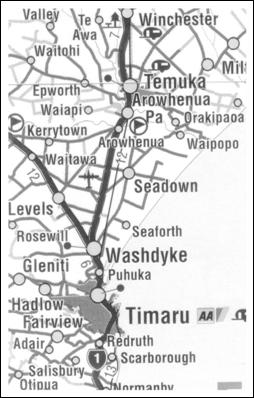
Richard’s place may have been the centre of community activities for we find that his brother Dennis Hoare and Mary Brosnahan were married April 16, 1866 at “ Mr. Richard Hoare’s place, Timaru District”. Also, by the time he died, aged 70, in 1905 old Richard Hoare was quite the local gent, hosting members of the South Canterbury Hunt on his farm and entertaining them at his “homestead” near Kerrytown.
At it’s peak in the late 1880’s Kerrytown had 200 residents. There were gay rumbustious times, too, along the Kerrytown Road, which can still bring a smile to the faces of those who remember, but it’s distinctive character came straight from the fields of County Kerry as Irish as the periwinkles and pig trotters in basins at Killorglin’s Puck Fair near Tralee.
The families of Irish living in the Kerrytown area at this time include the Brosnahan, Fitzgerald, Moore, O’Sullivan, Scannell, Breen, Nolan, Kelly, Heffernan, Leonard, Scanlan, O’Connell and O’Keefe families.
School
The district was first served by a single room cob building on Richard’s brother’s Dennis Hoare’s property and was attended by 15 pupils, who were taught by Mr. O’Sullivan. The school site was later moved to Mr. Denis Sullivan’s property, who gave 5 acres of land on the corner of Naughtons and Foleys Roads. The school consisted of a two-room building and the teachers were Messrs. Hannifan, Donnelly and Barry Scollard. This school site was over three miles from the crossroads of Kerrytown Road and the Temuka to Pleasant Point Road.
May Malloch relates a story that Richard Hoare was tired of the distance his children had to travel to school, so he arranged to have a school building built in Kerrytown, and then sent for the nuns to run it. This lines up with what we know happened.
In 1884 Richard Hoare presented a property of 4 acres to the Temuka Parish. He also had built a convent of four rooms. Fr. Fauvel then wrote to the Sisters of St. Joseph of the Sacred Heart in Australia. On 6th May 1884 two sisters arrived at Temuka to commence their duties at Kerrytown on 12th May. The original two-roomed school was shifted onto this site too.
May Malloch can remember that the people who had attended the school could be easily told in later years by their excellent handwriting style.
St Joseph’s Church – Temuka
In around 1869, Fr Chataigner S.M. who was based in Timaru had a small wooden church built in Temuka. When the Marist Brothers set up a parish in Temuka in 1876, the first parish priest Fr. L. Fauvel S.M., wanted a replica of his own parish church at Coutances in France.
The community set to building their stone church. The foundation stone was laid in 1879. A Mr. Collet, who was not catholic, gave the limestone rock. Richard Hoare and his brother Dennis Hoare were involved with helping cart the stone to the building site.
The generosity of the local community allowed to building to progress, and the building was completed early in 1881. Thirty stained glass windows came from Europe and these incorporated the names of those benefactors who gave to the church building. The names on the windows include:
Mrs. R Hoare, Mrs. J. Fitzgerald, Mrs. M Gaffaney, Richard Hoare, Dennis Hoare, John Fitzgerald, William Fitzgerald and Simon Coughlan.
Death
Mary Hoare died 31 Dec 1897 and was buried in the Temuka Cemetery. Richard Hoare died seven years later on 28 January 1905 and was buried in the Temuka Cemetery with Mary. From the Tablet we have the following extract:
Mr. Richard Hoare a well-known and highly respected resident of Kerrytown passed away on 28th January 1905. Deceased who was seventy years of age came to the colony forty years ago, and since then was extensively involved in the farming pursuits on the Levels plains. The grounds and portion of the buildings of the Kerrytown Convent were the result of his magnificent liberality.
The funeral which took place on 30th January was one the largest seen in Temuka, there being about one hundred vehicles and quite a number of horsemen and pedestrians in the procession. Rev Father Kerley S.M., and Rev. Father Tubman S.M., officiated at the church and subsequently at the place of interment.
(Newspaper clipping at Nana’s: The funeral of Richard Hoare took place at the Temuka Cemetery on Saturday morning……St Joseph’s church ……. druids attending.)
Having given a lot to his family, the church and the community, it is sad to see that Richard’s name was not put on his grave. (This has been corrected in recentl years).
He left a substantial estate valued at nearly 4000 pounds.
Extracts from Will of Richard Hoare
National Archives, Christchurch REF CH 5215 7 Feb 1905, HOARE Richard, Kerrytown Farmer
· Executors: Denis Hoare, Mary Ann Hoare and Alexander Hamilton (Timaru Bank Manager)
· Inventory
Furniture:
Pictures, Piano, Over Mantel, Linoleum, Firescreen, Leather Suite, Basket Chair, Octagon, Bookcase, Pole and Curtain, Dressing Table, Bedstead, Spring Mattress, Bedding, Pictures, Set of Ware, Pole and Curtains, Linoleum, Washstand, Bedstead, Spring Mattress, Curtain and Pole, Set of Ware, Washstand, Pictures, Blankets and Sheets, Bedstead, Mattress, Chain Mattress, Pole and Curtains, Bedding, Pictures, Linoleum, Chest Drawers, Two Stretchers, Blankets, Pictures, Linoleum, Blankets, Wood Bedstead, Bedding, Table Chairs, Crockery, Clock, Mangle, Pots and Pans, Passage Linoleum
Horses:
One Draught Gelding “Champ”, One Draught Gelding “Darkie”, One Draught Gelding “Ben”, One Draught Gelding “Scottie”, One Draught Filly 2 year old, One Draught Filly 1 year old, One Draught Gelding 1 year old, One Trap Mare “Guy”, One Trap Gelding “Tommy”.
Implements:
One McCormack Reaper and Binder, One Massey Harris Reaper and Binder, Four Farm Drays, One Tip Dray, One Waggon, Two Double Furrow Plough, One Disc Harrows, Two Sets Harrows, One Roller, One Grass Sower, One Seed Cleaner, One Set Scales, One Travelling Hut, One Grain Drill, One Hay Rake, One Moulding Plough, One Scuffler, One Duncan Grubber, One Scoop, Two Traps.
Harness:
6 Sets Leading Harness, 3 Cart Saddles and Bridle, 9 Collar Hames and Winkers, One Riding Saddle and Bridle, 2 Sets Trap Harness
Sundries:
One Bellows and Anvil, One 200 Gallon Tank, Grind Stone, Spade, Shovel, 2 Forks, 200 Empty Sacks
Cattle:
Six cows, Three Calves, One Bull, Three Pigs
Sheep:
380 Ewes, 290 Lambs
Growing Crops:
107 acres wheat, 8 acres Barley, 8 acres Potatoes, 24 acres Turnips, 10 acres Rape
Shares:
One share Canterbury Farmers Co-operative Association, Two shares Pleasant Point Saleyards Company, Five shares South Canterbury Dairy Company Ltd.
Freehold Land:
RS16341 Pareora Block VIII 62 acres
RS12795 Pareora Block VIII 80 acres
Lot 73 Borough of Timaru 1 rood
Section 9943 Block V Seadown 50 acres
Section 23049, 12912, and part 12916 Block V Seadown 16 acres, 1 rood, 18 perches
Cash in Bank:
National Bank of New Zealand 1 pound, 4 shillings, 2 pence
Jewellery
Silver open faced Geneva Lever chronograph watch
Silver Chain
· Will dated 28th Nov 1894
· Daughter Mary Ann Hoare, all my household furniture and effects (except Piano)
· Daughter Margaret Hoare – piano
· All else into trust to sell and convert to money
· To daughter Mary Ann Hoare 500 pounds
· Toson Denis Hoare 700 pounds
· To daughter Margaret Hoare 300 pounds
· To daughter Julia Hoare 300 pounds
· To son James Hoare 300 pounds
· To married daughter Kate Nolan 10 pounds
· To married daughter Annie Walsh 10 pounds
· To daughter Elizabeth Hoare 10 pounds
· Then equally between my children Mary Ann Hoare, Margaret Hoare, Denis Hoare Julia Hoare, Gertrude Hoare, James Hoare, Kate Nolan, Annie Walsh, and Elizabeth Hoare when children attain the age of 21
· Will Adjusted 28 June 1902
· Piano to Julia Hoare
· Land RS13795 to Denis Hoare in leiu of 700 pounds
· Sales of land raised 4,797 pounds, 10 shillings
· Sales of Animals, Implements and Shares raised 1,115 pounds, 6 shillings, 3 pence
· Sales of Grain 393 pounds 18 shillings 9 pence
· Total Estate 6,384 pounds, 8 shillings, 5 pence
· Homestead block containing 50 acres was knocked down to Patrick Nolan, a son-in-law, but he was unable to pay deposit. Further sale succeeded.
· Land sold to John Cartwright, Mary Heffernan, Timothy Michael Brosnan, James Hoare, Margaret Hoare, John Scannell, William James Cartwright
References and Further Reading
Many of these stories and recollections are copied directly from the following sources:
The Kerrytown Brosnahans – Sean G Brosnahan
The Fitzgeralds of Arowhenua – Paul and Pat Scott
St Joseph’s School Kerrytown Centenary 1883-1983
The Echunga Arrives – Internet http://www.rootsweb.com/~nzlscant/echunga.htm
Robert Henderson – Internet http://www.angelfire.com/ok2/cbluff/roberthenderson1862.html
Hoare Webpage – Internet http://members.aol.com/RennyBe/index6.html
White Wings – Sir Henry Brett
Diary of William Jewell – Canterbury Museum
Probate of Richard Hoare – CH5215 National Archives, Christchurch