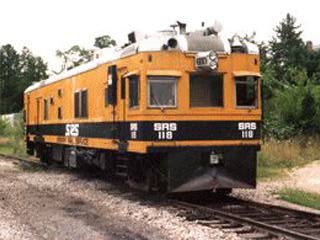
Sperry Rail Service uses two kinds of vehicles in their testing. I worked on the big Detector Cars. There are also a growing number of hi-rail trucks.
The Sperry Detector Car is essentially a self-propelled railroad car with specialized test equipment designed to find small, invisible cracks in the steel rails. If such cracks are not discovered early, they will grow to the point where the rail will break, usually while a train is rolling over it. Needless to say this would have a detrimental effect on the train, its cargo, and the surrounding countryside, not to mention the railroad's public relations image.
The cars are divided into two basic classes: the "communal" cars and the "private room" cars. The lower numbered cars are "communal" cars, the higher numbered cars have the private rooms. No two cars are identical, but they can be more or less differentiated by the window configuration. Communal cars have two small windows stacked at about the center of each side, cars with private rooms have larger windows all at the same height. SRS 118 above is a communal car. At present, there are about the same number of each type. The "classes" refer to the living arrangements inside the car. Communal cars are so named because they have a large central area with four bunks, two stacked on each side. See the floor plan below. Both of the cars I served on were communal. I have been on one of the private room cars, thanks to a friend who still works for Sperry as a driver-mechanic. Essentially, the plan is identical, with three tiny rooms occupying the space where the bunks are on the communal cars. The back engine room is a bit smaller to make everything fit.

Each Sperry car has three diesel engines. Up front is a six cylinder inline Caterpillar with a GE generator. This has a hydraulic throttle and powers the two GE traction motors on the front truck. Transitioning between series (low range) and parallel (high range) is automatically controlled by relays, which are located in a cabinet that forms the front bulkhead of the front engine room partition. On the left side of the car (as you face forward) is a small, three cylinder, air-cooled Lombardini diesel generator which is run at night to provide electric power. A large four cylinder Caterpillar diesel in the rear (where the baggage door is) provides power during the day. Both Cats are water-cooled by radiators mounted in the car's roof.
The living quarters are small but comfortable. A small galley (about five feet by eight feet) right behind the front engine room contains a refrigerator, electric range, microwave, and a bit of counter and storage space. Behind this is a lounge with a camper style table and a couple benches, which have storage under the seat cushions. Behind this section is the sleeping quarters as described above. On the communal cars, a closet-like shower with a sink is on the left (again, facing forward) and an equally claustrophobic toilet is on the right.
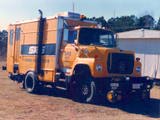
Life on a truck is a bit easier than the Detector Cars, because the two man truck crew gets to sleep in a motel every night. No being awakened at 2:00 in the morning by a freight screaming past six inches from your pillow, horn blaring! Lately, Sperry has started splitting the job of the truck test -- the truck doesn't stop for hand tests. A hi-railer Chevy Suburban rolls behind and performs all hand tests. This gets the test vehicle over the road faster and reduces the interruption of train operations. Until they mark a rail out, that is!
A typical day for me began at around 6 a.m. I'd get up, dress, and the first thing I'd do was water the car, if we were near a water plug. This involved dragging a garden hose to the faucet (rarely closer than a hundred yards or so), turning on the water, and then going back to the car and turning the valves to fill the two water tanks -- one for domestic water and one for test water (I usually filled the test water first because that was more important to the operation of the car, and it also got the hose taste out of the water). While the tanks were filling I'd eat breakfast. The more senior crew members slept right through this, until I started up the back Cat, which is quite loud. This would warm up a few minutes, then I would rev it up, let the clutch for the generators in, and switch power from the "Lombo" (the night generator) to the back Cat. Next I'd switch on the test equipment to warm it up, and go shut down the Lombo.
The next step was to oil up all the external test equipment. That done, I'd calibrate the test gear inside, make sure there was a tape on the readout table, spare tapes handy for changing, and the "back porch" (or test room) was generally ready for the day's work -- plenty of sharp pencils, etc. Finally I'd crank up the propelling engine to warm it up, check the oil in the Lombo, conduct the safety tests, make sure nothing was in the way on the tracks, make sure I'd remembered to wind up the hose, and by this time the rest of the crew was up and going to work.
While I worked for Sperry, both cars I was assigned to (SRS 123 and later SRS 118), were working on Norfolk Southern. NS assigned both a Road Forman or Conductor and the local Track Supervisor to ride the Sperry car. I understand that some roads have the Track Supervisor handle the Conductor's duties as well. At any rate, the Conductor is responsible for the operation of the car over the division. The Track Supervisor tells the crew what tracks have to be tested. The car is actually run by Sperry employees.
Upon receiving clearance to test a specific track in a specific block, the Sperry car engages its test gear and moves slowly along the track at between 6.5 and 13 miles per hour. The test equipment causes pens to wiggle on a long paper tape. Certain wiggles indicate a flaw in the rail. When the Sperry Operator sees something on the tape he doesn't like, he uses a buzzer signal system to tell the driver up front to stop.
Sperry cars are an exception to the general rule that a train must have clearance from the dispatcher to back up. When the Sperry car is testing a block, it has sole access to that block and blanket permission to back up within that block. This allows the car to make a smooth stop and back up to possible defects in the rail, at which point the operator gets out and performs a hand test with an ultrasonic test rig mounted on the rear of the car. If the rail is OK (and there are complex rules governing what kinds of indications have to be hand tested in what circumstances, which often vary from railroad to railroad), the car continues on its poky way. It the rail is pronounced bad, it is marked and a railroad work crew following the Sperry car comes and immediately changes the rail out. If they can't get to it right that instant (because of a previous rail being marked out ten minutes ago), the section of track is slapped with a slow order until the crew can replace the faulty rail. Naturally there is a limit to the number of rails a section gang can change out in one day, and marking out too many rails will usually cause the Sperry car to be tied up early. This works to the railroad's advantage (safety wise, anyhow), as the Sperry crew is more likely to mark a rail defective than to let it go, because marking it defective will potentially get them a shorter day's work!
At the end of the work day, the Sperry car is tied up on a side track near where testing stopped. My experience was that this siding was usually right next to the main line and adjacent to a grade crossing, which made sleep a challenge on the heavily used lines we were testing. The track was usually on my side of the car, too. The hand brake was wound up, the car's wheels blocked, and the water tanks filled if possible (the morning filling was simply to top off the domestic water). Once the boss had finished all his record keeping on the computer (the computer has nothing to do with the actual testing, and isn't even connected to the test equipment -- that surprised me), the Lombo was cranked up and power switched, at which point the back Cat could be idled down and shut off. The silence was now deafening.
Because these cars go several years between seeing the inside of a shop, all maintenance is performed wherever the car happens to be. Mostly, this is done after the car is tied up and everybody from the railroad has gone. Even heavy repairs, like changing out trucks, can be done track side, I'm told (thankfully I never had a reason to find out something like that firsthand). This is not a job for people who don't like getting dirty!
The downside is that you're basically rail bound. Many of the sidings the Sperry car gets parked on are out in the middle of nowhere. I have been on cars parked right up next to an Amtrak station, and out at a lonely road crossing without so much as a shanty for a mile. Frequently the sidings are in less than desirable neighborhoods. I've also spent a weekend smack damn in the middle of a major freight yard. That isn't as much fun as it sounds like, I assure you.
Sperry Detector Cars are the only rail test vehicles to use both induction testing and ultrasonic testing for railroad rails. Sperry hi-rail trucks and all other rail test equipment use only ultrasonic testing methods.
The Induction testing uses the tendency of a magnetic field to conform to the shape of its conductor. A field is set up around the steel rail by passing a heavy current through it, and a coil is passed parallel to the rail. As long as the rail is "healthy" the coil will not cross any magnetic lines of force, so no current will be induced into it. Any change in the shape of the rail (i.e. a crack) will change the shape of the magnetic field around the rail correspondingly, inducing a current into the coil. This current is amplified and filtered, and used to activate the pens that make the squiggly lines on the tape.
The ultrasonic system works like sonar. A beam of high frequency sound is transmitted into the rail, and the time it takes to bounce back measured. A crack will cause the beam to be returned sooner than the base of the rail would. When that happens, a squiggle appears on the tape.
The test equipment on a Sperry car is carried in a carriage slung between the axles of a custom-built, proprietary truck at the rear of the car. I don't want to say too much about this truck for fear of disclosing proprietary information to Sperry's competitors and getting myself sued (not that I remember that much).
All SRS Hi-Rail trucks are built on Ford chassis
802 built 1982 - retired 1996
803 built 1989 - wrecked 1994, rebuilt 1995
804 built 1990
805 built ?
806 built ? - ex-BN gasoline, dieselized 1995 w/ ex-BN chassis
807 built ?
808 built ?
809 built 1993
810 built 1993
811 built 1995
812 built 1995
813 built 1995
814 built 1995
815 built 1996
816 built 1996
817 built 1996
818 built 1997
Thanks to Mark Gustaffson for providing the above Hi-Railer roster information.
First of all, Sperry doesn't renumber equipment, nor do they assign the same number to two vehicles. All new test cars or trucks get a new number. So the two photos below are definitely of the same car.
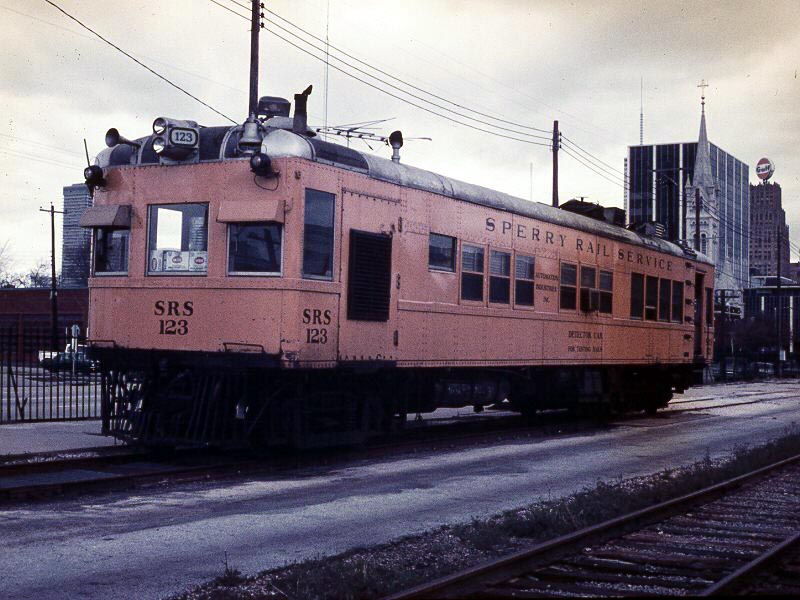
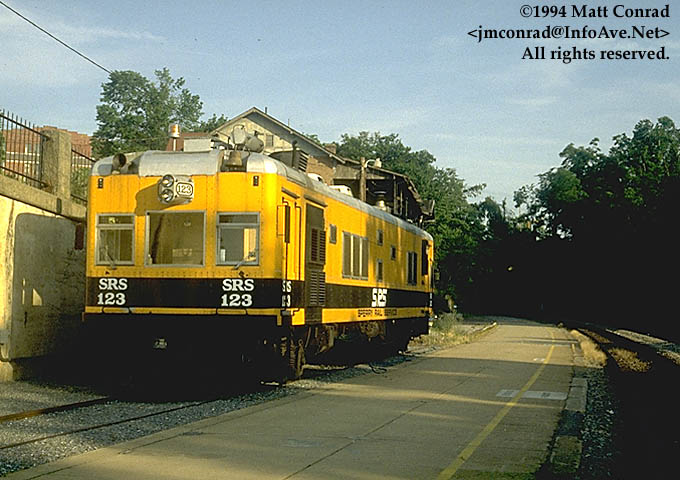 Left
photo by Stephen Foster, used by permission.
Left
photo by Stephen Foster, used by permission.
Right photo by Matt Conrad.
.
.
.
.
.
.
.
When I saw Stephen's photo, on the left, it occurred to me that a side-by-side comparison of the two cars would be neat -- especially since Stephen's photo and mine are from almost the same angle. Stephen's dates from 1972, mine dates from 1994.
You'll notice that many of the details are the same. The bell and horn are recessed into the roof. The front windows are in essentially the same location. Although the front engine room access door has been replaced with one that has more louvers, it's the same size and is in the same place. The lounge windows are identical. Two of the four back engine room windows are identical, as well, although the forward two have now been blanked out. Although it's hard to tell, the grille on the roof for the front engine radiator is essentially the same -- it's just freshly painted in my photo, and old and dirty in Stephen's.
The major changes seem to be in the sleeping compartment and the galley. The half-height galley window (the first one behind the front engine room door in the older picture) has been blanked out and reduced to a mere vent. More noticeably, the sleeping compartment has been changed around. I'd love to know what the bunk arrangement was when Stephen took his photo. The two small, stacked windows evident at the center of the car in my photo show the location of two bunks. The windows are located near the head end of the bunks. The other small window behind them is in the shower (see the floor plan above). The bunks had to have been located in a different spot originally. If they'd always been where they are now, the top bunk would have been right across those three windows in the middle!
Another major change is the car's "nose job". I found out about "nose jobs" when I transferred from 123 to 118. The former got a nose job, the latter didn't. Note the floor plan above -- there's a bulkhead across the car that separates the front engine room from the operator's compartment. This bulkhead contains the electrical control gear for the propulsion system. There's gobs of room between this bulkhead and the front of the 123 -- not so on 118! You actually have to turn sideways and skin through to get to the inside access door to the "Lombo" on cars with the unmodified front end. There's actually just room for two people to pass one another in the front of 123. It's obvious that Stephen's photo predates this modification by the lack of the crew door ahead of the engine room door on the front of the side.
More minor changes are the removal of the sunshades on the front windows (probably because they don't do any good -- I know because the test room still has 'em), lowering of the headlight, addition of a safety cover over the roof access ladder near the test room door, and the replacement of the window air conditioners with roof mounted units.
Internally, Stephen's photo probably shows a car still equipped with a Winton gasoline engine as the propelling engine. All Sperry cars are now propelled by a inline six cylinder Caterpillar diesel. I can't remember what the back engine was originally.
Sperry Rail Service
46 Shelter Rock Road
Danbury, CT 06810.
email: [email protected]

Made on a Mac! (Close those MiSerable Windows!) |
Last major update January 2000
Copyright 1999 Matt Conrad. This page may not be reproduced in any media!Send comments to [email protected] |