 Laodicea is at the intersection of three important roads, [7] so it is a very popular city amidst times of travel and commerce. Laodicea is one of the richest commercial centres in the Greco-Roman world. [8]
Australian College of Ministries
Subject: TCB109 Introduction to Biblical Interpretation
Lecturer: John Rees
Date of Subject: Semester 2, 1999
Ministry Centre of Subject: Carlingford
Student’s Name: Grant Mitchell
Student’s ID: C9901028
Item Of Work: Tutorial & Short Paper - Revelation 3:14-22
Words: 1137
Worth: 30% of subject mark
Date Submitted:
Due Date: Wednesday 13th October 1999
Signed:_____________________________ Date:______________
Literary Context
This is an apocalyptic writing, written to the people of God in times of trouble to bring hope. This makes it a writing to Christians, not the whole world.
Each letter begins with tade legei - the words of, paralleling Thus saith (the Lord), making them like prophetic oracles. [1]
Historical Context
Written during the reign of a Roman Emperor who was oppressing the church - enforcing the cult of emperor worship, even on those who professed to be Christians (although Barnett contends that "the Church of Laodicea does not appear to have been troubled … by the external pressure of the emperor cult…" [2]). Most likely Domitian, AD94-96, but possibly Nero AD54-68. [3] A writing for Christians amidst suffering.
Author
Written from Jesus Christ (1:1) through John (possibly the apostle John [4]) under the inspiration of the Holy Spirit. Written to Christians amidst suffering as words of hope and warning from their Lord and Saviour.
Geographical Context
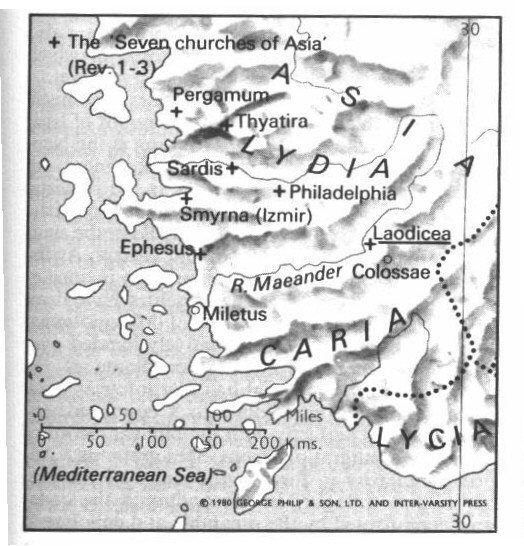
One of seven churches in Asia Minor (now Asiatic Turkey) [5] to whom the letters of Rev. 2-3 are addressed. It is very close to Colossae and East of Ephesus.
Figure 1: Laodicea, one of the ‘seven churches of Asia’ [6]
Laodicea is at the intersection of three important roads, [7] so it is a very popular city amidst times of travel and commerce. Laodicea is one of the richest commercial centres in the Greco-Roman world. [8]
Four points of interest have been discussed and developed concerning Laodicea:
This letter has been written to Christians who live in an affluent society, who are amidst suffering, and written as words of hope and warning.
Biblical Context
This is the last of seven letters written to churches in the area. The similarity of each address gives us some structure: [15]
Content Analysis
The introductory statement for Laodicea does NOT contain an element of the opening vision. This makes the statement a strong contrast of who Jesus is, how he wants his church to be, against how the Christians of Laodicea were living. [16]
In fact, there is no praise for this church at all! Things must not be good in this church as the expected structure has been so disturbed.
The church is described as "lukewarm". This is taken to mean that the church had become useless and unproductive. Cold and hot water are useful in their own contexts, but lukewarm is not. There may also be a comparison with the hot springs of Hierapolis, which lost its heat as it traveled toward Laodicea and also picked up calcium carbonate (making it sickly to drink); and also a comparison with the cold waters of Colossae, which may or may not be drinkable. [17]
(Some commentators believe that lukewarm is a description of lack of spiritual fervour. [18] Although this is close in idea, it does not make any sense that the church could then be better being cold. [19])
The church was filled with pride (v17). In some way they had taken on board the culture of the city they lived in, not willing to accept external aid - this physical event had been transferred to the spiritual realm. Their pride had corrupted them, making them unable to change to become useful and productive. That is, they were fooled into thinking they were self-sufficient in being effective for Christ, without going to Jesus for those things HE was offering.
Jesus then counsels the church to turn to him for what they do need. The images here are in strong comparison with the elements of the area - pure gold, instead of the tainted riches of the city; white clothes, in contrast to the (black) clothing; salve in contrast to the region's well known eye sore remedy.
This church had become spiritually poor, naked and blind. The source of spiritual riches, clothing and sight could only be found in Jesus Christ.
The words of these warnings do not have a finality about them. [20] Thus it is a right and good thing that the church is now called on to repent - not to come to a point of salvation, but turn away from being people who are filled with pride, trying to do things their own way, and so being unproductive for God.
There is no also a great expression of grace. A church that was given no praise, is now offered the opportunity to re-enter into a familiar relationship, close fellowship, with the Lord Jesus. [21] The act of eating in the culture this was written to was an expression of intimacy with family or friends. Jesus states that he is offering it, and the church at Laodicea only has to allow Jesus to enter relationship with them. What grace!
There is no promise that the possible suffering that may occur, whether it be from the Imperial government or from the prophecy or being "spat out", will be removed. There is only a promise of hope that those who do repent and live in obedience and reliance of Christ will receive glory in the kingdom to come. This idea is also present in 2 Tim. 2:12. [22]
The completion of each letter finishes with words not only affirming who is speaking, but that what has been said is not only for the church it was written for, but all churches in all times to come. [23]
Conclusion
The culture of the Laodicean city has so affected the Christians, that they may be speaking words and living lives that not only would Christ spit out, but the people of the city would too - it has no great effect. The church is warned of the consequences of not relying on Christ, and yet is given so much grace and promise in what could happen if only they repent and live as real disciples of Christ.
Notes
1
Beasley-Murray, G.R. Revelation (NCBC), Rev. edn (Grand Rapids, Mich., USA: Eerdsmans, 1978), p72.2
Barnett, Paul. Apocalypse Now and Then (Sydney South: Aquila, 1989), p63.3
Morris, Leon. The Revelation of St. John (TNTC) (Grand Rapids, Mich., USA: Eerdsmans, 1969), p34ff.4
Beasley-Murray, pp33-37.5
Douglas, J. D. (ed.) The New Bible Dictionary, 2nd edn (Leicester, England: IVP, 1962), p681.6
Ibid.7
Morris, p81.8
Ibid.9
Beasley-Murray, p103.10
Ibid.11
For casting doubts see: Hemer, Colin J. The Letters to the Seven Churches of Asia in their Local Setting (Sheffield, England: JSOT, 1986), p200.12
Morris, p84.13
Hemer, 193.14
An. xiv. 27 (cited from The Modern Library edn., 1942, p.335) in Morris, p83.15
Beasley-Murray, p72.16
Morris, p82.17
Hemer, p187.18
As Stott does: Stott, John R. W. What Christ thinks of the Church (London, England: Lutterworth, 1958), p.116.19
Hemer, 187.20
Beasey-Murray, p105.21
Morris, p84.22
Mounce, Robert H. The Book of Revelation (NICNT) (Grand Rapids, Mich., USA: Eerdsmans, 1977), p130.23
Ibid.
Bibliography
Barnett, Paul. Apocalypse Now and Then (Sydney South: Aquila, 1989)
Beasley-Murray, G.R. Revelation (NCBC), Rev. edn (Grand Rapids, Mich., USA: Eerdsmans, 1978)
Douglas, J. D. (ed.) The New Bible Dictionary, 2nd edn (Leicester, England: IVP, 1962)
Hemer, Colin J. The Letters to the Seven Churches of Asia in their Local Setting (Sheffield, England: JSOT, 1986)
Morris, Leon. The Revelation of St. John (TNTC) (Grand Rapids, Mich., USA: Eerdsmans, 1969)
Mounce, Robert H. The Book of Revelation (NICNT) (Grand Rapids, Mich., USA: Eerdsmans, 1977)
Stott, John R. W. What Christ thinks of the Church (London, England: Lutterworth, 1958)
All Scripture quotations are taken from the Holy Bible: New International Version. Copyright Ó 1973, 1978, 1984 by International Bible Society.