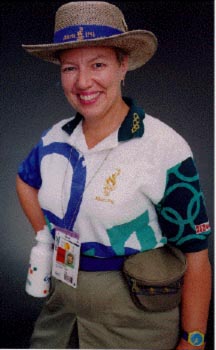
Ann McNemar (pictured right), a nurse on 9 West, had a behind-the-scenes, front-row seat to the Olympic Games as a scribe for the equestrian events. She was afraid of horses and climbed up on one only because she was too embarrassed to tell the riding instructor she hadn't come for lessons. "I had tagged along with a group of friends who wanted to learn to ride. The teacher assumed I did, too," explains Ann McNemar, laughing.
And for the reluctant student, riding became a life-long love and her ticket to an up-close, behind-the-scenes look at Olympic competition. McNemar, a nurse on 9 West, was tapped as a scoring assistant for the equestrian competition during the Summer Games in Atlanta.
When the call for applications for volunteers appeared in an equestrian magazine three years ago, friends encouraged her to apply. She was one of about 20 accepted.
"In many ways, scoring at the Olympics was easy," admits the veteran scorer for local events. "There's a lot more technical support." Timing information, penalties at cross-country fences, and movement scores during the dressage events were entered into timing equipment linked to computers, which reformatted the data for television and the commentators, and printed the results.
Everything was also recorded by hand so that manual and electronic scores could be compared before the final results were published. During grand prix jumping, McNemar oversaw the manual scoring master sheet. On endurance days, she was one of two scorers for the steeple chase events. For dressage events--competitions in which the horses move through a series of specific movements--she served as a computer scribe. "I fed the scores directly into the computer," she says. "I was very nervous about doing it right. Once the whole screen disappeared! I certainly have a better appreciation as to what goes on behind the scenes."
The weather and security concerns topped the agenda of behind-the-scenes worries for Olympic participants. "Having the games in Atlanta spurred a world-wide research effort on horse and heat-related issues," McNemar says. "A good bit of data was developed."
Because of the South's sultry summer weather, the cross-country course was shortened, rest stops added, and mist machines installed. "Competitions started early and ran late, with breaks during the middle of the day. Weather sensors and temperature monitors were in place and the competitions would have been stopped if necessary."
Heightened security meant thorough inspections of vehicles and individuals coming in for the competitions. "I kept hearing people talk about sanitizing things. I thought they were talking about ticks on the horses, but it turned out to be for bombs."
McNemar's involvement in international competitions didn't end with last summer's Olympics. She'll be involved in next year's North American dressage event and plans to attend the world equestrian championship in Ireland in 1998.
She and her horse Avenue may participate in some local games as well. "I
don't love jumping that much because I'm becoming breakable," she says with
a laugh. "Avenue knows more than I do and I'm learning from her. We'll
compete once we both figure it all out." (-by Sara Byars)