| Mesh Tension |
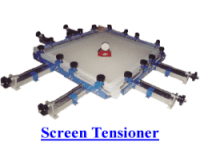 |
| Experience has shown that only when screens are correctly tensioned will they yield adequate performance,namely,high resistance,optimum adhesion to stencil systems and suitable elasticity for off contact.Stretching is the most important operation in screen preparation and as such has a direct influence on the printing results. |
| Pre-Press Considerations: |
| Mesh Tension, |
| Mesh should be tensioned to the point where it is stable.Certain meshes can be tensioned to higher levels than others,but,consistency is important.The extent or degree of some of the printing problems caused is directly proportional to the looseness of the mesh, (eg), If a low grade mesh is tensioned to 16n/cm originally,500 impressions later it may be at 12n/cm.If a second frame of the same mesh was tensioned to 14n/cm, the same 500 impressions may wear this mesh down to 8n/cm.The lower the mesh tension the faster the rate of wear. |
| Improper Tension Problems: |
| Longer set-up times. Stencil or image breakdown. Requires excessive squeegee pressure. Registration can jump during production. Smearing or slurring of the print. Build-up of ink underside of the screen. Inconsistent ink deposit. Requires excessive "off-contact"(Snap). Loses tension quickly during production. Creates inconsistent stencil thickness. Longer screen processing. Increased dot gain. |
|
| The goal is to not only reach the desired mesh tension,but to try and maintain that value during printing.If mesh has "bagged out"(dropped in tension)the vicious cycle begins.The off contact on the machine will need to increase the squeegee pressure etc.In fact,what the printer will be doing is to try and use the squeegee to properly tension the mesh. |
| Several methods that can be used to help reduce tension loss: |
| Tension over increased time. Tension to higher levels initially. Re-tension the mesh after allowing it to relax. Pre-stress(deflect) the frame. Print on a softer surface. |
 |