| Selecting The Mesh |
| Monofilaments are available in four basic thread grades: |
| S Small M Medium T Thick HD Heavy Duty |
| T is the most commonly used by textile printers.It is important to note that HD thread will be substantially thicker than an S thread.This will effect the percentage of open area which will influence the ink deposition. |
| Mesh Compositions. 1. SILK. White silk was the original material used in screen printing.It has ,with the advent of modern synthetic fabric been for the most part eliminated from use. 2. Nylon. Is not commonly used by fabric printers due to its hydrophilic nature,which makes it dimensionally unstable. 3. Polyester. Is by far the best choice for textile printing applications because of its low cost,high dimensional stability,and low moisture absorbency(hydrophobic) An important variable that comes to play when purchasing monofilament polyester mesh,is the thread quality and thickness. |
| Coloured Screen Mesh: For or Against? |
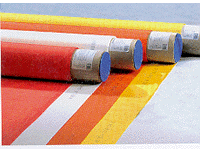
| This question is consistently asked in technical circles,but it has been proven that due to the high inherent reflectability of normal white mesh,there is a tendency for white actinic light to be diffused and reflected within the mesh itself.This causes the photo emulsion to harden in areas which should remain unexposed. |
| Yellow and orange coloured fabrics counteract this tendency by absorbing the actinic light,so that only yellow and red inactinic light is reflected.A better exposure is thereby assured both for direct and combination screens,which naturally results in cleaner,clearer prints. |
 |
|
 |
 |