Page 2. The Fishless Cycle.
March 12 - April 17, 2001
5 weeks! (a bit longer than normal)
I knew I wanted to do a fishless
cycle on this tank.
because it would prepare the biofilter
for the fish without
going through all the mess and
bother of using actual fish.
(and possibly harming or killing
those fish in the process!)
I had never tried it before, but
after reading a lot about it on the internet
I deceided it was definately the
way to go.
See this article for information on fishless cycling.
The tank contains one large sponge
filter (a hydro V)
and a whisper power filter. the
sponge is meant strictly for biological
filtration, the whisper (later
changed to an aquaclear) strictly for mechanical filtration.
I filled the tank with water on
March 11, turned on the air for the sponge filter,
(the whisper was left off for the
entire fishless cycle) and just let it sit for 24 hours.
(to dispell chlorine)
then on Monday, March 12, I began
the cycling..
I added 1/8 Tsp ammonia, that brought
the ammonia level in the tank to 0.25ppm
added another 1/4 Tsp, brought
the level to 0.50ppm.
added more and more ammonia until
the level reached 4.0ppm.
I squeezed out the filter media
from my planted tank into this tank
to get those bacteria going..then
tested.
conditions at the end of day one
were:
ammonia 4.0ppm
Nitrite 0ppm
Nitrate 0ppm.
then waited...I added no new ammonia at all during this first phase.
day 2, conditions the same..
day 3, the same..
day 4, still unchanged..
day 10..still no change *sigh*
day 18 STILL unchanged! grrr!
this was getting very frustrating!
nothing was happening!
I was still adding filter squeezings now and then from the other tank, I cut some plants from the other tank and dumped them in..nothing was working..
finally, Day 23, April 3rd, 3 weeks
since the start, a TRACE of Nitrite! 0.25ppm! woo hoo!
and ammonia had fallen from 4ppm
down to 2ppm!
the next day, Nitrite even higher!
2ppm..and ammonia lower, 1ppm!
it was working!
now here is where I made a mistake..from
all the reading I had done on fishless cycling I was under the impression
that once nitrites appear and ammonia levels begin to fall, you must start
adding ammonia again! because the bacteria are finally multipling and Eating
the ammonia right?! made sense to me..so once nitrites appeared, I started
adding small amounts of ammonia again.
I added 2 Tsp's ammonia on 4/4,
4/5, and 4/8..during this time ammonia stayed steady at 0.5ppm, and nitrite
stayed at 5ppm...Nitrates also appeared and steadily climbed..but the mistake
was adding more ammonia..by doing that, I was feeding the bacteria that
were producing nitrites, and causing them to create much MORE nitrite than
I needed to complete the cycle! Geoff and Dave C. , my friends from the
freshwater
forum, finally convinced me to stop adding ammonia..and it took another
7 days for the cycle to finish after that...so from the time nitrites first
appeared to the final end of the cycle was 14 days! much longer than normal..adding
ammonia when nitrites appeared probably prolonged the cycle by at least
a week!
But finally, on April 17, Day 37,
it was done!
While the tank was cycling
I played around with water change ideas.
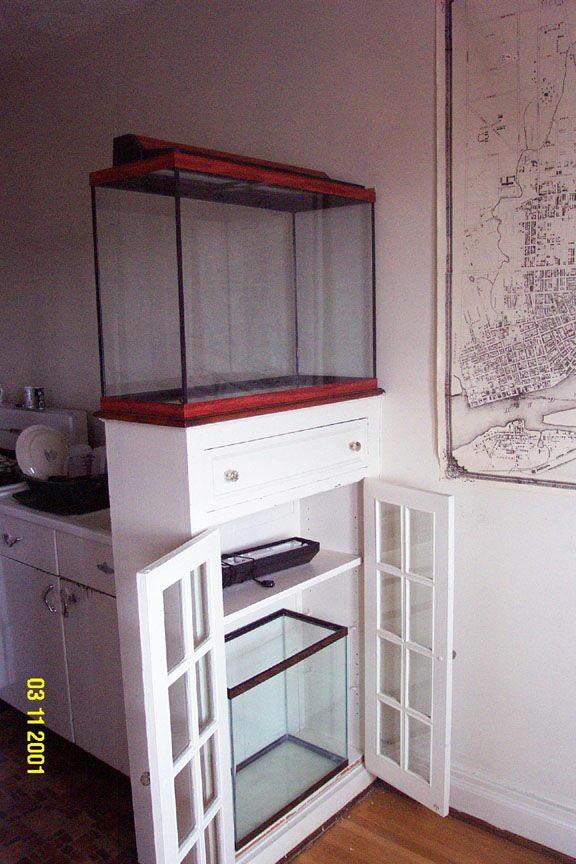
this is a photo of my original
set-up.
Inside the bookcase sits a 15gallon
aquarium,
this was going to be the holding
tank, I would fill it with water,
with a hose attached to the kitchen
faucet (the kitchen sink is right
next to the tank) put in an air
stone and a heater, let the water "age"
for 24 hours, then siphon out 15
gallons of old water from the main tank,
then use a pond pump to pump
the new 15 gallons from the storage tank
up into the main tank..then re-fill
the storage tank and the cycle repeats.
this worked well, I used it for
the first few weeks I had the fish, but I
had to drag out all the hoses and
pumps each time..it was a pain..plus, with this system I
was only doing waterchanges 3 or 4 times a week,,usually the fish would
get a water change every
second day. I simply didnt have the time to do a daily water change. I
wanted a better way..
Talking with people on the internet
some more..I found out about a great "drip system" you essentially drip
water directly into the tank, and a PVC overflow removes old water..its
fully automated! using this system my fish would get a 25% water change
EVERY day! much better for them, and much easier for me!
Dave C. (thanks Dave!) e-mailed
me plans he used to build his overflows, and I went out and bought the
pvc tubing.
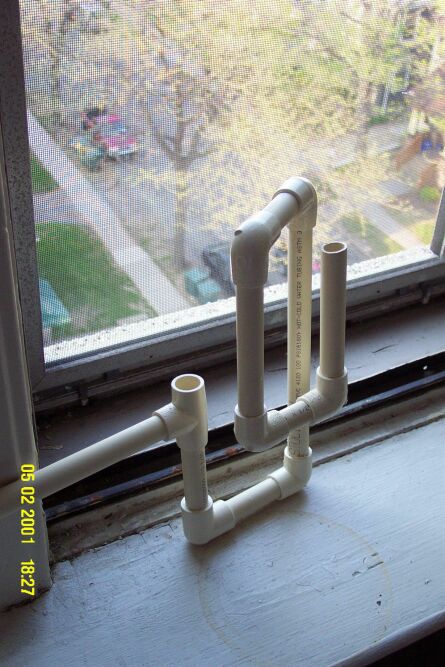
Here is my completed overflow. this
contraption sits on the tank, water drains in at the opening on the upper
right, then drains out at the long tube on the left (where the yellow date
numbers are)..then a long tube extends down into the kitchen sink..the
old water just drips down the drain! its a great system!
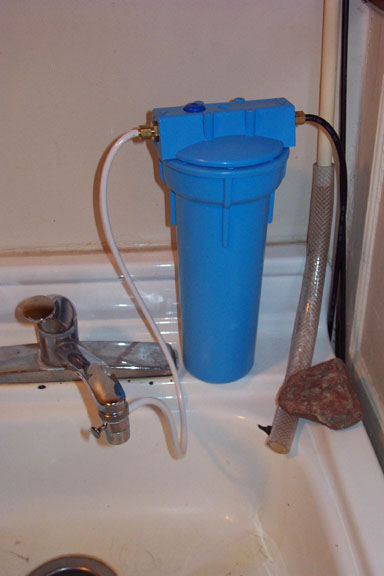
And here is a photo of the
"front end" of the system.
There is a valve right on the kitchen
faucet, when the valve is pushed in, water flows to the tank, when the
button is pulled out, water flows through the valve
for "normal" kitchen sink use,
doing dishes and etc.
.the best way to install a system
like this would be to "hard wire" it right into your
water line. but I live in an apartment
and so was unable to modify any plumbing!
So I use it by turning on the water (cold water) at a trickle, almost no pressure, then push in the valve..water flows through the filter (which contains a carbon insert to remove chlorine) then out to a "dripper nozzle" which is rated for 1/2 gallon per hour. So I am dripping in 12 gallons of water per day. you can get nozzles in 1 gal and 2 gal ratings also. I got the filter at Home Depot, (you want a one-micron carbon insert) and I got the dripper from www.dripirrigation.com. If you hard wire the water line, you will also need a pressure regulator and other hardware..I control the water pressure manually, simply by turning on the faucet very low.
The water drips directly into the
tank right on top of the power filter outflow, so it gets mixed right in
immediately. the water goes in cold, but my heater has had no problems
keeping the water at the proper temperature.
To Page 3. Getting the Discus! 
\
 Back
to Discus Main..
Back
to Discus Main..