
 Sun
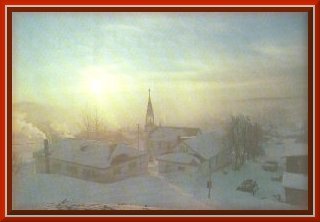
breaks through the freezing mist at Hornepayne, Ontario - a railway town
about 161 kilometres (100 miles) north of Michipicoten. In such towns the
railway is still the lifeline - as it once was through most of Canada -
particularly during the long and bitter winters. In the summer there is
a different toll to pay for the privilege of living in this largely unspoiled
area - contending with a voracious population of mosquitoes and blackflies.
Sun
breaks through the freezing mist at Hornepayne, Ontario - a railway town
about 161 kilometres (100 miles) north of Michipicoten. In such towns the
railway is still the lifeline - as it once was through most of Canada -
particularly during the long and bitter winters. In the summer there is
a different toll to pay for the privilege of living in this largely unspoiled
area - contending with a voracious population of mosquitoes and blackflies.
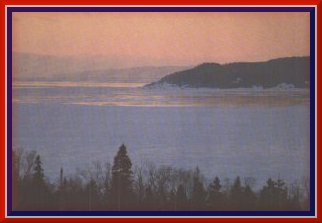 Michipicoten
Harbour is on Lake Superior, the deepest and largest of the Great Lakes
- it is 616 kilometres (383 miles) long. Thhunder Bay, at the head of the
Great Lakes, is the third largest Canadian port for ocean-going vessels
and the main port for trans-shipment of golden prairie wheat. The Great
Lakes system is one of the most important natural features of the North
American continent. The combined area of the lakes is the largest surface
of fresh water in the world. To the west of Lake Superior is Quetico Provincial
Park, a wilderness teeming with wildlife. To the far north on Hudson Bay
is Ontario's immense Polar Bear Provincial Park, where bears, caribou,
arctic foxes and snow geese live undisturbed.
Michipicoten
Harbour is on Lake Superior, the deepest and largest of the Great Lakes
- it is 616 kilometres (383 miles) long. Thhunder Bay, at the head of the
Great Lakes, is the third largest Canadian port for ocean-going vessels
and the main port for trans-shipment of golden prairie wheat. The Great
Lakes system is one of the most important natural features of the North
American continent. The combined area of the lakes is the largest surface
of fresh water in the world. To the west of Lake Superior is Quetico Provincial
Park, a wilderness teeming with wildlife. To the far north on Hudson Bay
is Ontario's immense Polar Bear Provincial Park, where bears, caribou,
arctic foxes and snow geese live undisturbed.
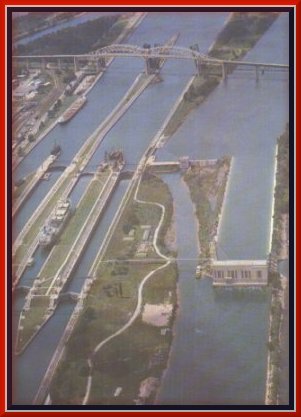 At
the "Soo" Locks at Sault Ste. Marie, Ontario, visitors can view the world's
largest locks, which are situated between Lake Huron and Lake Superior,
from special observation towers. Because of its prime location, Sault Ste.
Marie has a number of industries, including steel-making. Robert and I
crossed the bridge, shown in this picture, when we came up to Ontario from
the US.
At
the "Soo" Locks at Sault Ste. Marie, Ontario, visitors can view the world's
largest locks, which are situated between Lake Huron and Lake Superior,
from special observation towers. Because of its prime location, Sault Ste.
Marie has a number of industries, including steel-making. Robert and I
crossed the bridge, shown in this picture, when we came up to Ontario from
the US.
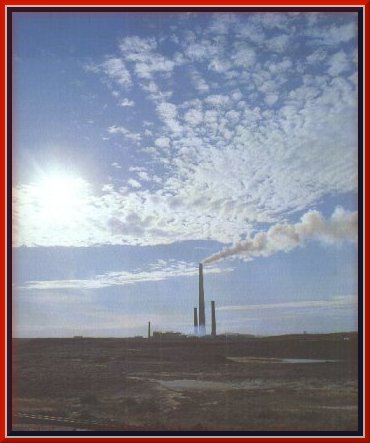
The International Nickel Company
of Canada (INCO) superstack rises above a barren landscape. Ontario has
a wealth of natural resources, nickel being one of the most important.
At Sudbury INCO mines most of the world's nickel. The devastated land is
now being renewed. Groups of young people and others scatter limestone
to neutralize the soil, and greenery is beginning to sprout again. I was
born in the small town of Espanola just an hour's drive west of Sudbury.
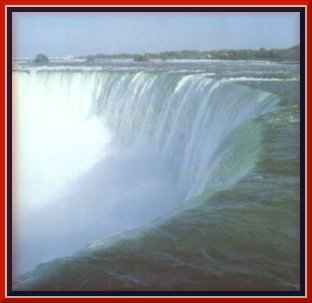
The Horseshoe Falls at Niagara
are about halfway between Lake Erie and Lake Ontario, where the Niagara
River plunges over the Niagara Escarpment. The 792-metre-long (2600-foot)
curving crest of the Canadian Horseshoe Falls is separated from the American
Falls by Goat Island. The Falls were first harnessed for hydroelectric
power in 1882. Today, the flow is regulated by an elaborate control works
upstream. Enormous quantities of water are re-directed through massive
tunnels to power stations on both sides of the border. Enough water is
left to maintain the beautiful sediment-free curtain. Visitors can descend
to the foot of the falls from behind - a spine tingling experience.
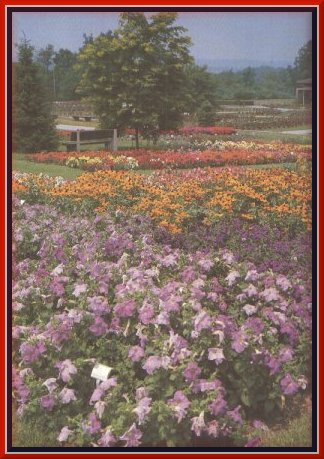
The Steel City - Hamilton,
Ontario - on the western tip of Lake Ontario, is also famed for its large
- 809 hectares (2000 acres) - and long-estaablished Royal Botanical Gardens.
More recently, the city has acquired a marvellous new culture centre, Hamilton
Place. The Niagara Peninsula, Ontario's main fruit-growing area, is especially
delightful at blossum time. The 'fruit belt" is protected on one side by
the Niagara Escarpment and is under the moderating influence of Lake Ontario
on the other side. The area, with such centres as Grimsby, Beamsville,
Vineland and Jordan, produces tonnes of grapes, peaches, apples, cherries,
pears and plums. The soil is particularly well suited to grapes just above
the escarpment. Vineyards, the largest in Canada, have been established
here since 1812.
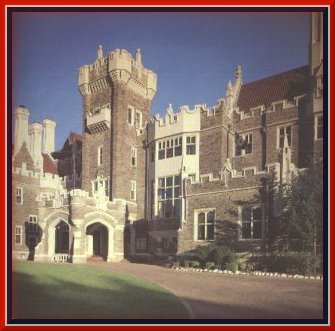
Casa Loma, Toronto, was the
fairy-tale castle of Sir Henry and Lady Pellatt. This extraordinary structure
cast the eccentric and extremely rich stokebroker $3 million. It was built
between 1911 and 1914 in a fascinating conglomeration of styles that appealed
to Sir Henry - from Norman and Gothic to Elizabethan and Edwardian. Casa
Loma had gold-plated faucets in the bathrooms, one of the largest wine
cellars in North America, and a library to hold 100000 volumes. This attempt
at living like royalty failed, due to the enormous rise in costs after
the First World War. The castle was eventually taken over by the Kiwanis
Club of West Toronto, who run it as a tourist attraction and raise large
sums of money for charity.
To ONTARIO
Page Two
