
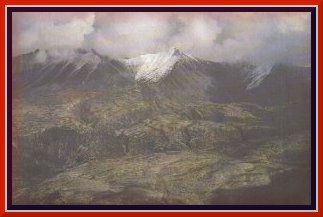
 The
Mackenzie Mountains in Nahanni National Park are one of the three mountain
ranges through which the South Nahanni River flows.
The
Mackenzie Mountains in Nahanni National Park are one of the three mountain
ranges through which the South Nahanni River flows.
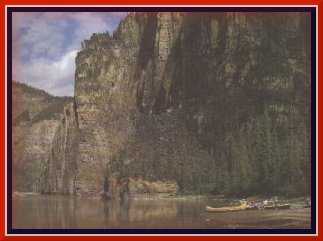
A group explores South Nahanni
River in rubber "canoes". To the Slave tribe of Athabascan Indians the
river was always Nahadeh -- Powerful River, a river whose magic force was
able to connect the spirit of man with that or nature. Within the park's
4765 square kilometres (1840 square miles) there is much that is memorable
and powerful : canyon systems among the deepest on Earth, hoodoos (mushroom-shaped
rocks), hot springs, seemingly bottomless lakes, and extensive cave systems.
In 1979 UNESCO proclaimed Nahanni National Park the first World Heritage
Site, to be preserved for all mankind.
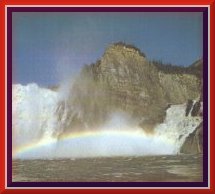
Virginia Falls is in Nahanni
National Park. Untouched, unharnessed, Virginia Falls is one of the continent's
superlatives. The South Nahanni River explodes over the falls, which are
more than one and a half times the height of Niagara. The portion of the
river on the south side plunges 90 metres (295 feet) straight down, while
the centre smashes against a pillar of limestome, and the north falls 52
metres (171 feet). Often rainbow crosses rainbow in the resulting fury
of water and mist.

Nunavut
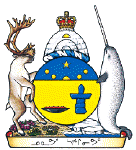
On April 1, 1999, the new
territory of Nunavut came into being, taking in the central and eastern
portions of the Northwest Territories. Nunavut means "our
land" in Inuktitut, the Inuit language.
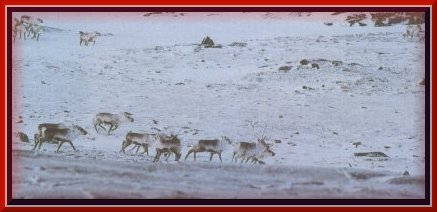 Caribou
gather at Repulse Bay, Nunavut. Herds as large as 100000 annually migrate
1900 kilometres (1180 miles) withing the Canadian and American North. This
prehistoric trek takes them from winter to summer feeding grounds and back,
and has convinced Canadian and United States governments to work out a
joint caribou management policy. Caribou are admirably suited for the North
because of their coarse, compact hair. Their fur is the warmest known.
Caribou
gather at Repulse Bay, Nunavut. Herds as large as 100000 annually migrate
1900 kilometres (1180 miles) withing the Canadian and American North. This
prehistoric trek takes them from winter to summer feeding grounds and back,
and has convinced Canadian and United States governments to work out a
joint caribou management policy. Caribou are admirably suited for the North
because of their coarse, compact hair. Their fur is the warmest known.
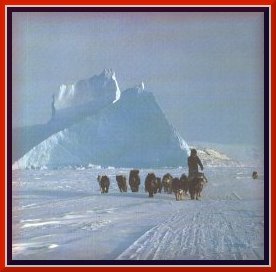 Some
of Canada's Inuit are returning to the challenge and the joy of the Hunt.
Some
of Canada's Inuit are returning to the challenge and the joy of the Hunt.
"In the spring when the sun
never sets
And when calm glassy waters
roamed the morning seas,
Oh, those were the happy
times.
When birds and seals
Lived only for playing,
Oh, those were the happy
times.
When we would stay up all
night,
Looking for birds' nests,
Oh, those were the happy
times.
When the sun began to warm
the morning air
And my sister could no longer
keep her eyes open,
Oh, those were the happy
times.
When I, too, fought the coming
sleep,
But my dreams would win in
the end,
Oh, those were the happy
times."
Lucy Evaloardjuak, Eskimo
resident of Pond Inlet
Back to CANADA index

