
[Confederate Holidays] [Confederate States Citizenship] [CSA Flags] [My Links] [Secession Documents] [Southern Documents]



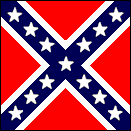
"The Battle Flag is square, having a Greek Cross (saltier) of blue, edged with white, with thirteen equal white five pointed stars; upon a red field; the whole bordered with white. There are three sizes: Infantry, 48 in. square; Artillery, 36 in. square; Cavalry, 30 in. square. The proportions for an Infantry Flag are: 48 in. by 48 in. (exclusive of the border); the blue arms of the cross, 7 � in. wide; the white edging to the cross � in. wide; the white border around the flag proper 1 � in. wide. Total outside measurement, 51 inches. The stars are five pointed, inscribed within a circle of 6 in. diameter, and are of uniform size. There should be five eyelet holes in the hoist, next the pole. The Artillery and Cavalry Flags are correspondingly reduced in all proportions."
*Standard: an ensign (military flag) of war
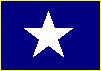
The first recorded use of the lone star flag dates to 1810. On 11 September 1810 a troop of West Florida dragoons set out for the provincial capitol at Baton Rouge under this flag. They were joined by other republican forces and captured Baton Rouge, imprisoned the Governor and on 23 September 1810 raised their Bonnie Blue flag over the Fort of Baton Rouge. Three days later the president of the West Florida Convention, signed a Declaration of Independence and the flag became the emblem of a new Republic. By 10 December, the flag of the United States replaced the Bonnie Blue after President Madison issued a proclamation declaring West Florida under the jurisdiction of the Governor of the Louisiana Territory. With this rebellion in mind, this flag was used by the Republic of Texas from 1836 to 1839. The single star stood only for the State/Republic that the flag flew over. Keep in mind that as the Lone Star flags began to appear late 1860 (as depicted in the article from the Charleston Mercury), that star stood only for the State it flew in. No one was even remotely thinking of a CSA back then - only seperate Republics, which is what the first seven seceeding States declared themselves upon secession. This was to avoid violating the US Constitution's prohibition of "no two States shall enter into a compact with each other." New nations require new flags, and this brought about the creation of State flags for many of the secceeding States.
The Lone Star concept was twofold. Some states looked at it as a reversal of the US Flag Act of 1818, which is still in effect today. That allows a new star to be added to the flag the 4th of July following the admission of a new State to the Union. Hence, some States looked at single star flags as "taking their star out of the Union".
The states of Alabama, Mississippi and Louisana, having been a part of the old Republic of West Florida, may have been inspired by that flag to create single star flags for their own republics since thay had a historical connection. The Mississippi and Louisiana flags were officially adopted. Alabama's was only a secession banner.
Not all Lone Star flags were blue. Many were of other colours as were the stars. But it was the single star depiction that ties them all together.
The Confederate government did not adopt this flag but the people did and the lone star flags were adopted in some form in five of the southern States that adopted new flags in 1861. In A War Time Journal of a Georgia Girl by Andrews, she records that her home-made Bonnie Blue flag represented the Southern Cause. In the context of secession many States used variations of Bonnie Blue flags to show their independence, but many of these States also had another Republic flag, so it seems like the Bonnie Blue represented to the Southerners of the 1860's unity in their independence. Just like the rectangular Battle flag with 13 stars represents the Old South today, the Bonnie Blue represented "the South" to the people in the war.
When Mississippi's Ordinance of Secession was signed on 9 January 1861, it was marked by a ceremony in which the 'Bonnie Blue Flag' was raised over the capitol building in Jackson. Among those who witnessed the event was an Irish comedian named Harry Macarthy, who shortly after wrote and performed the famous song, 'The Bonnie Blue Flag'. (The song "The Bonnie Blue Flag" was just as popular as Dixie in the early 1860's).
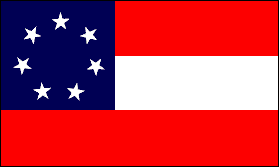
"That the Flag of the Confederate States of America shall consist of a red field with a white space extending horizontally through the center, and equal in width to one-third the width of the flag. The red spaces above and below to be of the same width as the white. The union blue extending down through the white space and stopping at the lower red space. The center of the union a circle of white stars, corresponding in number with the States in the Confederacy."
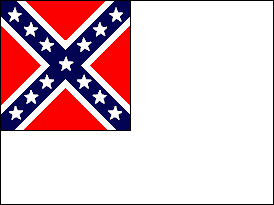
"The field to be white, the length double the width of the flag, with the union (now used as the Battle Flag) to be a square of two-thirds the width of the flag, having the ground red; thereon a broad saltier of blue, bordered with white, and emblazoned with white mullets or five pointed stars, corresponding in number to that of the Confederate States."
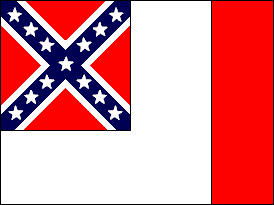
"The Congress of the Confederate States of America do enact, That the Flag of the Confederate States shall be as follows: The width, two-thirds of its length, with the union (now used as the Battle Flag) to be in width three-fifths of the width of the flag, and so proportioned as to leave the length of the field on the side of the union twice the width of the field below it; to have the ground red and a broad, blue saltier thereon, bordered with white and emblazoned with mullets or five pointed stars, corresponding in number to that of the Confederate States; the field to be white except the outer half from the union to be a red bar extending the width of the flag."
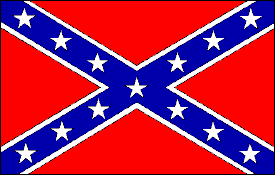
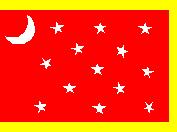
This flag was used primarily in mid-1862 and 1863 but its use quickly faded after Van Dorn's untimely death in 1863. Although Van Dorn's career was more colorful than impressive, he was the architect of the brilliant Holly Springs raid that stopped Grant dead in his tracks in his first attempt at Vicksburg. While seeing use on flags in Missouri and some early secession flags in South Carolina, the crescent moon was only seen in quantity on the battle flags of Van Dorn.
The borders of the Van Dorn flags have been seen in white, yellow, and often yellow/gold fringe.
A. During the 1st 24 days of existence the Confederate government had no flag.
B. When Jefferson Davis was inaugurated as President of the provisional government of the Confederate States of America on 18 February 1861, the Capitol Building in Montgomery flew the Alabama State Flag.
C. A committee was established to design a national flag with the deadline being 4 March 1861.
D. Hundreds of designed were submitted including many from people still in the United States.
E. There was much disagreement and the when the final day approached they had narrowed the proposal to four patterns. One was the popular Battle Flag design ' but with 7 stars.
F. That morning the Confederate Congress decided in favour of the 'Stars and Bars' design. There were strong sentiments favouring a flag that closely resembled the old US flag. That afternoon the '1st National' was hoisted above the Capitol in Montgomery.
G. In their hurry to adopt a flag that day (and have it prepared for the ceremony that afternoon)' the Confederate Congress had neglected to enact a flag law. There is nothing in the Journal of Congress except a committee report' there is no flag law to be found in the Statute Books. The 'Stars and Bars' was never established as an official flag of the Confederate States of America by the laws of the land.
H. Shortly thereafter in the first major battle of the war '1st Manassas' the flag caused great confusion because of its close resemblance to the US Flag. It was decided by the military department to select a Battle Flag to use on the battlefield to avoid such confusion. The St. Andrews design as originally submitted to the Confederate Congress was selected and went into use in November of 1861.
I. As the war extended, sentimental attachment to the 'Stars and Stripes' began to wane. It had come to be viewed by the Southern people as a "symbol of oppression and imperialistic aggression." It was almost changed in 1862 but they committee could not reach a consensus.
J. In 1863, it was decided that the 'Stars and Bars' had to go. Senate Bill 132 was passed on 1 May 1863 with little or no debate. It was signed into law that afternoon by President Jefferson Davis. This bill made the 'Stainless Banner' the 1st official National Flag of the Confederate States of America although it is historically known as the '2nd National Flag.' (See Note 1). The Flag Act of 1863 describes the flag in the following language:
"The Congress of the Confederate States of America do enact, That the flag of the Confederate States shall be as follows: the field to be white, the length double the width of the flag, with the union, (now used as the battle flag,) to be a square of two thirds the width of the flag, having the ground red; thereon a broad saltier of blue, bordered with white, and emblazoned with white mullets or five pointed stars, corresponding in number to that of the Confederate States."
K. Because the flag contained such a large white field it was being mistaken for a flag of truce particularly on ships. On 27 February 1865 Senate Bill 137 was passed adding the red bar on the end. President Davis signed it into law on 4 March 1865. This was the last official flag of the Confederate States of America. The Flag Act of 1863 describes the flag in the following language:
"The Congress of the Confederate States of America do enact, That the flag of the Confederate States shall be as follows: The width two-thirds of its length, with the union (now used as the battle flag) to be in width three-fifths of the width of the flag, and so proportioned as to leave the length of the field on the side of the union twice the width of the field below it; to have the ground red and a broad blue saltier thereon, bordered with white and emblazoned with mullets or five pointed stars, corresponding in number to that of the Confederate States; the field to be white, except the outer half from the union to be a red bar extending the width of the flag."
Note 1 William Porcher Miles (from the Minutes of the Third Session of the First Congress):
"The country was aware how it [Battle Flag] had been received by the army it had been consecrated. The battle flag should be used then with simplicity, but to demand that it should be taken alone, he would reply that it was necessary to emblazon it. The battle flag, on a pure white field, he thought was the best he could find."