
|
Overview of Modern Scottish Constitutional Politics |
Put the word Scotland into any WWW search engine and all sorts of weird and wonderful romantic stuff emerges about Gaelic, clan genealogy and kilt wearing Jacobites fighting English redcoat soldiers in mist covered Highland glens. Well as the moderator of the Scotia discussion forum all I can say is that I grew up in Scotland but that doesn't seem too much like home to me. The land I grew up in was predominantly Presbyterian,Church of Scotland, pro-Windsor Monarchy and was British to the core and I never once heard Gaelic being spoken in the central Lowlands where most of Scotland's population lives. I heard a mixture of Scots and English most of the time and some Urdu now and again. I remember as a kid in the 1970's that people were still very proud of Britain's role in World War II when the UK stood as a beacon of hope to all of Nazi occupied Europe. Our grandparents and older schoolteachers told us all about the Luftwaffe's raid on Clydebank and the U-boats trying to sink the Atlantic convoys and Winston Churchill's wartime speeches. They were justifiably proud of what their generation of Scots had done while saluting the Union Flag.
|
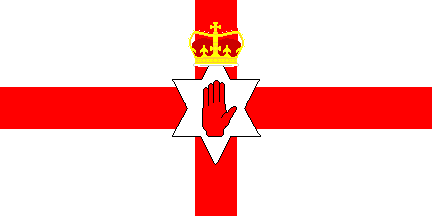
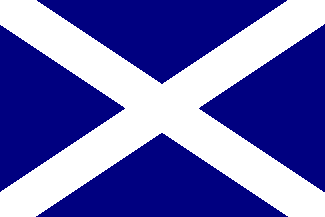
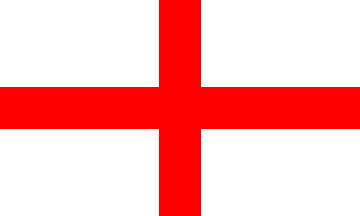
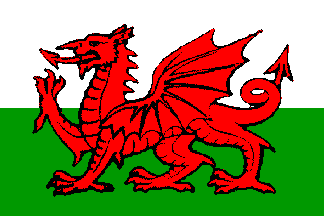
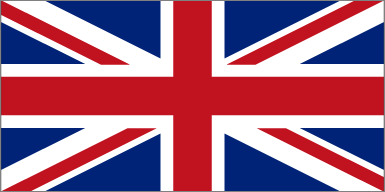 But times change and with the loss of Empire, the discovery of North Sea Oilandentry into the EEC backed by the British electorate in 1975 there has been a reevaluation in recent decades of the relative emphasis placed on the Scottish and British levels of identity. The four flags above are the national flags of Northern Ireland, Scotland, England and Wales. The UK never attempted to obliterate the national existence of its component parts as the Home Internationals and the frequent separate involvement of the four Home Nations in FIFA's World Cup finals has testified. Scotland maintained many national institutions within the Union such as a separate legal and education systems and many social scientists argue that its modern sense of nationhood has developed long after 1707. There are ethnic nationalists in Scotland today who are trying to claim that Scotland has somehow always been an unwilling colony of the UK and that the English have somehow always been Scotland's enemy. This has always seemed bizarre and totally nonsensical to me. In my experience Scots and English people have absolutely no problem getting along as friends and neighbours and it is hard to see how the relation between the two nations could not fundamentally be a friendly one in future. With entry into the European Union a lot of the original economic and geostrategic rationale for the Treaty of Union of 1707 between Scotland and England to form Great Britain no longer applies. Many people in Scotlaned think that renewed national level from Edinburgh makes more sense these days and do so without disliking England or the English people in general and most are able to do so while maintaining a continuing sense of British identity. How is this possible? Well take a look at a map. But times change and with the loss of Empire, the discovery of North Sea Oilandentry into the EEC backed by the British electorate in 1975 there has been a reevaluation in recent decades of the relative emphasis placed on the Scottish and British levels of identity. The four flags above are the national flags of Northern Ireland, Scotland, England and Wales. The UK never attempted to obliterate the national existence of its component parts as the Home Internationals and the frequent separate involvement of the four Home Nations in FIFA's World Cup finals has testified. Scotland maintained many national institutions within the Union such as a separate legal and education systems and many social scientists argue that its modern sense of nationhood has developed long after 1707. There are ethnic nationalists in Scotland today who are trying to claim that Scotland has somehow always been an unwilling colony of the UK and that the English have somehow always been Scotland's enemy. This has always seemed bizarre and totally nonsensical to me. In my experience Scots and English people have absolutely no problem getting along as friends and neighbours and it is hard to see how the relation between the two nations could not fundamentally be a friendly one in future. With entry into the European Union a lot of the original economic and geostrategic rationale for the Treaty of Union of 1707 between Scotland and England to form Great Britain no longer applies. Many people in Scotlaned think that renewed national level from Edinburgh makes more sense these days and do so without disliking England or the English people in general and most are able to do so while maintaining a continuing sense of British identity. How is this possible? Well take a look at a map.
|
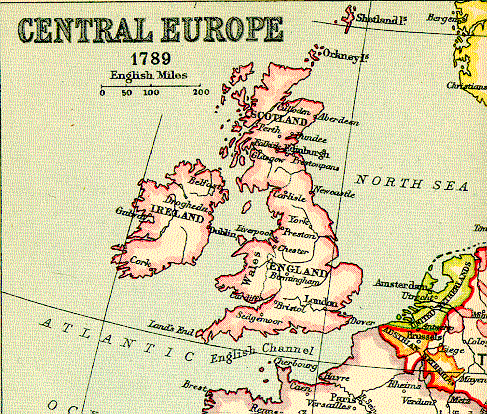 The British Isles are a natural geographical unit and have so much shared common historical experience that they are a natural cultural unit like the Nordic world even if the political unity of the British Isles through the grouping of the three historic kingdoms of Scotland, England and Ireland into the United Kingdom of Great Britain and Ireland was shattered by the breakaway of the 26 counties of the Irish Free State in 1922. The IFS did however remain on paper at least one of the self-governing dominions within the empire and did not completely sever its ties to the British crown de jure until 1948. Dublin chose not to participate in the British Commonwealth of former British Empire colonies and dominions which was also emerging at that time but still remained very closely linked economically to the UK until entry into the EEC in the early 70's opened up new opportunities for the RoI economy from which it is now currently reaping the benefits. The events that resulted in the partition of Ireland took place in a very different social climate from that of today in which religious belief was still a key motivating factor in most people's lives. An Irish Home Rule Bill which would have resulted in a wide degree of self-government within the UK and the Empire had been accepted at Westminster prior to the outbreak of WWI and a Scottish Home Rule Bill was well on the way to being passed as well. These plans came to nothing as Irish nationalism was a divisive force which was not representative of all the people on the island of Ireland as it was perceived as having a Roman Catholic sectarian motivation by the Protestant majority within Ulster. Such a motivation was not entirely surprising given the legacy of the minority Anglican Ascendancy within pre-Union Ireland. Most Ulster Protestants were Presbyterians and were descendants of Lowland Scots who had settled there after James VI had of Scotland had become the king of England and Ireland in 1603. The Presbyterian community had also been discriminated against in pre-1801 Ireland but had seen the Union with Great Britain and the subsequent liberal reforms as being a greatly positive developmentfor their community and therefore wanted no part of renewed rule from Dublin. An armed insurrection was launched in Dublin in 1916 by unrepresentative ethnic nationalist extremists in the midst of a World War in which volunteers from both Irish nationalist and Ulster unionist divisions were actively fighting and dying for their king and country. The rebels of 1916 rejected any possibility of political partition of the island of Ireland regardless of what happened at the ballot box. The handling of the aftermath was badly botched by the British government and the rest as they say is history. The British Isles are a natural geographical unit and have so much shared common historical experience that they are a natural cultural unit like the Nordic world even if the political unity of the British Isles through the grouping of the three historic kingdoms of Scotland, England and Ireland into the United Kingdom of Great Britain and Ireland was shattered by the breakaway of the 26 counties of the Irish Free State in 1922. The IFS did however remain on paper at least one of the self-governing dominions within the empire and did not completely sever its ties to the British crown de jure until 1948. Dublin chose not to participate in the British Commonwealth of former British Empire colonies and dominions which was also emerging at that time but still remained very closely linked economically to the UK until entry into the EEC in the early 70's opened up new opportunities for the RoI economy from which it is now currently reaping the benefits. The events that resulted in the partition of Ireland took place in a very different social climate from that of today in which religious belief was still a key motivating factor in most people's lives. An Irish Home Rule Bill which would have resulted in a wide degree of self-government within the UK and the Empire had been accepted at Westminster prior to the outbreak of WWI and a Scottish Home Rule Bill was well on the way to being passed as well. These plans came to nothing as Irish nationalism was a divisive force which was not representative of all the people on the island of Ireland as it was perceived as having a Roman Catholic sectarian motivation by the Protestant majority within Ulster. Such a motivation was not entirely surprising given the legacy of the minority Anglican Ascendancy within pre-Union Ireland. Most Ulster Protestants were Presbyterians and were descendants of Lowland Scots who had settled there after James VI had of Scotland had become the king of England and Ireland in 1603. The Presbyterian community had also been discriminated against in pre-1801 Ireland but had seen the Union with Great Britain and the subsequent liberal reforms as being a greatly positive developmentfor their community and therefore wanted no part of renewed rule from Dublin. An armed insurrection was launched in Dublin in 1916 by unrepresentative ethnic nationalist extremists in the midst of a World War in which volunteers from both Irish nationalist and Ulster unionist divisions were actively fighting and dying for their king and country. The rebels of 1916 rejected any possibility of political partition of the island of Ireland regardless of what happened at the ballot box. The handling of the aftermath was badly botched by the British government and the rest as they say is history.
|
 The British Isles have until recently remained very much polarized along the dividing line of 1916 in constitutional terms and within this context the cause of Scottish self-government was setback by about 75 years since there was no religious based politics of nationalist grievance within overwhelmingly Presbyterian Scotland and politics was dominated by London based social class oriented political parties. Constitutional changes made in the last 3 years, however, are creating a new reality in which the old landsacpe of bipolar division is being replaced. The steady decline and eventual collapse of Britain's imperial global role which once covered 25% of the world's landmass and the failure of Britain's first past the post 2 party confrontational class based political system to arrest the relative economic decline compared to other large European states within the EEC eventually brought the national question in Scotland back onto the political agenda in the late 60's and 70's. After the failure of a devolution referendum in 1979 to really capture the public's imagination in the dying days of a minority Labour government and 18 years of subsequent virulently right wing anti-devolutionist Conservative Party government, a limited degree of self-government has recently been devolved to Edinburgh from Westminster for the first time since the parliamentary Union of the kingdoms of Scotland and England to form Great Britain in 1707 after an overwhelming "Yes" victory in 1997. A much weaker Welsh Assembly lacking significant primary legislative powers was set up after a very narrow victory by the "Yes" side. In England the St. George's Cross has replaced the Union Flag at sporting events and there are increasing calls for an answer to the so called West Lothian Question so that only English MP's would vote on legislation pertaining to England only at Westminster. In Ulster the once unthinkable has happened and Sinn Fein, the political voice of IRA terrorism, and the SDLP have joined a devolved Stormont governing coalition and the Republic of Ireland has dropped its irredentist territorial claims to Northern Ireland while on the other hand the Ulster Unionist party has agreed to power-sharing with its political opponents and all the major parties have agreed to the principle of a United Ireland only being possible through consent at the ballot box under the terms of the Good Friday Agreement which was backed by Northern Ireland's voters in the 1998 referendum. Across the British Isles then the rigid post-1922 polarization in constitutional terms has crumbled and the geographical location of political power has become much more multipolar rather than rigidly bipolar. Hopefully in the years ahead the Council of the Isles will become the British Isles equivalent of the Nordic Council. The British Isles have until recently remained very much polarized along the dividing line of 1916 in constitutional terms and within this context the cause of Scottish self-government was setback by about 75 years since there was no religious based politics of nationalist grievance within overwhelmingly Presbyterian Scotland and politics was dominated by London based social class oriented political parties. Constitutional changes made in the last 3 years, however, are creating a new reality in which the old landsacpe of bipolar division is being replaced. The steady decline and eventual collapse of Britain's imperial global role which once covered 25% of the world's landmass and the failure of Britain's first past the post 2 party confrontational class based political system to arrest the relative economic decline compared to other large European states within the EEC eventually brought the national question in Scotland back onto the political agenda in the late 60's and 70's. After the failure of a devolution referendum in 1979 to really capture the public's imagination in the dying days of a minority Labour government and 18 years of subsequent virulently right wing anti-devolutionist Conservative Party government, a limited degree of self-government has recently been devolved to Edinburgh from Westminster for the first time since the parliamentary Union of the kingdoms of Scotland and England to form Great Britain in 1707 after an overwhelming "Yes" victory in 1997. A much weaker Welsh Assembly lacking significant primary legislative powers was set up after a very narrow victory by the "Yes" side. In England the St. George's Cross has replaced the Union Flag at sporting events and there are increasing calls for an answer to the so called West Lothian Question so that only English MP's would vote on legislation pertaining to England only at Westminster. In Ulster the once unthinkable has happened and Sinn Fein, the political voice of IRA terrorism, and the SDLP have joined a devolved Stormont governing coalition and the Republic of Ireland has dropped its irredentist territorial claims to Northern Ireland while on the other hand the Ulster Unionist party has agreed to power-sharing with its political opponents and all the major parties have agreed to the principle of a United Ireland only being possible through consent at the ballot box under the terms of the Good Friday Agreement which was backed by Northern Ireland's voters in the 1998 referendum. Across the British Isles then the rigid post-1922 polarization in constitutional terms has crumbled and the geographical location of political power has become much more multipolar rather than rigidly bipolar. Hopefully in the years ahead the Council of the Isles will become the British Isles equivalent of the Nordic Council.
|
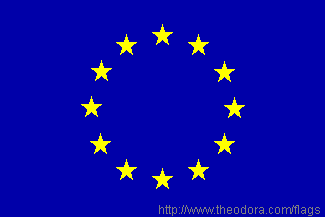 People often like to talk about the SNP, the main opposition party in Scotland, as Nationalists and separatists and the other major parties as Unionist but that is a bit misleading these days at least when looked at in academic terms. How can you still sensibly talk about separatist parties now that all the mainstream parties support the Maastrict Treaty and most are in favour of joining the new euro currency after a referendum between no and yes camps? The main rationale for the Euro lies in the fact that if the European Union is to be a free trade zone with free movement of labour, goods and capital then it is inherantly wasteful to have 15 separate national currencies in use as the currency transactions wastes billions in bureacratic red tape while the US has a common currency for its 50 states. For Europe to compete with the US economically in a lot of fields it needs to have a single currency and a single 320 million market block rather than being balkanised into 15 separate national economies. The key to making a greater degree of EU integration work in a culturally and linguistically diverse continent is the principle of subsidiarity which is all about keeping real political power in the hands of people at the grass roots level by maintaining a decentralised federal system of government that ensures that the local, regional, national and European levels of government carry out only those functions that they are best suited for, to maintain full democratic accountability. In a well run federal system such as in Australia or Switzerland there is a very limited range of powers allocated to the federal level of governmentin a manner designed to best coordinate the internal and external relationships of the members states on the basis of a written constitution. The first steps towards an EU constitution are emerging with the Charter of Fundamental Rights and Freedoms. There are still nationalists who dream of a 19th century style Scottish or British nation-state outside of the European Union but they appear to be in the minority. Mainstream politics is concerned with the relative importance of the Scottish, British and European Union dimensions in terms of governance and most people are comfortably able to accomodate differing degrees of attachment to all three levels of identity. Scottish politics in reality are therefore largely post-nationalist in content although the terminology used does not always reflect that reality. If you are interested in the detailed electoral statistics the Scottish Liberal Democrats provide the raw numbers for all therecent Scottish election resultswithout any comment or biased interpretation. People often like to talk about the SNP, the main opposition party in Scotland, as Nationalists and separatists and the other major parties as Unionist but that is a bit misleading these days at least when looked at in academic terms. How can you still sensibly talk about separatist parties now that all the mainstream parties support the Maastrict Treaty and most are in favour of joining the new euro currency after a referendum between no and yes camps? The main rationale for the Euro lies in the fact that if the European Union is to be a free trade zone with free movement of labour, goods and capital then it is inherantly wasteful to have 15 separate national currencies in use as the currency transactions wastes billions in bureacratic red tape while the US has a common currency for its 50 states. For Europe to compete with the US economically in a lot of fields it needs to have a single currency and a single 320 million market block rather than being balkanised into 15 separate national economies. The key to making a greater degree of EU integration work in a culturally and linguistically diverse continent is the principle of subsidiarity which is all about keeping real political power in the hands of people at the grass roots level by maintaining a decentralised federal system of government that ensures that the local, regional, national and European levels of government carry out only those functions that they are best suited for, to maintain full democratic accountability. In a well run federal system such as in Australia or Switzerland there is a very limited range of powers allocated to the federal level of governmentin a manner designed to best coordinate the internal and external relationships of the members states on the basis of a written constitution. The first steps towards an EU constitution are emerging with the Charter of Fundamental Rights and Freedoms. There are still nationalists who dream of a 19th century style Scottish or British nation-state outside of the European Union but they appear to be in the minority. Mainstream politics is concerned with the relative importance of the Scottish, British and European Union dimensions in terms of governance and most people are comfortably able to accomodate differing degrees of attachment to all three levels of identity. Scottish politics in reality are therefore largely post-nationalist in content although the terminology used does not always reflect that reality. If you are interested in the detailed electoral statistics the Scottish Liberal Democrats provide the raw numbers for all therecent Scottish election resultswithout any comment or biased interpretation.
|
Return to Home Page |