�Be sober, be vigilant; because your adversary the
 devil, as a roaring lion, walketh about, seeking whom
 he may devour.�
                                 1 Peter 5:8
�Be sober, be vigilant; because your adversary the
devil, as a roaring lion, walketh about, seeking whom
he may devour.�
1 Peter 5:8
|
|
For centuries it has been thought that the Salem Witch Trials happened because of politics, hatred, greed, or attention deficiency. Not to say that any of those things could or could not play a part, or even be the sole cause. No one will ever really know the genuine reason for the witchcraft hysteria - it's a secret of the dead. None of us were around back then, however, we are free to wonder, to guess what might have happened, to ponder the real cause. We've been doing so for three-hundred years.
| 
|
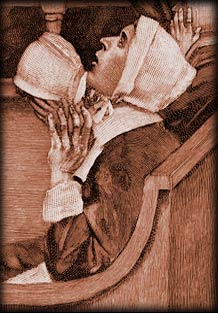
The hysteria is so often dismissed as things that were just in the people's minds, such as with hypochondria. Given we are free to ponder, what if the paranoia, the accusations, the hallucinations, the convulsive fits . . . were real? What if there were an actual medical cause for these outbursts?
What if the secret of the dead lies within the Puritans of Salem, Massachusetts' everyday diets?
. . . And what if there was proof?
Let's take a walk in the shoes of the Puritans of January 1692. Times were hard, and winters were cold. Reading was a popular past time in the cold winter months, and during the winter of 1691 and '92, reportedly, reading of divination was particularly of interest among the young girls, though the Puritans beliefs forbid even playing hide-and-go seek, as it might "open the door to Satan." Whenever chores were done, there was not much to do for two young girls, such as nine-year-old Elizabeth Parris and eleven-year-old Abigail Williams. Oftentimes, Tituba, the Reverend Parris' slave from Barbados, would entertain them. One morning, however, the two took their entertainment upon themselves. This morning was January 20, 1692.
The story goes that as the two peered into their homemade crystal ball (a glass filled with water with an egg yolk in it) expecting to see who their future husbands would be by watching what shape the yolk would take, the two were startled when in the glass, the shape of a coffin appeared.
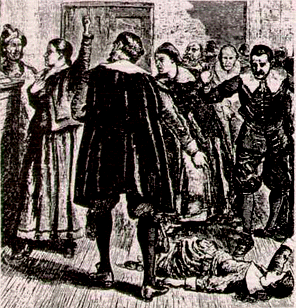
After that moment, no one knows for sure what happened. Soon, the girls began going into "fits," as they were called: their legs and arms flew about as they shouted strange gibberish. Doctors were called in, but could not help the matter, and prayer and fasting - the Puritan cure for such horrors - also did not stop the fits. As word got around the Village, other people were also noted as having the same symptoms - even some adults were afflicted, the oldest being seventy-one years old.
| 
|
In the Puritan mind, where Satan stood ready to break down the doors of a God-fearing community, no other explanation could be found except one thing:
The accusations flew first to the poor, the strange - those considered on the fringes of society: the aforementioned Tituba; Sarah Good, a beggar; and Sarah Osborne, a bedridden old woman in her nineties were the first to fall. Such people were the usual causes of witch hunts, and Salem Village was no different in its initial choice of victims. In Colonial America, typically a few jailings, possibly an execution or two, were enough to drill fears and bring the matter of witchcraft to an end. For the people of Salem Village, however, sending their accused neighbors to hang didn't stop the finger-pointing, and the accusations took an uncharacteristic turn. Soon the successful, rich, church members - those considered God-fearing citizens, such as Martha Corey and Rebecca Nurse, were the next to fall.
At first, Tituba claimed innocence. After being refreshed by Parris' lash, however, she stated the following before the Magistrates in March of 1692:
�The devil came to me and bid me serve him,� she reported as villagers sat spellbound while she spoke of black dogs, red cats, yellow birds, and a white-haired man who bade her sign the devil�s book. There were several undiscovered witches, she said, and they "yearned to destroy" the Puritans. Finding witches became a crusade � not only for Salem but all Massachusetts. Before long the crusade turned into a convulsion, and the witch-hunters ultimately proved far more deadly than their prey.
Linnda Caporael was the first to have the idea that the Salem Witch Trials could have been the result of ergot poisoning. Ergot is a fungal disease of cereal grasses, especially rye, caused by the ascomycete fungus clavicep purpurea. The filamentous mycelium of the flower attacks the ovaries, which become deformed and enlarged, and then wither. The deeper mycelium within the ovary becomes dense and hard, forming sclerotium.
Ergotism, caused by eating infected grain (in animals), or breadstuffs made with infected flour (in humans), is characterized by mental disorientation, miscarriages in females, muscle cramps, convulsions, dry gangrene of the extremities, and finally, death. Ergot also seriously weakens the immune system. The psychoactive drug LSD (Lysergic Acid Diethylamide), which Webster's defines as "an illicit drug that causes psychotic symptoms similar to those of schizophrenia," is chemically related to the ergot alkaloids.
The giant trees are bending
Their bare boughs weighed with snow
And the storm is fast descending,
And yet I cannot go.
Clouds beyond clouds above me,
Wastes beyond wastes below;
But nothing drear can move me;
I will not, cannot go.
- Emily Brontë
Ergot occurs from a cold winter followed by a wet spring. Throughout history, drops in population have followed diets heavy in rye bread and weather that favors ergot growth. During the huge depopulation in the early years of the Black Death, right after 1347, conditions were ideal for ergot.
There is the possibility of the plague and ergot coexisted - many symptoms of the two are similar. In fact, the worst plague damage happened where ergot suppressed the human immune system, making it vulnerable. Given the plague deaths showed huge regional variations, the plague could have and probably did follow pockets of rye ergot.
The symptoms of bewitchment are incessant, but the way those symptoms were received was not. "Crazy" behavior was commonplace in the medieval plague years. Then, in the sixteenth and seventeenth centuries, ergot symptoms began being blamed on witchcraft (in Europe and Massachusetts alike). Witch hunts were rare in places where people didn't eat rye.
The 1740's marked the "Age of Rationalism," when ergot symptoms became holy possessions, instead of demonic. Visions, trances, and spasms now meant that god smiled upon you. This period of religious revival is called the "Great Awakening" by historians.
I have eaten your bread and salt,
I have drunk your water and wine,
The deaths ye died I have watched beside
And the lives ye led - were mine.
- Kipling
