The week
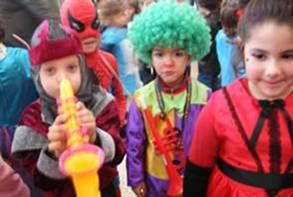
before Lent is carnival time in Spain. There is no one way that carnival is
celebrated in Spain - each city has a slightly different style.
The most important and well known are celebrated in Tenerife (Canary
Islands) and Cádiz (Andalusia)
 The most glamorous of the
carnival celebrations, this is the carnival that most resembles the big
event in Rio. As Tenerife is closer to Africa than Europe, the weather will
be warm. The most glamorous of the
carnival celebrations, this is the carnival that most resembles the big
event in Rio. As Tenerife is closer to Africa than Europe, the weather will
be warm.
The Carnival Santa Cruz de Tenerife is often listed as among the
world's greatest annual festivals, and the natives consider their
celebration second only to Rio de Janeiro in Brazil. By most measures, Santa
Cruz de Tenerife hosts the largest, most impressive carnival in Spain.
Love of fiestas is an essential part of the make-up of the Canary Islanders,
who celebrate Carnival on all seven islands. Just as this island holds the
largest mountain [The Teide volcano] in Spain, there is no rival in Spain to
Tenerife's massive Carnival celebration.
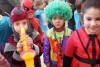 The
main events of the festival begin a week before Ash Wednesday, but the
season starts months before, as groups prepared themes and costumes for the
great party. The Carnival officially begins with the election of the
carnival queen. There are many flamboyant processions by Carnival groups,
fancy-dress parades starring Brazilian samba schools and fantastic costumes,
street musicians, a cabalgata (horse parade), keen chorus and musical dance
competitions -- all reaching a climax in the arena on the Tuesday. The
main events of the festival begin a week before Ash Wednesday, but the
season starts months before, as groups prepared themes and costumes for the
great party. The Carnival officially begins with the election of the
carnival queen. There are many flamboyant processions by Carnival groups,
fancy-dress parades starring Brazilian samba schools and fantastic costumes,
street musicians, a cabalgata (horse parade), keen chorus and musical dance
competitions -- all reaching a climax in the arena on the Tuesday.
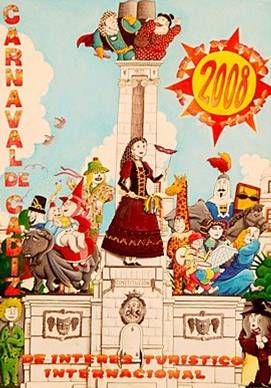
The carnival in Cadiz has a healthy dose of music and comedy added to
the mix.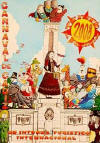
Cadiz is famous for the sense of humour of its citizens and the age-old
Carnival where authority, politicians, celebrities and the church are
parodied and ridiculed with unparalleled skill and wit in comic song. The
central figures here are the choirs, or agrupaciones, which are groups of
between three and forty singers.
The Falla's Contest is a Music festival held in the Gran Teatro Falla before
Carnival, it is a relatively serious competition as the show is televised
across Spain. Competition is keen, and contestants spend months in
preparatio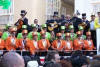 n. n.
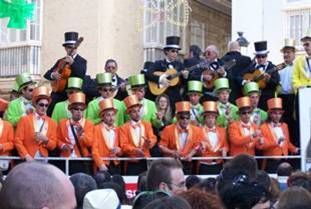
The most popular type of group is the chirigotas, choirs normally of ten
unison or close-harmony singers, accompanied by bombo, caja (drum, box -
used as a percussion instrument) and guitar. Their repertoire is the most
satirical of the different types of groups and the literary quality of the
songs can be very high (they may be written by local authors). Only a few
musical forms such as the tango or pasodoble are used, so that everyone
knows the tune and can concentrate on the words.
Click
here to find out information about this
carnival in our town - GIJON.
C.P RAMON MENENDEZ PIDAL
GIJON-SPAIN -CLASS 5 A
|