
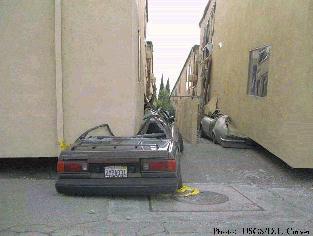
An earthquake is the shaking or rocking of the ground caused by a shifting or moving along a fracture of earth called a fault line. A fault is a fracture in the rocky mass inside the earths crust. The depth and length of these faults can vary greatly around the world. An earthquake will occur when stress builds up within these rocks. The release of this stress is the earthquake itself. The power of the earthquake is from all of this stress and therefore, the greater the stress that is being released from the rocks, the more powerful the earthquake.
One great comparison to an earthquake would be the breaking of a pencil. As the pencil has pressure put on it, more and more stress occumulates on the pencil. In this case, the release of the stress is the snapping of the pencil, as oppossed to the ground shaking in the case of an earthquake. This release of energy and stress travels in waves through the earths crust and causes the shaking felt in an earthquake or vibrating of the pencil in the pencil experiment.
This waves of energy are known as Seismic Waves. These waves that travel at a few kilometers per second through the ground can be measured my seismographs. These seismographs measure the intensity/how much energy is released, in the earthquake. An example of a seismogram can be viewed on the next page.