A FEEDBACK CONTROL SYSTEM
MODEL FOR THE TREATMENT OF CANCER
BY
Prof Dr.
Mohammad Munir Hasan
ABSTRACT
A new
model for the treatment of cancer which is based on the feedback control system
has been
proposed. This innovative approach is completely different from all other
approaches (surgery,
chemotherapy, radiation therapy, gene therapy, immunotherapy, etc.) on which the
researches are being carried out currently. We know that there are many feedback
control systems
working in our body to control various outputs. If a person does not get cancer
throughout his life, it is because of the presence of such a control system
working in the body. Cancer is
developed due to the abnormal functioning or break in this control system. The
treatment lies in
the repair of the control system, which may be done by supplying low-energy
resonant
monochromatic radiations of specific predetermined frequencies to the cancerous
cells and help them
absorb this energy by resonance. This process is likely to bridge the break in
the control system
and the cancer may be treated in a natural way.
KEY
WORDS
Cancer, Modeling of Cancer, Feedback Control System, Treatment of Cancer
INTRODUCTION
Cancer is undoubtedly one of the most fatal
diseases of the modern era. Estimates of the worldwide incidence, mortality and
prevalence of 26 cancers show that in the year 2002, there were 10.9 million new
cases, 6.7 million deaths and 24.6 millions persons alive with cancer [1, 2]. It
is estimated that by the year 2020, cancer rates could further increase by 50
percent [3]. The World Cancer Report tells us that cancer rates are set to
increase at an alarming rate globally [4].
We can make a difference by taking action
today. Apart from conventional methods of treatment, the new avenues are to be
explored to find a treatment of this dreadful disease. Accordingly, this paper
suggests a new model which merits consideration for researchers.
So far most of the applications of electronic
and electrical engineering in medical profession have been in the field of
diagnostics. In fact such application is so general that the persons in the
medical profession find themselves helpless without the electro-medical
equipment. The principles underlying the functioning of these electro-medical
equipments are either electronic, electromagnetic, optical or sonic properties
of the various tissues and organs of the living body. The rapid development in
this field and their universal acceptance is mainly because of the beauty of the
electronic methods which are very accurate, fast in response, mostly
non-intrusive, easy to handle and needing comparatively low maintenance. In the
field of therapeutics although the application so far is very much limited, yet
looking at the organic composition of the living bodies, consisting of atoms,
ions and molecules which not only have chemical mass but also have the
electrical and magnetic properties, it is not difficult to appreciate that the
electrical and magnetic methods can play a very important role in this direction
as well. In the following, a method has been described which could possibly be
used in the treatment of many diseases including cancer, using the intrinsic
resonance characteristic property of the atoms and molecules.
It is well known that there are many automatic
or feedback control systems working in our body to control the metabolic and
other behaviour to keep the output quantities within well defined limits [5].
For example, our body temperature remains at 98.6 degrees Fahrenheit (37 degrees
Celsius) whatever the outer or surrounding temperature may be. Similarly, to
control the blood pressure in the body, baroreceptors detect the actual blood
pressure, and if it is different from the normal or preset value, the vasomotor
centre, arterioles, aorta, the vagus and glossopharyngeal nerves working as a
part of the feedback control system keep the pressure within limits.
 It is
known that all healthy bodies carry some cancerous cells throughout their lives
without forming a malignant tumor [5]. It must then be due to a feedback control
system in the body which effectively controls the growth of the cancerous cells.
Then cancer can be viewed as the break or malfunction of this control system.
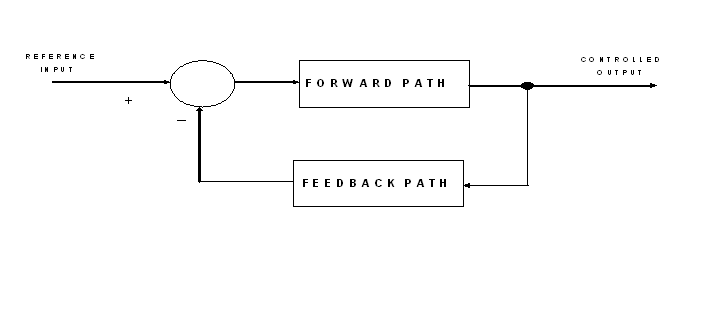
The schematic diagram of a typical feedback control system is shown in Fig.1.
It is
known that all healthy bodies carry some cancerous cells throughout their lives
without forming a malignant tumor [5]. It must then be due to a feedback control
system in the body which effectively controls the growth of the cancerous cells.
Then cancer can be viewed as the break or malfunction of this control system.
The schematic diagram of a typical feedback control system is shown in Fig.1.
Fig. 1 A
Typical Feedback Control System
The output of a feedback control system is
controlled by the following functional components:
•
Reference Input (or pre-set value)
•
Sensing
•
Feedback component
•
Comparison (generation of error
signal), and
•
Processing
Looking at the functions of these components
and at the modes which produce cancer, there are reasons to believe that in the
case of cancer the fault may lie in sensing part of the control system.
From control system point of view, a cancerous
cell has two prominent characteristic properties; (i) undesired and rapid rate
of proliferation, and (ii) inability of this cell to send the information to the
control system which controls the growth of the cells. Looking at the above, it
appears that on the one hand some parts of the cancerous cells have acquired
higher energies to effect rapid rate of cell growth, and on the other hand the
parts which are responsible for sending signals to the control system have
become dead or almost dead due to loss of energy. So, this problem can be viewed
as the energy imbalance within the cells from one part to the other, changing
the normal energy bonds, such that when high-energy part of the cell starts
rapid and unusual growth, the other low-energy or almost-dead part is unable to
transmit this information to the control system which, quite obviously, cannot
take corrective measures by losing the normal feedback control that prevents
excessive growth.
In this paper, it is proposed that this lack of
information or break in the control system is due to the decrease in the
amplitudes of vibrational or rotational motions of some of the elements or
molecules in the cells, and it is proposed that if some desired quantity of
energy is supplied selectively to the cancerous cells from some external source
in such a way that the amplitudes of vibrational and/or rotational motions of
the elements is enhanced, it is likely that the break in the control system may
be repaired. And if it is so, then it will once again start sending signals to
the control system which in turn will take desired corrective measure and thus
cure it in a natural way.
THEORY
The above principle which is based on quantum
theory can be elaborated in terms of the following three properties of atoms and
molecules:
1.
Atoms, ions and molecules exhibit
internal resonances at certain discrete characteristic frequencies. These
internal atomic resonances occur at frequencies ranging from the audio up to and
beyond the optical regions.
2.
Signals applied to an atom (or a
molecule) at or near one of its internal resonances will cause a measurable
response in the atom and may absorb energy from the signals under normal
positive-temperature thermal equilibrium conditions.
3.
The strength of the total
response that will be obtained from a collection of many atoms (or molecules) of
the same kind depends directly on population difference, i.e., the difference in
population between the lower and upper quantum energy levels responsible for
that particular transition.
According to quantum theory, every atom has a
set of allowed energy levels located at definite energy values characteristic of
that type of atom. If two of these energy levels occur at energy values Em
and En where Em > En, then the atom
will exhibit a transition at the frequency fmn, given by:
fmn = Em - En
h
where
h is Planck’s constant (= 6.626 x 10⁻³⁴ joule-sec.). If a
signal is applied at this transition,
then the atom may absorb energy from the signal. When we plot absorption versus
frequency in the immediate vicinity of any of the transition frequencies of the
atom, the resulting plot generally has the appearance of a resonance curve. The
strength and the line width of each individual resonance will, in general, be
different. These atomic resonances are by no means limited to optical
frequencies, but also occur at microwave and even at lower frequencies. A
typical diagram showing three quantum energy levels and corresponding resonant
responses are shown in Figures 2a and 2b, respectively.


Real atoms and molecules have much more
numerous and complex arrays of allowed energy levels. Fig. 3 shows an actual
recording [6] of a set of closely-spaced absorption lines or characteristic
resonances when infrared radiation was passed through a sample consisting of HCI
vapor.

The most important point to consider here is
that the atomic resonant response (absorption) is significant, and the magnitude
of the response, under most circumstances, is directly proportional to the
magnitude of the applied signal.
Now let us discuss briefly what happens when
the energy in the signals in the form of electromagnetic radiations are absorbed
in the organic materials.
The energy in a photon of electromagnetic
radiation is given by the equation
E = h f
with the result that higher frequency
radiations (e.g. x-rays and gamma-rays) have high photon energy levels. The
amount of absorption of energy is related to the density of the material,
 , and the mass attenuation coefficient,
mm.
Thus the linear absorption coefficient is given
by:
, and the mass attenuation coefficient,
mm.
Thus the linear absorption coefficient is given
by:
m
 = mm
= mm
From above, it is clear that the absorption of
energy depends upon the molecular composition of the substance and the energy of
the incident photons. Generally, the mass attenuation coefficient decreases with
increasing photon energy [7] and so, high-energy radiations experience
relatively low absorption by the tissues, and can penetrate deep into the body
or even pass through it.
The absorption of high energy x-ray or
gamma-ray quanta occurs by three main processes: (1) the photoelectric effect,
(2) the Compton effect and (3) pair production. The photoelectric effect is
predominant at photon energy of 100 KeV or less. In this case, a collision
between the incident photon and an electron of the material can result in the
electron gaining a substantial kinetic energy. So much, in fact, that in some
cases it can ionize neighboring atoms or molecules. Compton scattering process
occurs at energies greater than 100 KeV. The collision results in the electron
assuming a kinetic energy greater than as in the case of photoelectric effect.
The difference between the two cases is that in the former the photon gives up
all its energy in the collision and hence disappears. In the latter case only a
fraction of original photon energy is given up. The photon is thus scattered
after the collision and does not disappear. Pair production occurs only at
photon energies greater than 1 MeV. However, the gamma-rays of use in biophysics
rarely have this much energy and so, this case is not too important.
It will, therefore, be seen from above that the
absorption of high-energy radiations will, in general, harm the human tissues
and so, cannot be used as therapeutic tool. Let us now see what happens if
comparatively low energy radiations are used.
From the equation, E = hf, it is seen
that the low frequency radiations will have low photon energy levels with
consequent increase in the mass attenuation coefficient. The incident radiations
thus may not pass through the body. The actual depth of penetration will, in
fact, depend on the photon energy and the density of the material. If, now,
somehow the absorption property of one of the organic tissue may be enhanced,
then it is more likely that the particular organic molecules receive appreciable
quantity of energy. This can be achieved by the Nuclear Resonance Energy
Absorption (NREA) process. God has been very kind to us by making the molecular
structure of each and every organic tissue different from others and so, the
resonant frequency pattern for one kind of tissue has to be different from
others. Thus, when a monochromatic radiation corresponding to one of the
resonant frequencies of a tissue molecule will produce maximal absorption of
energy in that particular tissue, the other kind of tissues may not absorb much
energy to produce any appreciable effects on them. So, if a monochromatic
resonant low-energy radiation is applied the molecular energy level can be
increased without producing Compton scattering or photoelectric effect. The
molecular energy of the tissues can, therefore, be increased without any harmful
radiation effects. Thus using this process those organic tissue molecules with
are on the way towards becoming dead due to the loss of vibrational or
rotational energy, can be re-vitalized by providing external energy by radiation
absorption process.
As explained earlier, to avoid any harmful
radiation effects (Photoelectric or Compton, etc.) the photon energy for
absorption should be very low, a few eV or less. These energies correspond to
frequencies in the optical band, or lower frequencies. Luckily, as mentioned
earlier, the atomic or molecular resonances are by no means limited to optical
or higher frequencies, but also occur at microwave or even lower frequencies.
It is also important to note that most (but not
all) of the lower frequency resonances in atoms are observed when a strong dc
magnetic field is applied [6]. In this process, known as the Magnetic Resonance
Transition, the observed resonance frequency is usually more or less directly
proportional to the strength of the applied dc magnetic field. The resonances
occurring at radio frequencies in typical magnetic fields of a few thousand
gauss arise from the intrinsic magnetic moments possessed by the nuclei of many
atoms, leading to the name Nuclear Magnetic Resonance (NMR), while the microwave
frequency resonances arise from the magnetic moments associated with the orbital
and/or the spin properties of the electrons in certain atoms, leading to the
name Electron Paramagnetic Resonance (EPR). Hence by using high intensity dc
magnetic fields lower energy signal absorption may be carried out effectively
with possible curing effect without any harmful effects of radiations.
Here one more point is worth considering.
Although at resonance peaks the energy absorption is maximum, yet this resonance
occurs at one single frequency (or very thin line width), and if the incident
radiations are of much wider band width and/or are incoherent (i.e. the various
photons are not in time or space phase) then most of the incident radiations
cannot be utilized and thus will be wasted. Conventional sources of light such
as fluorescent tubes, incandescent lamps or even the Sun are incoherent sources
[8] and so are of very little practical use. If, however, these radiations are
made monochromatic then at resonance almost the whole energy of the incident
photons can be absorbed.
Although the Nuclear Resonance Energy
Absorption (NREA) for the treatment of cancer can be made effective at optical
frequencies, yet due to the particle-like property of the higher-energy photons
the problem of incoherence may impose some difficulties. The lower frequency
radiations, however, behave more like continuous waves and hopefully infrared or
even lower frequencies may give better results than the radiations in the
optical range.
METHODOLOGY
In order to carry out research under this
hypothesis, it is required that the cancerous and healthy tissues of the same
part of the body (organ, skin, etc.) be analyzed by NMR spectroscopy to get two
response curves within a thin band of selected frequencies. These responses be
compared to detect any change in the amplitudes corresponding to some important
elements or molecules. If a change, especially a decrease in the amplitude is
detected then that change can be attributed to the conversion of normal cells to
cancerous cells. It is expected that different types of cancers may give
different results. Large number of tissues may be analyzed to confirm this
behavior. If the results are found consistent in a particular type of cancer,
then the affected part of the body may be exposed to external low-energy
monochromatic radiations corresponding to the detected frequency response
(probably by LASER) in an attempt to increase the amplitude of vibration by
resonance.
As the internal organs will be difficult to
reach, the research may be started by experimenting on skin cancers. If results
are found encouraging, then the other parts may be treated. The required energy
may be taken to the different organs inside the body with the help of optical
fibers.
CONCLUSION
A new approach has been proposed for the
treatment of cancer. It is a very logical approach and requires that the
research may be carried out using this approach as well.
REFERENCES
1.
D. Max Parkin, et. Al., CA Cancer
J Clin: No. 55, March-April 2005, pp 74-108.
2.
Cancer Research UK, The Incidence
of Cancer Worldwide: http://info.cancerresearchuk.org/cancerstats/geographic/world/incidence/
3.
World Cancer Report –
International Agency for Research on Cancer, 2003
4.
WHO Report: Alarming Increase in
Cancer Rates, 2003
5.
Arthur C. Guyton: Textbook of
Medical Physiology, W.B. Saunders Company, Sixth Edition.
6.
Siegman, A.E.: An Introduction to
Lasers and Masers, Mc-Graw-Hill Book Company, 1978.
7.
Hallett, F.R., et.al.:
Introductory Biophysics, Methuen Publications, 1977.
8.
Beesley, M.J.: Lasers and Their
Applications, Taylor & Francis Ltd., 1978.
Extract from
the Technical Comments of
NATIONAL
INSTITUTE OF HEALTH, USA
National
Institute of Health
National Cancer Institute
Bethesda, Maryland 20892
June 14, 1990
Dear Dr Hasan:
Your letter of May 9 addressed to Dr. Vincent T. DeVita, Jr. has been referred
to me for reply. Dr. DeVita left the National Cancer Institute in 1988 and is
now directing Cancer research at Memorial Hospital in New York City.
Your idea of attempting to control the metabolic behavior of cells as part of a
feedback control system is intriguing, but you should attempt to develop some
preliminary experimental data to demonstrate that you are on the right path and
to make your proposal competitive and credible to others in your search for
(financial) support.
Your hypothesis that there may be frequencies of electromagnetic
radiation which might be used to resonate with particular chemical structures of
electronic configurations so as to enhance the absorption of energy by a
biochemical system has its counterpart in the realm of photochemistry, where
double-bonded groups in molecules are often sensitive to specific wavelengths of
optical radiation. In the field of microwave absorption spectroscopy, the
vibrational and rotational motions of particular molecular structures are
associated with resonant absorption at characteristic frequencies. Similar
observations can be made for resonant modes of absorption in infrared
spectroscopy.
It is tempting to liken cancer cells to elements of a feedback
control system and to seek to control their metabolic behavior by modulating the
energy input in a selective manner. You no doubt appreciate that the complex
biological world of normal and cancerous cells is governed not only by energy
considerations such as those you develop in your theoretical model, but also by
complex subtleties of molecular biology and chemistry.
You may find interesting two other observations in biophysical
research which came to my mind when I read your proposal. One of my fellow staff
members at the G. E. Research Laboratory in Schenectady around 1964, Dr.
Theodore Mihran, was an electrical engineer working in the engineering and
mathematical design of high power klystrons and radio frequency traveling wave
electron tubes. He also spent a short time around 1965 on a visit to Oak Ridge
National Laboratory studying biological cell synchrony, and found that the
mathematical equations which describe the build up in amplification of
oscillations in electronic power tubes was identical with those governing
certain conditions he observed in the growth of cell colonies. This work was
never published to my knowledge.
An eminent retired investigator in Stockholm, Professor Emeritus
Nordenstrom of the Karolinska Institute, published a handsome book in 1983 on
“Bioelectronic Circuits in the Body”. He postulated a number of closed feedback
loops in the body in which charged entities could circulate in systemic
circuits. The work was supported by experimental data and was remarkable in that
he claimed to have obtained complete regressions of malignant tumors in the
treatment of a dozen or so patients by the application of externally imposed
electromagnetic or electric fields. In other experiments the induction of
permanent reorganizations in the structures of biological tissues was made
visible by x-radiographs showing the presence and radio-opacity of these solid
structures in the thorax. The explanations of these phenomena are not clear, and
the work must be regarded as largely empirical in its approach.
Roger S. Powell
Program Director
Diagnostic Imaging Research Branch
Radiation Research Program
CC: Dr. Broder
Dr.
Chabner
Dr Antoine
Dr. Shtern