 Back to the Main Page


The Story Behind the Wind Tunnel: In the beginning of the 1990-91 school year, several students were assigned to assess the practicality of the construction of a wind tunnel. After examining the problem, the students concluded that with their present experience and expertise, the project was not feasible. In order to obtain the necessary skills to complete the project, they decided to build a hydrodynamics table. This piece of equipment creates a current of water around a tested object, and by observing flow patterns, data can be derived as to the object's flow characteristics. It is useful for simple two dimensional, non variable flow speed observation. This piece of equipment was a collective project of serveral students, which went from concept to use in a very short time period of about 2 months.
Now that this project was completed, two students decided to attempt to build a wind tunnel. However, due to the time restrictions with the school year, it was not possible to go any further than the planning stage. In the beginning of the 1990-91 school year, we became to project co-managers with Jon Beck, a senior. In this period, we began to actually create a concept of what we wanted the finished product to look like. we contacted several different companies and organizations involved in aerospace engineering, such as Lockheed, Boeing, Wright-Patterson Air Force Base, and NASA. From NASA through the help of researcher Dr. Donald Baals, we obtained plans for a wind tunnel which was within our ability and needs. Using this as a basis, we took this and several of our own ideas and, after numerous hours of work, came up with the concept of what it would look like. As a comparison, the Baals Wind Tunnel produces speeds of 40 miles an hour using a 1/4 horsepower motor, and we anticipate speeds of up to 300 miles per hour in ours, which will use a five horse power motor. Also, the Baals Tunnel is about five feet long, while ours is expanded to twelve. Unfortunately, with these changes, cost proved to be a limiting factor. After reviewing all the parts costs, we estimated the project to cost about $5,000. Due to the school's budgetary restrictions, we knew we would have to go to private business interests to obtain this kind of funding. In order to better convey our intents and to give a better look at what the finished product would look like, we taught ourselves AutoCAD through manuals and trial and error. this drawing phase took about 300 hours on a computer, most of which was completed at airpax in Frederick, Maryland, which donated the use of one of its computers. Using these drawings and a written overview, we presented our material to representatives of the Westinghouse Corporation, Dresser Worthington Pump, and the Governor of the State of maryland. From these three sponsors, we obtained $3,700 in grants. As the school year was ending, we took what we had and wrote and order sheet to be sent out at the beginning of the next year.
When the next year began, the other project manager had graduated and gone to college in another state, so we became the sole directors. In order to better recognize the donations of our sponsors, the Science Department held a press converence with our sponsors in attendance. through this publicity, Telemecanique and Riverside Contractors found out about our project and contacted us, inquiring about how they could help. These two sponsors donated their time, expertise, and well in excess of $2,000 of equipment, giving us the needed funds for completion of the project. We then revised the order list and began to put all of the aspects together. The result: the South Carroll High School Wind Tunnel.
-From South Carroll's Home Page
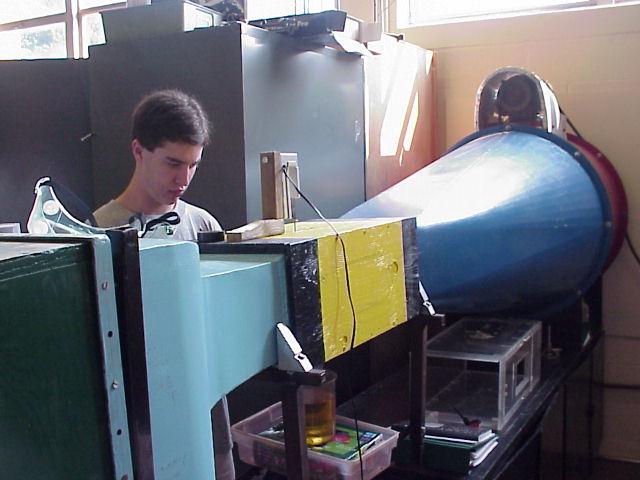
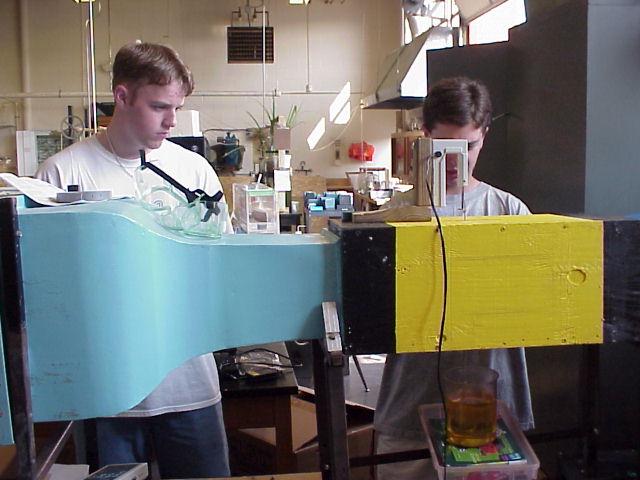
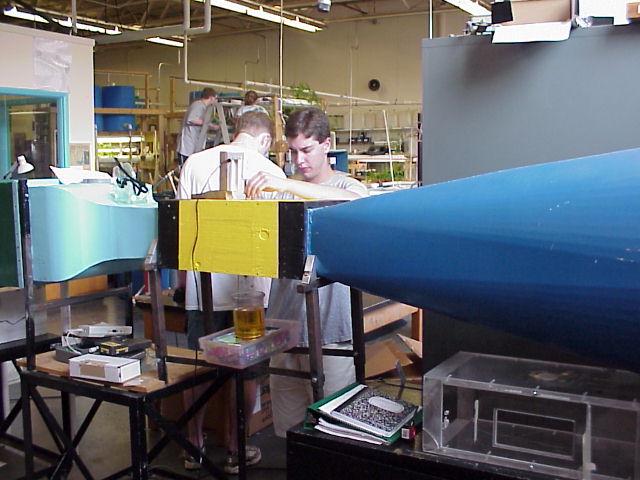
How the wind tunnel is used today:The wind tunnel is now up and running and has been found to be a very benificial part of the science research classroom. The wind tunnel is the home of many experiments.
One shot of our wind tunnel
working with the wind tunnel
another picture of students working with the wind tunnel
Back to the Main Page