Bonding
There are three types of bonds to know, and they are based on the metallic properties of the atoms. Remember, metals are to the left of the stairs (on the periodic table). Non-metals are to the right of the stairs. Semi-metals (or metalloids) touch the flat parts of the stairs.

|
Type of Bond |
Types of Elements |
Description of Electrons |
Other Information |
|
Metallic |
Metal and Metal |
Sea of mobile electrons |
Allows for electricity and magnetism |
|
Ionic |
Metal and Non-Metal |
Transfer of Electrons |
Metals give electrons (become "+" cations) |
|
Covalent |
Non-Metal and Non-Metal |
Sharing of Electrons |
Can be single, double, and triple bonds |
|
None |
Anything with a Noble Gas |
Noble Gases already have a full outer shell |
Noble Gases Do Not React (under normal conditions) |
Based on the information above, what type of bond would be formed in between
each of the following pairs of elements? (Highlight the cells to see the correct
answer.)
|
sodium and chlorine |
IONIC (metal and non-metal) |
|
lithium and calcium |
METALLIC (metal and metal) |
|
carbon and oxygen |
COVALENT (non-metal and non-metal) |
|
magnesium and argon |
NO BOND (metal and noble gas) |
|
iron and oxygen |
IONIC (metal and non-metal) |
|
molybdenum and chlorine |
IONIC (metal and non-metal) |
|
lithium and fluorine |
IONIC (metal and non-metal) |
|
nitrogen and carbon |
COVALENT (non-metal and non-metal) |
|
copper and zinc |
METALLIC (metal and metal) |
|
bromine and bromine |
COVALENT (non-metal and non-metal) |
|
neon and helium |
NO BOND (noble gas and noble gas) |
|
uranium and oxygen |
IONIC (metal and non-metal |
Oxidation Numbers
-an oxidation number is the charge that is formed when an element forms an ionic bond
-the charge depends on how many valence electrons the element with either give or take from another element
-if an element gives away an electron, it becomes positively charged "+" (cation)
-if an element takes an electron, it becomes negatively charged "-" (anion)
Example: Calcium has 2 valance electrons. It is easier
for calcium to lose 2 electrons than it would be to gain six electrons.
Therefore, calcium would get a 2+ charge.
|
Group # |
1 |
2 |
3-12 |
13 |
14 |
15 |
16 |
17 |
18 |
|
# Valence electrons |
1 |
2 |
----- |
3 |
4 |
5 |
6 |
7 |
8 |
|
Oxidation # |
1+ |
2+ |
----- |
3+ |
4+ / 4- |
3- |
2- |
1- |
0 |
Crossing Over
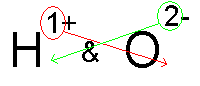
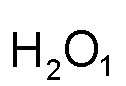
To find out what compound will be made when two elements react, you can either draw the dot diagrams and try to pair up unpaired electrons. This can become messy and confusing. There is an easier way. All you need is the oxidation number for the elements you are combining. Then you cross over the numbers to get the subscripts. Subscripts just tell you how many of that element is in a compound. Subscripts are not written with + and - signs.
NOTE: This process is best for ionic compounds, but it will also work for covalent compounds.
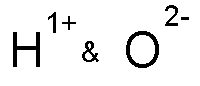
Example: hydrogen and oxygen
|
Hydrogen (group 1) and |
Cross over the numbers (not the +/- signs) |
This is what you get |
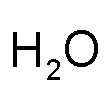
Don't write the number "1" if you have it |
|
|
|
|
|
Practice problems. What compound forms when the following
elements react?
(Highlight empty cells to see the correct answers.)
|
magnesium and chlorine |
MgCl2 |
|
potassium and nitrogen |
K3N |
|
rubidium and sulfur |
Rb2S |
|
calcium and bromine |
CaBr2 |
|
boron and hydrogen |
BH3 |
|
strontium and phosphorous |
Sr3P2 |
|
magnesium and oxygen |
Mg2O2 (really MgO) |
|
beryllium and argon |
No reaction! |