(x)
of Electrons
(2x2)
Structure of the Atom (7R and 7E)
| Year | Scientist | Contribution Toward the Structure of the Atom |
| 400 BC | Democritus | Coined the phrase "atomos", named the atom |
| 1911 | Rutherford | Discovered the nucleus of the atom through his gold foil experiment. When beaming alpha particles through a sheet of gold foil, he noticed that most of the alpha particles went straight through, but a small percentage of them were deflected. This meant that there was a place in the atom where there was a bit of mass (the nucleus) and the rest was empty space (occupied by electrons). |
| 1913 | Moseley | Used X-rays to investigate nuclei (plural of nucleus) of atoms, determined atomic number for atoms |
| 1913 | *Bohr | Described the "planetary model" of the atom, with electrons in distinct energy levels surrounding a nucleus of protons and neutrons |
| 1932 | *Schrödinger | Described the "electron cloud model" of the atom, which more accurately gives the probability of finding an electron at a given location in the atom |
Parts of the atom
| Part of the Atom | Particle Charge | Particle Mass | Location in Atom | If you change the #, you get... |
| Proton | +1 | 1 | Inside Nucleus | A new element |
| Neutron | 0 | 1 | Inside Nucleus | A new isotope |
| Electron | -1 | 0 | Outside of Nucleus in Specific Energy Levels (Bohr model) |
A new ion |
Other Information
| # protons | = Atomic Number | # neutrons | = Atomic Mass - Atomic Number | |
| # electrons | = # protons in a neutral atom | Mass | = # protons + # neutrons |
Bohr Model
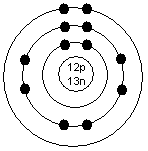
To draw the Bohr model of the atom, you need to know the atomic mass and atomic number of the atom you wish to draw. You need the atomic number to determine the number of protons and electrons (they are the same in a neutral atom). To determine the number of neutrons, subtract the atomic number from the atomic mass. Write the number of protons and neutrons in the nucleus. Electrons fill energy levels in order from the first level up until you run out of electrons. When an energy level is full, begin a new level and continue placing electrons until all electrons are accounted for. The table below gives an example of drawing the Bohr model for an isotope of magnesium, and provides the number of electrons that fit per each energy level. Note that in the diagram electrons are represented by dots (●).
|
Energy Level (x) |
Maximum # of Electrons (2x2) |
Bohr Model | ||
| 1 | 2 | Magnesium-25 |
|
|
| 2 | 8 | 25Mg | ||
| 3 | 18 | Mass = 25 | ||
| 4 | 32 | Atomic # = 12 | ||
| 5 | 50 | #p = 12 | ||
| 6 | 72 | #e- = 12 | ||
| 7 | 98 | #n = (25-12) = 13 | ||
Electron Dot Diagrams
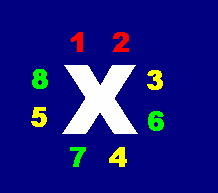
Electrons dot diagrams show the relative locations of the valence electrons.
Valence electrons are the electrons in the outermost shell. Valence
electrons are generally used for bonding. The dots represent the valence
electrons. A maximum of 8 valence electrons can be placed. The
electrons are placed in a specific order. The first two go together on a
single side. The next three spread out, one per side. The last three
pair up with the previous three. (See the diagram.) Valence
electrons come from the groups number. Just keep the ones digit from the
group number and you know the number of valence electrons. Note, you
cannot do this for transition metals (groups 3-12).
| Group # | 1 | 2 | 13 | 14 | 15 | 16 | 17 | 18 |
| # Valence Electrons | 1 | 2 | 3 | 4 | 5 | 6 | 7 | 8 |
| Example Dot Diagram |  |
 |
 |
 |
 |
 |
 |
 |
Electron Configuration (7E Only)
Slideshow: ElectronConfiguration.ppt
Periodic Table (7R and 7E)
| Lothar Meyer (1835-1895) | Dimitri Mendeleev (1834-1907) |
|
|
| Think of putting all your clothes away until your drawers are full. Then, you buy new clothes and have no place to put them. You then need to reorganize all your clothes in order to make the new clothes fit. | Think of putting together a jigsaw puzzle. You put pieces together based on colors and the pictures on them. You leave empty spaces when a piece doesn't fit. You can guess what a missing piece looks like based on the other pieces nearby. |
Example of the Periodic Table (legends are below the table)
| 1 | 2 | 3 | 4 | 5 | 6 | 7 | 8 | 9 | 10 | 11 | 12 | 13 | 14 | 15 | 16 | 17 | 18 | |
| 1 | H | He | ||||||||||||||||
| 2 | Li | Be |
B
|
C | N | O | F | Ne | ||||||||||
| 3 | Na | Mg | Al |
Si
|
P | S | Cl | Ar | ||||||||||
| 4 | K | Ca | Sc | Ti | V | Cr | Mn | Fe | Co | Ni | Cu | Zn | Ge | Ge |
As
|
Se | Br | Kr |
| 5 | Rb | Sr | Y | Zr | Nb | Mo | Tc | Ru | Rh | Pd | Ag | Cd | In | Sn | Sb |
Te
|
I | Xe |
| 6 | Cs | Ba | La-Lu | Hf | Ta | W | Re | Os | Ir | Pt | Au | Hg | Tl | Pb | Bi | Po |
At
|
Rn |
| 7 | Fr | Ra | Ac-Lr | Rf | Db | Sg | Bh | Hs | Mt | Ds | ||||||||
| (6) | La | Ce | Pr | Nd | Pm | Sm | Eu | Gd | Tb | Dy | Ho | Er | Tm | Yb | Lu | |||
| (7) | Ac | Th | Pa | U | Np | Pu | Am | Cm | Bk | Cf | Es | Fm | Md | No | Lr |
Classification Legends
| Metallic Character (Based on font color in the periodic table above) |
Reactivity | Location on Periodic Table | Percent of Elements |
| Metals | Generally Lose Electrons When Bonding | To the left of the "stairs" | About 75% of Elements |
| Semi-Metals (Metalloids) | May act as either a metal or non-metal | Touching the flat parts of the "stairs" | About 10% of Elements |
| Non-Metals | Generally Gain Electrons When Bonding | To the right of the "stairs" | About 15% of Elements |
Periods (rows), Group/Family (column)
| Group # |
Group Names (Based on background color in the periodic table above) |
# Valence e- | Oxidation # | Special Elements to Know |
| 1 | Alkali Metals | 1 | +1 | Francium (most reactive metal); Sodium (Na) Potassium (K) |
| 2 | Alkaline Earth Metals | 2 | +2 | --- |
| 3-12 | Transition Metals | (must be given to you) | (must be given to you) | Copper (Cu) Iron (Fe) |
| 13 | --- | 3 | +3 | Semimetals (B, Al) |
| 14 | --- | 4 | +4 (-4) | Semimetals (Si, Ge) |
| 15 | --- | 5 | -3 | Semimetals (As, Sb) |
| 16 | --- | 6 | -2 | Semimetals (Te, Po) |
| 17 | Halogens | 7 | -1 | Fluorine (most reactive non-metal); Semimetals (At) |
| 18 | Noble Gases | 8 (except He: 2) |
0 | Do Not React (under normal
conditions) Full outer shell |