For the scenes of Werner Anderson floating "overboard" with John Archer coming to the rescue
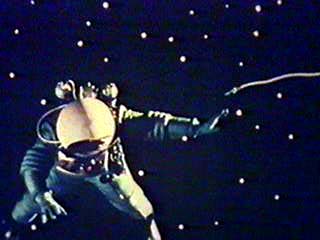 atop an oxygen tank, the actors (including
the two who remain securely on the outer skin of the Luna) had to be suspended
by wires and manipulated by off-screen "puppeteers." Heinlein states
that about 36 wires were employed, as well as dozens of additional safety lines
, and all of this "spaghetti" (as he calls it) had to remain invisible
to the audience. They used a balsa wood "oxygen tank" and embedded
a carbon dioxide canister, similar to those used for fire extinguishers,
in one end. This was to provide the "thrust" Archer needed to reach
Anderson and would also produce a brief puff of gas that
atop an oxygen tank, the actors (including
the two who remain securely on the outer skin of the Luna) had to be suspended
by wires and manipulated by off-screen "puppeteers." Heinlein states
that about 36 wires were employed, as well as dozens of additional safety lines
, and all of this "spaghetti" (as he calls it) had to remain invisible
to the audience. They used a balsa wood "oxygen tank" and embedded
a carbon dioxide canister, similar to those used for fire extinguishers,
in one end. This was to provide the "thrust" Archer needed to reach
Anderson and would also produce a brief puff of gas that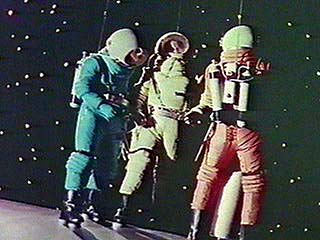 enhanced the dramatic
impact of the scene. Unfortunately, this latter detail caused problems during
shooting, for after only a few seconds of use, the canister would produce
condensed CO2 "snow" that fell
downward and ruined the illusion of weightlessness. Endless re-takes had to be
shot and the filming seemed to take forever.
enhanced the dramatic
impact of the scene. Unfortunately, this latter detail caused problems during
shooting, for after only a few seconds of use, the canister would produce
condensed CO2 "snow" that fell
downward and ruined the illusion of weightlessness. Endless re-takes had to be
shot and the filming seemed to take forever. According to Heinlein, one of the most challenging problems for the special effects crew was the creation of realistic outer space and lunar lighting conditions, including a backdrop of twinkling stars. He reports that they used nearly 2000 automobile light bulbs strung out on seventy thousand feet of wires for the stars. Since an undesirable red halation appeared around white lights, each light bulb had to be painstakingly coated with a green gelatin screen twice a day. Huge banks of powerful arc lights were used simulate the harsh lighting conditions in the vacuum of space. The sound stage used for these scenes had to be kept perfectly free of cigarette smoke and dust, which would produce motes of light due to their colloidal properties and spoil the effect of airlessness. Not completely satisfied with the light effects finally seen in the lunar surface shots, Heinlein was more pleased with how the space walk sequences turned out in the finished film. "The effect was rather ghostly," he commented.
The lunar surface was designed by artist Chesley Bonestell, who went to typically extraordinary lengths to ensure the visual accuracy of his finished product. He began by first selecting the location on which the Luna would land. Bonestell wanted a place where the earth would be visible down near the horizon so that the
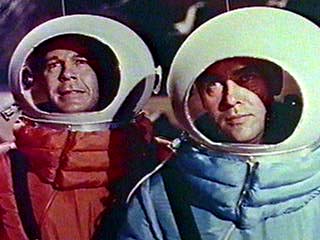 camera could easily see it. He picked the crater
Harpalus in the high northern latitudes of the moon on the side facing the
earth. Using Mount Wilson observatory photographs, Bonestell then constructed a
model of this location on his dining room table, using plasticine, tissue paper
and paint. After taking a pinhole photograph from its center, he meticulously
recreated a larger version of his original model on the sound stage at United
Artists. He designed separate backdrops and surface sets, one which gave the
perspective of the moon's surface and horizon as seen by the crew from the open
door near the top of the Luna; another which showed how things would look to
them while walking on the lunar surface. Employing prevailing ideas about how
the moon would look, Bonestell created a haunting world of craggy mountains,
deep craters, bold contrasts and breathtaking beauty. Most baby-boom SF
fans must confess to a slight disappointment that the moon, as revealed by the
cameras of the first Apollo missions, did not quite live up to Bonestell's
expectations!
camera could easily see it. He picked the crater
Harpalus in the high northern latitudes of the moon on the side facing the
earth. Using Mount Wilson observatory photographs, Bonestell then constructed a
model of this location on his dining room table, using plasticine, tissue paper
and paint. After taking a pinhole photograph from its center, he meticulously
recreated a larger version of his original model on the sound stage at United
Artists. He designed separate backdrops and surface sets, one which gave the
perspective of the moon's surface and horizon as seen by the crew from the open
door near the top of the Luna; another which showed how things would look to
them while walking on the lunar surface. Employing prevailing ideas about how
the moon would look, Bonestell created a haunting world of craggy mountains,
deep craters, bold contrasts and breathtaking beauty. Most baby-boom SF
fans must confess to a slight disappointment that the moon, as revealed by the
cameras of the first Apollo missions, did not quite live up to Bonestell's
expectations!The smallest details were not overlooked. The magnetic boots worn by the spacemen loudly clank while they are walking around inside their control cabin, but don't make a sound when they venture into the silent vacuum that surrounds the ship's metallic hull. And when they land on the moon, they are not as deeply pushed into the couches by the force of deceleration as they were when leaving the earth's more massive gravitational field. All these little touches help make Destination Moon the most scientifically accurate SF film of the fifties.
