Disentangling “xylella fastidiosa”
¿Is it over for garage-science?
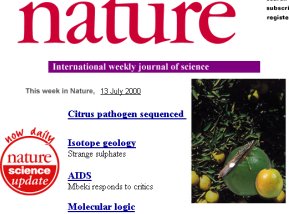
On July 13th, 2000, the prestigious journal “Nature” showed
oranges on the cover. It was a clue about the article on page 157 describing
de intricate genome of a bacterium with a singular scientific name: "xylella
fastidiosa".
The article described the genetic study of this pathogen, which
causes citrus variegated chlorosis—a serious disease of orange trees. A
truly fastidious living being to those plants and to the species who cultivates
them. An undoubtedly important work. But the first thing calling the reader's
attention was a startling list of names. It looked like one of those stone-engraved
memorials to honor the victims of some tragedy. But it actually was the
list of authors.
That's right, following a short and descriptive title
there was a long list of the 116 scientists who had participated directly
in the research work published. And we can be sure that each one of those
persons was there by his or her own right, thanks to their contribution
to the development of a complex, multidisciplinary and laborious project.

Not very long ago such a list would have been unthinkable;
but modern scientific research and technological development have evolved
towards increasingly complex conditions which frequently make necessary
the coordination of large groups. Big teams for big problems
With projects like this, the times of the heroic scientist confronting
alone his fight to unravel the secrets of Nature seem a matter of the past.
Indeed, the times of those 18th century English gentlemen of science are
over. It also seems far the time of low-budget Nobel winners like the Curies
or those of garage-based inventors like Thomas Edison. All of them evoke
old black and white images in our memory.
Is it over then for garage-science?. Can a lonely scientist
have any future in an intricate technological society like ours?
The truth is that along with great global projects, like
the human genome, the end of the 20th century has witnessed the spontaneous
flourishing of many little great breakthroughs from modest groups with
good ideas and ambitious goals.
For instance, Georg Bednorz and Alex Müller, working
for IBM in Zürich, constituted a minimal working nucleus centered
on matters certainly marginal to their employer. Yet, with relatively modest
means but with a revolutionary bet on copper oxides, they turned the whole
field of superconductivity upside down and won the Nobel Price for Physics
in 1987.
Looking for modern garage-based inventors is not difficult
either. The richest Bill Gates in the world is a good example of craftsmanship
and innovation from the bottom in the field of high technology. And, of
course, not only him, but also many other creators of future with already
famous brand-names like Yahoo! or Linux began like basement entrepreneurs.
The structure of DNA, the synthesis of Nylon, the "Big-Bang"
theory, the discovery of PCR (Polymerase Chain Reaction) which prompted
the boom in genetic engineering, or the recent discovery of the largest
bacterium ever known are all examples of very significant breakthroughs
resulting from individual striving rather than from well-planned coordinated
efforts from large interdisciplinary teams. Thus, in these days too, we
can be sure that scientific revolutions are still being engendered in the
backyard of our official science.
Could this Big, directed science and the small, free science
live together in our society?. They should!. Our great projects and multinational
efforts are good to consolidate our knowledge and apply it in creative
forms to achieve goals and win challenges otherwise impossible . At the
same time, the most successful individual contributions are precisely those
questioning, challenging and revising that knowledge, thus leading to scientific
revolutions and even new fields of knowledge. Both trends are intertwined
in a criss-cross pattern which conforms the tapestry of our collective
knowledge.
The scientific and technological superstructures which
make possible projects like the exploration of Mars or the human genome
are a sign of today's technoscience. But we should avoid that this characteristic
could lead to the exclusion or depreciation of a very valuable lower-scale
scientific work or could misrepresent the free individual scientific enterprise.
Thus, rather than a simple boost of Big Science, our science policy should
evolve towards multiplicity. Multiplicity of scales, multiplicity of goals,
diversity of technologies which could compete or add up to solve our problems.
An evolution towards technodiversity which would be certainly profitable
and socially beneficial.
Pedro Gómez Romero, July 23, 2000
|