When we think of evolution our minds frequently picture
a bunch of animals hanging from a crowded "family tree", or the typical
sequence of four or five
stages from ape to man packed conveniently to fit one
page. We also tend to think that this biological evolution described in
our books takes place so slowly that only after geological time spans any
change is perceptible at all. And indeed that is true... sometimes.
But it is also true that sometimes the effects of evolution
can be realized within much shorter periods of time. This is especially
obvious when we consider the evolution of species with lifetimes much shorter
than ours.
The Birch and the Moth.
A (true) tale of adaptation.
The story of peppered moths is a
great example of evolutionary changes in relatively short periods of time.
This story tells us about the funny
changes that took place on the population of peppered moths in England
around 1850. All moths of this species captured before 1848 around the
city of Manchester looked like this:
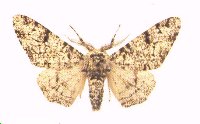 Sometime later, in 1848, a dark moth
of the same species was captured in Manchester. Just like this one:
Sometime later, in 1848, a dark moth
of the same species was captured in Manchester. Just like this one:
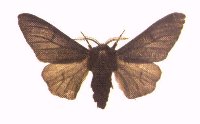
And that was not an isolated case.
It was just the beginning of a remarkable change in the population taking
place in just a few decades. The plot below shows the statistics of the
populations of each type of moths in 1850 and in 1900. The change is obvious
and overwhelming.
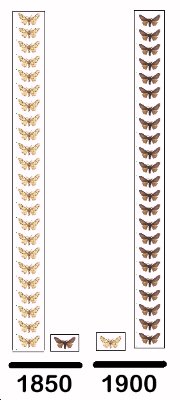 In 1850 There were 23 light moths for
each dark one whereas in 1900 the ratio is one light to 23 dark. How can
we understand this population change?.
In 1850 There were 23 light moths for
each dark one whereas in 1900 the ratio is one light to 23 dark. How can
we understand this population change?.
The offspring of dark moths is made
of dark moths (except if a mutation takes place). Thus, if natural selection
was responsible for the change in population, according to Darwin's theory,
dark moths must have been better adapted to their environment. But why?.
Environmental changes.
There are several species of birds
that feed on these moths, which rest on the trunk of abundant birch trees
during the day.
Around the middle of the 19th century,
the environment of the moths suffered a radical change. Before the industrial
revolution most trees had light trunks spotted by lichens. Towards the
end of the century, the growth of industrial regions led to a growing presence
of smoke and soot that destroyed the lichens and darkened the trees.
We can now compare both situations
and ask ourselves what moths have a better chance to survive and procreate
in each case.
 |
 |
|
1850
|
1900
|
Imagine you are a hungry bird looking
for a snack. Which moths are spotted first ?
When we analyze environmental changes,
population changes are easy to explain
So... the moths adapted to their
environment by changing colors, sort of like a chameleon ?.
Not quite.
At this point it would be good
to explain that when we talk about the moths "adapting" to their environment
we are using a verbal shortcut that can lead to confusion. None of the
moths does anything to better fit to the environment.
So... how can a population end up
better adapted to the environment if each individual member doesn't adapt
to that environment ?
This apparent contradiction disappears
when we understand that evolution rests on the superabundance of the offspring
(only a small part of the moths born in a given generation will reach maturity
and will procreate) and on the variability of characters (color in this
case), derived from accidental mutations. These take place randomly and
independently of the environment and in most cases do not represent any
evolutive advantage (in our story, a change in color from light to dark
might have taken place anytime before the 19th century, but under a clean
environment dark mutant individuals would have been fast food for the birds)
Nevertheless, under certain circumstances,
a mutation can arrive to the right place at the right time and get perpetuated
like in this case of peppered moths fit to "modern times".
Interestingly enough, this story
continues.
In 1956 the British government
approved the "Clean Air Act", a law aimed at reducing air pollution. Since
then the percent of light peppered moths in industrial regions has been
steadily increasing.
Changing with times:
Other examples of (even faster)
adaptation.
Resistance to antibiotics
Antibiotics hardly ever destroy
all the bacteria they are supposed to fight. The few surviving bacteria
can reproduce and form a new colony very quickly (or at least we think
that is very quick because we have lives several orders of magnitude longer
than theirs). Thanks to their fast pace the effects of natural selection
can be made evident to us in the short range. Mutations take place, populations
change very quickly and soon are dominated by individuals not affected
by the antibiotic. We say that that particular type is (or has become)
resistant to that antibiotic.
Resistance to insecticides
Just like bacteria can turn resistant
to antibiotics, insects can become resistant to insecticides.
Sometimes we try to destroy pests
with insecticides, but there are many of those little bugs and not all
of them die. If any of these weird specimens happens to be immune to the
insecticide thanks maybe to a lucky mutation, it will be the founding father
of a new breed of bugs resistant to that particular
chemical. |