|
|
|
 |
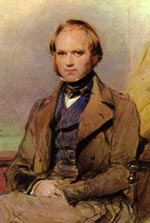
Can you imagine a world without Darwin?. A world without the deep legacy that Robert Darwin left behind?. Our own world but empty of Charles Robert Darwin's contribution to the understanding of the mechanisms that drive evolution?. Would we still be enlightened by the dogma spread by fanatic creationists?. The same dogma that it is disguised today as creation science?. |
| . | |
| Our collective perception of the
world is also in evolution. Sometimes is even subject to dramatic changes.
One such change was about to set sail on December 27, 1831 with Her Majesty
Ship Beagle. We will see how this episode is a beautiful example of what
we could call the butterfly effect, and reminds us the potential transcendence
of isolated single events enhanced by the dynamics of chaotic systems like
our own world.
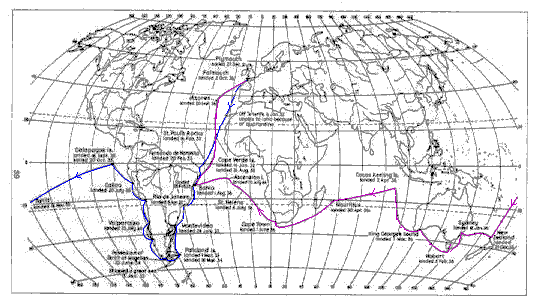
Her MS Beagle, a 235 tons vessel, sailed along the seas of the southern hemisphere with the object of “completing the survey of Patagonia and Tierra del Fuego; to survey the shores of Chile, Peru, and some islands in the Pacific; and to carry a chain of chronometrical measurements round the world” (footnote).
|
With
the object of the trip in mind, it is clear that a scientist aboard the
ship was not a first priority. Yet, the commander of the ship, captain-to-be
Robert Fitz-Roy, was determined to include a naturalist in the trip; but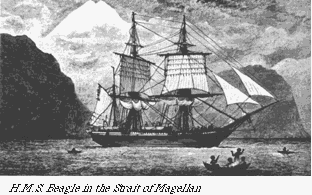 not just anyone. The candidate ought to be a cultivated gentleman, though
not necessarily an aristocrat like Fitz-Roy himself. It was going to be
a very personal and subjective choice. No wonder!, for that companion would
be the only one sharing room, dinner and casual conversations with the
Captain during the many long months and years ahead. The fact is that despite
the reduced size of the ship the captain was not supposed to mix with his
men, beyond the regular chain of command. Fitz-Roy thought a good
Christian, cultivated naturalist will be perfect company and could certainly
appreciate with him the many natural wonders created by God that they could
find along the way.
not just anyone. The candidate ought to be a cultivated gentleman, though
not necessarily an aristocrat like Fitz-Roy himself. It was going to be
a very personal and subjective choice. No wonder!, for that companion would
be the only one sharing room, dinner and casual conversations with the
Captain during the many long months and years ahead. The fact is that despite
the reduced size of the ship the captain was not supposed to mix with his
men, beyond the regular chain of command. Fitz-Roy thought a good
Christian, cultivated naturalist will be perfect company and could certainly
appreciate with him the many natural wonders created by God that they could
find along the way.
|
|
August 24, 1831,
John Stevens Henslow, professor of botany at Cambridge, writes to his pupil
and friend, a young Charles Robert Darwin about a unique opportunity. It
so happened that Rev. George Peacock, also at Cambridge, had been asked
to recommend a proper person as naturalist-companion for Fitz-Roy, and
he wrote to Henslow on the matter. Encouraged by his mentor and recommended
to Peacock, 22 year old Darwin decided to grab that opportunity. With the
promise of many wonders ahead but without salary he took the ship to the
adventure that changed his life.
During his privileged trip aboard the Beagle, Charles Darwin had the opportunity to observe and note ignored species in remote shores. His stop at the archipelago of Galapagos was specially fruitful and led him to the discovery of singular relations between animals and plants of each island. In going from one island to another the fauna was naturally related but also presented distinct characteristics which could not be explained by differences in climate or geological conditions. Finch populations in different islands for instance were all alike except for their beaks, a difference that Darwin associated to their feeding patterns. Darwin saw, as certainly many others had seen before, many natural wonders including giant reptiles, true living fossils endemic of these islands. But he did not stop at seeing and awing. He wondered and pondered and didn't settle with not understanding. 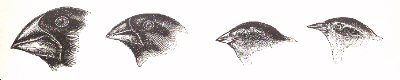 |
| When he arrived back in England
Darwin was a new man and he knew much better than ever what he wanted in
life. He devoted long years to the study and classification of data, not
only on animals met along his trip but on anything relevant to the questions
that had haunted him during that voyage: Are species mutable?. And Why?.
Darwin tracked nature's clues like nobody else before and understood that
the origin of the great variety of living species on Earth lies precisely
on change and evolution. As a matter of fact evolution in the natural world
had been proposed earlier (Lamarck among others, see below). The greatest
of Darwin's contributions was to discover the mechanisms leading to that
evolution during long periods of time, mechanisms that he centered in natural
selection.
23 years after the end of his voyage, Darwin's first and most emblematic writing was published, his book "Origin of Species trough Natural Selection". Aside from the solid principles established in this work, Darwin's book represented a great challenge the dominating ideas about our world. Those old ideas were deeply rooted in religious beliefs that had prevailed for centuries and that spoke of an immutable world, essentially unchanged from its creation.(footnote).
th of Darwin's analysis. Success and recognition blessed Darwin before his death; by then his theories were already recognized as such and he was solemnly buried in Westminster Abbey, next to Isaac Newton. |
| With these antecedents Darwin could
be considered a visionary, a unique individual advanced to his time. And
he certainly was so. However we cannot disconnect his work from his circumstances.
In our social world there is no spontaneous generation either.
In the case of evolution, the first known theory was formally proposed in 1809 - coincidentally the year Darwin was born - by the French philosopher and naturalist Jean Baptiste de Lamarck. He didn't call it evolution but recognized 'transformation' of species after long periods of time and proposed natural progression from the smallest living organisms to more complex and 'perfect' plants and animals. In order to explain the course of evolution, Lamarck proposed four basic principles: an internal impulse of all living organisms towards perfection, the capacity to adapt to circumstances, a frequent spontaneous generation and inheritance of acquired characters. Despite the absence of a solid scientific evidence to back them up and the many errors contained in his principles, Lamarck established a very important precedent. As a matter of fact, Darwin, as many other naturalists, initially thought that Lamarck's ideas were preposterous; but this was before his voyage. The gradual and unprovoked change of mind that Darwin underwent was based on overwhelming evidence piling up on his mind, which in turn contributed most than any other thing to the consolidation of evolution as part of our collective knowledge. A most important influence on Darwin was made by the person and work of geologist Charles Lyell (1797-1875), a methodical scientist that set the foundations of Geology with his studies on geological evolution. Lyell established for the first time the extremely long geological timescales that would later be the base for the biological evolution proposed by Darwin himself. Charles Darwin was a devoted fan of Lyell during his first years dedicated to scholarly learning of natural science and later applied Lyell's scientific methods to biological evolution. Lyell ended up being a good friend of Darwin, guided him in the need to apply rigorous experimental methods in his research and encouraged him to publish the "Origin of Species". Finally, another key influence in the way of Darwin to establish his conclusions was the economist Robert Malthus (1766-1834) author of a book on "Population" (1798). Darwin read this book "for amusement" in 1838 after having read many other books, journals and transactions in his industrious effort to gather data to analyze. From Malthus' ideas related to the struggle for existence Darwin finally got a starting point for his very long sought question of how evolution would work, "... it at once struck me that [...] favourable variations would tend to be preserved and unfavourable ones to be destroyed."Nevertheless, he was more anxious to avoid prejudice than to publish his thoughts. It wasn't until June 1842 that he allowed himself the satisfaction of writing a very brief abstract of his theory (35 pages, enlarged to a new version of 230 pages during the summer of 1844). Last but not least, the familiar influences
on Darwin are also worth considering. His father, Robert Waring Darwin
was a physician, head of an accommodated country side English family. His
mother died when he was only 8 years old. Young Charles Darwin was not
a good student, he seemed too distracted by leisure activities such as
specimen collection and later by fishing and hunting. By his father design
Charles Darwin begun studying medicine, but he never finished. In his autobiography
he recalls how he couldn't stand witnessing a couple of surgical procedures
at that time ("long before the blessed days of chloroform" ..."The two
cases fairly haunted me for many a long year").
|
|
But, what would have been if Darwin or those circumstances had never existed?. No doubt it would have been a great opportunity lost. But, would have the world remained orphan of evolution theory?. Certainly not. Nature's clues in the form of living species would
still have been there, waiting as needed for a member of a self-aware species
(ours, of course) to disentangle its 'secrets' and tell the rest of us.
In the Science trade, priority for a discovery or theory is established
following the criterion of the first public presentation. Thus, Wallace's
communication to Darwin was a bomb, since it anticipated the conclusions
of the laborious work that Darwin had been conducting for twenty years,
and that he was in the process of writing down.
|
| This episode of history gives an
answer to our question about a Darwinless evolution. Of course we will
never know how it would have been a world without Darwin but with Wallace.
But certainly Wallace had followed the clues, and though admittedly with
less detail in his analysis he reached very similar conclusions on the
mechanisms of natural selection. He departed from Darwin in aspects related
to human evolution since he believed that natural selection alone was not
able to explain the superior nature of our species. But that was just a
matter of time. Maybe we would have needed to wait for the divulgation
of Mendel's laws on inheritance, genetics or even for modern molecular
biology and DNA to tie definitively our species with the rest. But it is
most likely we would not have needed to wait so long.
Our species found in the victorian English
society of the 19th century the adequate conditions for this discovery.
The long ruling of Queen Victoria (1831-1901) corresponded to a period
of maximum prosperity for the British empire. It begun with the promulgation
of commercial freedom; in 1836 the British colony of Australia was created
and in 1840 New Zealand also became a colony. Voyages like that of the
Beagle were the rule and not the exception. Those were adventures moved
by exploration and commercial winds, not by war.(footnote)
|
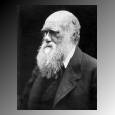
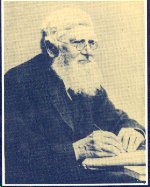
So... In a Darwinless society, here's the picture of the venerable old man we would cherish as the discoverer of the mechanisms that drive evolution:
Questions and comments to [email protected]
 Back to main page on Science, Technology and Society