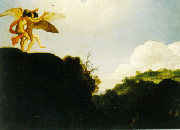
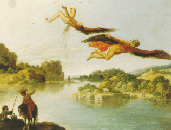
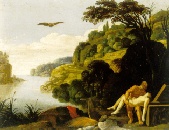
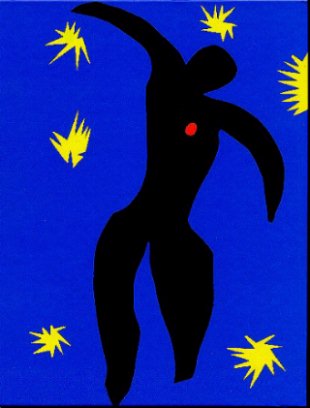
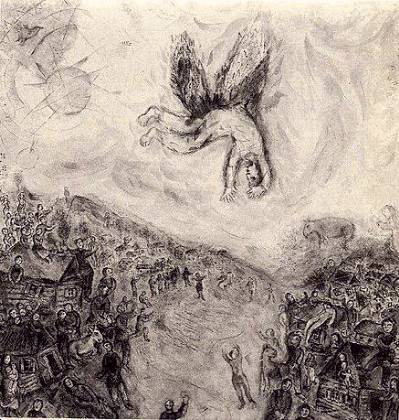
In the southern italian city of Naples, far away from the better known
circuits of Rome or Florence there is a Museum called "Museo e Gallerie
Nazionali di Capodimonte". One can find there a unique series of paintings
by venetian artist Carlo Saraceni ( c.1585-1620) on the myth of Icarus.
|
|
|||||
|
|
|
|||
|
|
|
|
|||
"Men at flight"
We have seen many old paintings with winged characters: angels, little
blond Cupids, cherubs and so on. But this series of paintings tells us
a story of flying men; not gods, not angels, but common mortals.
-Is it a real story ?- could ask our five-year-old child.
Well, maybe the events the story tells us did not happen in reality
but the story-telling was certainly real. As a matter of fact that story
was recorded in writing by Ovid (The Metamorphoses) and has been echoed
through the centuries in messages like those by Saraceni and many other
artists.
The real but abridged story of Icarus and Daedalus
The ancient greeks knew and Ovid wrote that Daedalus was a skilled
architect-inventor-sculptor highly respected in his hometown of Athens.
But human as he was, he was not free of sin. He became jealous of his nephew
and apprentice Talus, a promising young man called to become his successor.
In a foolish outrage Daedalus "flung his nephew headlong down from Minerva's
sacred citadel" in an attempt to kill him. But the goddess Pallas changed
the boy into a bird, "clothing him with feathers in mid-air" (Ovid 186).
For this crime Daedalus was exiled to Crete to serve King Minos, where
he eventually had a son, Icarus, with the beautiful Naucrate, a mistress-slave
of the King.
Minos called on Daedalus to build the famous Labyrinth in order to
imprison the Minotaur, a dreaded human-eating monster protected by the
King. He made a good job but could not keep a secret. By revealing the
mystery of the Labyrinth he allowed the killing of the Minotaur by Theseus.
When Minos found out what Daedalus had done he was so enraged that he imprisoned
Daedalus & Icarus in the Labyrinth themselves.
To escape from the Labyrinth and from Crete Daedalus designed sets
of wings made of feathers and wax for him and his son. Before flying to
freedom he warned Icarus not to fly too low - for his wings would touch
the water and get wet - nor too high - for the sun could melt the wax.
But young Icarus, overwhelmed by the thrill of flying, forgot his father's
warning and flew too close to the sun. Sure enough the wax in his wings
melted down and he fell into the sea killing himself.
Knowledge, power and punishment
There are many ways to look at this mythical tale and as many ways
to interpret its message. But the one that strikes me most is the clear
association of knowledge, power and punishment made with the chain of events.
Daedalus attempts to gain his freedom by improving upon his human condition.
He uses his knowledge to gain power over his limiting nature. In a metaphorical
way his technology aims at matching his power with that of the goddess
Pallas. But only gods are the power to convert falling humans into
birds. Daedalus, and humankind with him, is humiliated and punished with
the death of his own son for daring to reach out of his humble human condition.
Icarus is the impulsive and inexperienced youth, too daring and deaf to
his father's wisdom. He makes a temerarious use of the powers given to
him by the wise and prudent inventor and pays with his life the failure
of the rude human technology.
Echoes of Icarus
The death of Icarus has moved many humans over the centuries. The aesthetic
appeal of his tragic story has inspired many artists. Icarus fate has been
reminded to us in old, modern and contemporary art. Just take a look at
the following examples:
| "The fall of Icarus"
Wall painting in Pompey 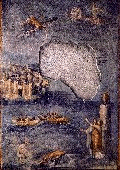 |
|
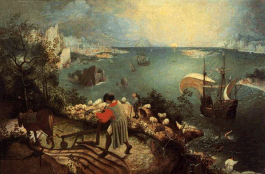
"Landscape with
the Fall of Icarus" Pieter Bruegel Full image 53K By the way...
|
||||
| there | are | performances too | ||||
|
|
 |
||||
And of course there have been books on the topic. Even essays dealing
directly with the icarian dangers of the use of science and technology
(See for example "Icarus or the Future of Science" by Bertrand Russell.
Kegan Paul, London, 1924)
Icarus is definitively the star of this story. He is the tragedy, he
is our lesson, he is the one in our "collective mind".
Let us see what the Web has to say about this. Look what I got when
I requested from a search engine a precise count of matches of pages mentioning
Icarus, Daedalus and a few popular characters:
| Name | Counts | Comments | |
| Daedalus | 17044 | ....|... | So many counts? |
| Brad Pitt | 22636 | ....|....|. | Should I have checked "DiCaprio"? |
| Icarus | 31115 | ....|....|....|. | Not bad for a Hollywood outsider ! |
| Pamela Anderson | 48205 | ....|....|....|....|.... | Sex does appeal |
| Elvis | 155697 | ....|....|....|....|....|....|....|....|....|....|....|....|....|....|....|... | He's still "The King" |
Looking at this improvised non-scientific (but unbiased) survey one can reach a few interesting (non-scientific) conclusions. Let us just state a couple of them relevant to our present story:
Now, if the deal is story-telling then let's get the complete story. Let's go beyond the fall of Icarus, pass the page of punishment and failure so well remembered and ask....
Whatever happened to Daedalus?
He was certainly devastated by the death of his son, but his infinite
grief came to and end. His prudent use of his imperfect technology led
him to freedom.
Did you find Daedalus in Bruegel's
painting ?
Neither did I.
 Click here to go back to Icarus Masterpieces
The following are some interesting links to Icarus/Daedalus pages:
http://www.ikaria.demon.co.uk/myth.htm
.......... Mythology on the island of Ikaria.
http://www.ikaria.demon.co.uk/art.htm
.......... Great collection of pictures on Icarus
http://www.plexus.org/choe/icarus.html "The Fall of Icarus and Re-imagining Technology". ..........Philosophical analysis on Ovid's Icarus and the recreation by Bruegel
 Back to main page on Science Technology and Society
 Get your own Free Home Page